
Archdiocese of Vancouver and The B.C. Catholic win 22 Catholic Media Association awards
The Archdiocese of Vancouver has received 22 awards from the Catholic Media Association, recognizing the work of The B.C. Catholic and the communications team’s excellence in print, digital media, photography, social media, video, and fundraising communications.
The B.C. Catholic earned top honours, receiving multiple first-place finishes and recognition across reporting, photography, and editorial work.
The B.C. Catholic placed second for best diocesan newspaper, and Judges praised the paper’s strong reporting, clear writing, and engaging presentation, noting its ability to make complex topics accessible to readers.
“The B.C. Catholic serves its audience very well,” wrote the judges. “Where others lean more heavily on wire copy, this staff produces an array of relevant new and interesting features that resonate with its readers.” Judges also singled out the quality of the paper’s writing and photography.
The paper won awards for its Lunar New Year’s supplement and Christmas edition.
Among the individual recipients, The B.C. Catholic’s Terry O’Neill won first place for the Gerard E. Sherry Award for Best Analysis/Background/Round-Up News Writing for his coverage of Medical Assistance in Dying in Canada, and first place for Best In-Depth News/Special Reporting — Diocesan Weekly.
O’Neill also earned second place and third place in Best Investigative News Writing for his reporting on the financial incentives behind euthanasia and the broader MAiD system in Canada.
O’Neill was praised for his “well-investigated” and “well sourced” reporting. Judges were impressed, noting his tremendous understanding of the proliferation of euthanasia in Canada and British Columbia.
O’Neill also earned an award for the work he did through the Canadian Catholic News service, reporting on St. Paul’s Hospital.
Paul Schratz received third place for editorial writing on a local issue for his piece, ‘Silent Night at City Hall’.
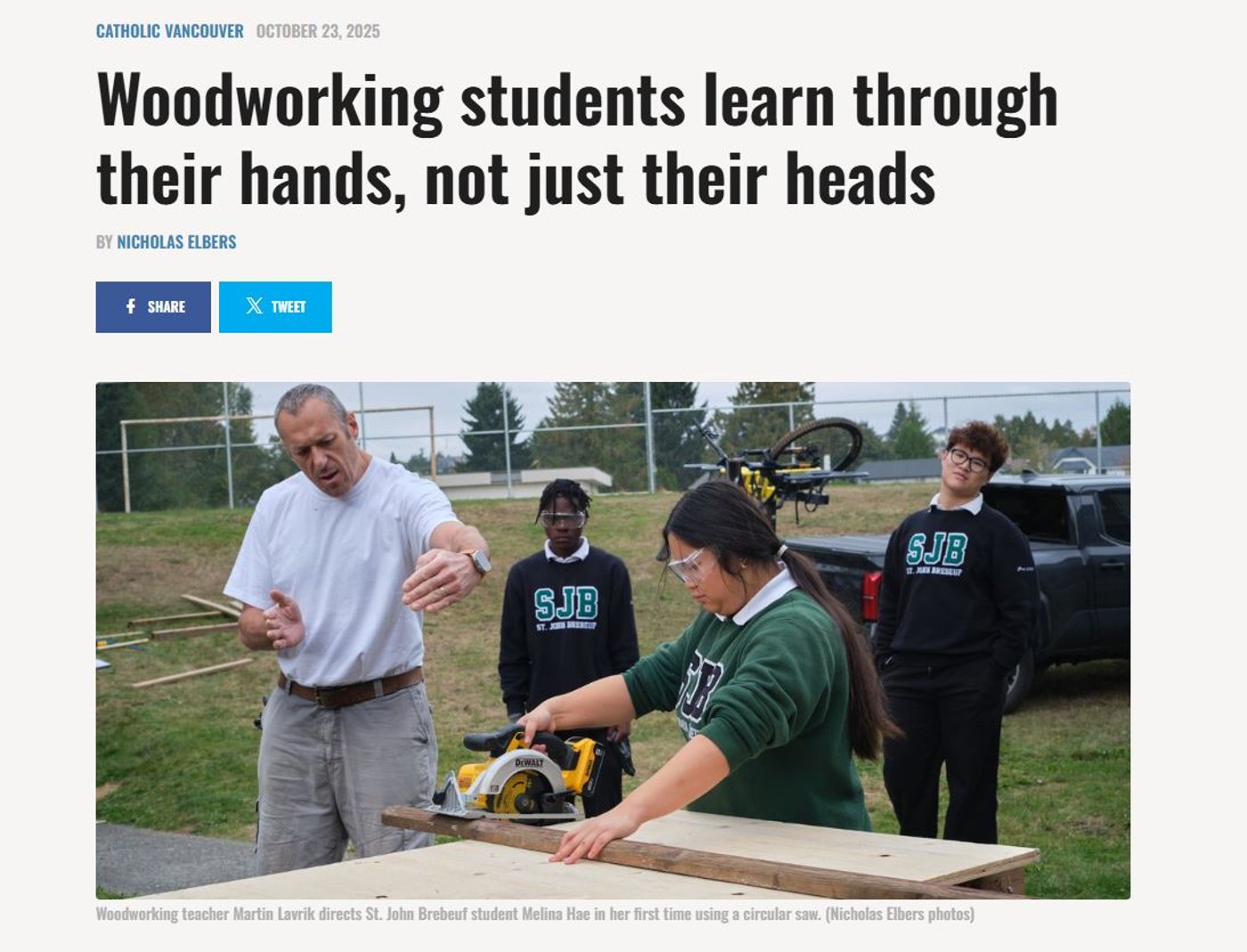
In the photography categories, The B.C. Catholic’s Nicholas Elbers won first place for his photo package documenting the annual Our Lady of Fatima Grotto pilgrimage in Mission and second place for a combined story and photo feature on St. John Brebeuf Regional Secondary School’s woodworking program.
Elbers also received two honourable mentions: one for a portrait of Sacred Heart Parish pastor Father Ray Smith and another for a photograph of a young altar server in training during a Catechesis of the Good Shepherd event.
The Archdiocese of Vancouver’s communications team was also recognized with eight awards. The team received first place for the Vancouver Archbishop social media account, which documented the transition from Archbishop J. Michael Miller to Archbishop Richard Smith, as well as first place for its coverage of the Jubilee Year.
The communications office also received second place for the main Archdiocesan social media account, along with several third-place finishes in digital communications, video, and fundraising categories.
One Sword, One Angel: The God Who Chooses Differently
St. Luke is consistently fond of presenting events in pairs and contrasts. The Gospel of Luke pairs the Annunciation and the birth of John with that of Christ; it pairs Simeon and Anna at the Presentation; it balances Stephen the martyr-deacon with Philip the missionary-deacon (chapters 7-8); it sets the conversion of Paul alongside the conversion of Cornelius (chapters 9-10). Now, in chapter 12, two apostles are set before us: James and Peter — one martyred, one miraculously delivered. The contrast mirrors that between the martyrs who shed their blood and confessors who spent their lives giving witness; both are paths of apostolic fruitfulness, chosen differently by the same God.
Herod Agrippa — the third of the Herod dynasty to persecute God’s holy ones (after Herod the Great, who massacred the Holy Innocents, and Herod Antipas, who beheaded John the Baptist) – had James, the brother of John, executed by the sword. James thus becomes the first of the Twelve to be martyred.
Tradition holds that before returning to Jerusalem, James had preached the Gospel in Spain. After his martyrdom, his body was transferred there and eventually discovered by a hermit; the site of his burial became one of the three great pilgrimage destinations of the Middle Ages, alongside Rome and Jerusalem. The Camino de Santiago, walked by millions to this day, is the living legacy of that tradition. St. James is the patron saint of pilgrims.
This is fitting: the Lukan theme of ‘the Way,‘ of life as a journey and pilgrimage, finds expression in all three of the great medieval pilgrimage sites. Jerusalem and Rome are both settings of the Acts of the Apostles. Spain enters the story through the martyrdom of James in chapter 12. Life is indeed a pilgrimage, and our final destination is heaven.
Seeing that James’s execution pleased the opponents of the apostle, Herod arrested Peter during the days of Unleavened Bread. Peter was held under maximum guard: four squads of four soldiers, chained between two guards, with two more at the door. The scene is deliberately Passion-like: as Christ hung between two criminals, Peter lies between two soldiers; as Christ was in the darkness of death, Peter is in the darkness of the dungeon.
The Church’s response to this darkness is instructive. There was no plan, no human strategy. What did they do? They prayed — earnestly, persistently, together. St. Luke’s Gospel already gave us the pattern: ‘Being in agony, he prayed the more earnestly‘ (Lk 22:44). This is the model for every Christian facing darkness: not distraction, not despair, but more earnest prayer.
The angel’s action is also laden with symbolism.
Parliament passes Bill C-9 into law
The Combatting Hate Act, the controversial piece of legislation that abolishes the longstanding sincere religious text defence from Canada’s hate speech laws, completed final passage on June 17.
After teaming up to vote down the Conservatives, NDP and Green Party MP Elizabeth May’s final attempt to discard Bill C-9, the Liberals and Bloc Québécois jointly approved the lone Senate amendment to the bill.
The only change the upper chamber made was adding the noose to the list of hate-motivated symbols that will be prohibited in the civic square 30 days after Bill C-9 receives royal assent. The other core provisions of the Combatting Hate Act are creating indictable offences for acts of intimidation and obstruction outside places of worship and establishments used by an identifiable group for a specific purpose.
These central measures have been overshadowed in the public discourse about Bill C-9 since early December when the then minority governing Liberals agreed to a late-breaking Bloc Québecois amendment to scrap Section 319(3)(b) of the Criminal Code, a narrow safeguard that stood since 1970.
Faith groups fear someone could be prosecuted under the new law for holding a sincere religious belief based on their faith’s teachings.
Upon reflection, the encapsulating quote of the Combatting Hate Act’s nine-month journey through the corridors of power in Ottawa may belong to Senator Andrew Cardozo of the Progressive Senate Group.
“If people of good faith and people of goodwill hate the law to combat hate, have we failed as a Parliament and can we not do better,” asked Cardozo on June 4 during the debate preceding the Senate’s third reading vote.
The expungement of the religious text defence indeed attracted widespread backlash from faith leaders, legal experts, civil society organizations, labour groups and concerned citizens.
Paul Lawton, director of grassroots action for the Association for Reformed Political Action (ARPA) Canada, expressed displeasure at how the government ultimately disregarded the wishes of this unprecedented coalition.
“We are disappointed by the government’s insistence on removing the religious defence clause in the face of so much public opposition,” said Lawton. “Canadians logged hundreds of thousands of phone calls to MPs and Senators, sent them hundreds of thousands of postcards and attended countless rallies and events to express their opposition to Bill C-9. This is a sad day for freedom of speech and freedom of religion, not just for Christians, but for all Canadians.”
Minister of Justice and Attorney General of Canada Sean Fraser has strived to downplay the significance of Section 319(3)(b)’s removal by asserting that “freedom of religion is already fully and robustly protected under the Canadian Charter of Rights and Freedoms.”
Many have challenged that statement by suggesting freedom of religion and expression Charter rights were undermined during the COVID-19 pandemic (parish restrictions) and the 2022 Freedom Convoy protests.
Father’s Day at Indigo Books
At our local Langley Indigo bookstore, there are two tables conveniently festooned with a variety of items that Dad apparently would want for Father’s Day.
I’m always interested in these displays, partially because I like shiny things, but mostly because when Indigo Books emerged from the transmogrification of Chapters a few years ago, I found myself entranced whenever the store offered a product suggestion for men.
Chapters was a relatively benign book shop that might have, at times, privileged male interests, but it was hardly a masculine space. Indigo, by contrast, is undeniably feminine. With its ever-growing collection of throw pillows, scented candles, and self-help books (we won’t talk about the fantasy romance selection), Indigo is BookTok, the place incarnate. Occasionally, one might find something interesting in the philosophy or science fiction sections, but even science fiction is tucked away next to young adult fiction, out of clear view from the main store, as though it were just bit embarrassing. When the powers that be at Indigo decide to tell men what to buy, it’s often cliché, but always thought provoking.
This year’s Father’s Day tables are a good example of this. There are books, of course; some on stoicism (that most masculine of philosophies), and history (WW2, of course); there are a few works of military fiction by Clive Cussler (who cannot have any regular readers under the age of 40) and Homer’s Iliad, the one shining star in an otherwise unremarkable array of modern literature. There are also notebooks for the nature enthusiast to take fishing and bird watching (hunting is absent) in the ever-dwindling wilds of our beautiful valley—and I think I saw a book about grilling.
Very little, save for a cheap novelty mug (engraved: “World’s Greatest Dad!”), and few children’s books about ‘dad’ actually reference Fatherhood, and taken at face value, the display reduces masculinity to a thin smattering of activities that seem ripped from some social media influencer’s interpretation of male living.
Additionally, not a single item (with the exception of the children’s books) seriously suggests the presence of children in the lives of the men for whom these gifts would be purchased. This may be because, for the majority of Indigo’s female clientele, their aging fathers—grandchildren-less empty nesters—neither need nor want reminders of their childless existence; but for a father of four, it reeks of self-absorption and impotency.
Every year, I am frustrated by the suggestion that I should celebrate my vocation by doing something else. “Give Dad a day for fishing! Let him have some time to himself! Give him a break!” In reality, I can think of no better way to spend Father’s Day than playing with my kids.
When the Church became Christian
In the Acts of the Apostles, the conversion of Cornelius is a very important event. Father William Kurz notes, “like the triple telling of Saul’s conversion (in Acts 9 and through Paul’s speeches in Acts 22 and 26), the conversion of Cornelius is told three times (in Acts 10 and through Peter’s speeches in Acts 11 and 15), an indication of the importance Luke attributes to it.”
Upon Peter’s return to Jerusalem, the circumcised believers confront him with a pointed accusation: “Why did you go to uncircumcised men and eat with them?” (Acts 11:3). The Navarre Bible notes that table fellowship “was regarded as a kind of spiritual sharing,” so that eating with Gentiles could be seen as being involved in idolatry.
St. John Chrysostom comments: “The question was not ‘Why did you preach to them?’ but ‘Why did you eat with them?’” — a charge rooted in deep-seated concern about ritual defilement.
Peter defends his behaviour primarily by telling his story, recounting it step by step. Pope St. Gregory the Great comments: “If, then, the pastor of the church, the prince of the apostles, who singularly did signs and miracles, did not disdain humbly to give a reason in defending himself from blame, how much more ought we sinners, when we are blamed for anything, to pacify those who blame us by giving a reason humbly!”
Peter concludes his defence with a rhetorical question: “If therefore God gave them the same gift as He gave us, who was I to be able to hinder God?” The community is silenced, then moved to glorify God: “Then to the Gentiles also God has granted repentance unto life.”
The narrative moves to Antioch, where the Gospel is preached openly to Hellenists for the first time. “And the hand of the Lord was with them, and a great number who believed turned to the Lord” (Acts 11:21).
The church in Jerusalem wisely sends Barnabas — a Hellenistic Jew who understands Greek culture — as its delegate. Luke describes him as “a good man, filled with the holy Spirit and faith” (Acts 11:24). Chrysostom explains this quality: “I think by ‘good’ here he means a kind, unaffected person, very much eager for the salvation of his neighbours.”
Barnabas in turn seeks out Saul in Tarsus, an act the patristic tradition regards as providential: without it, Paul might have remained an obscure figure, and the history of Christianity would have looked very different.
Together they teach at Antioch for a year, and it is there that “the disciples were for the first time called Christians” (Acts 11:26). St. Athanasius comments: “Although the holy apostles were our teachers… it is not from them that we have taken our name: we are Christians through Christ and it is for him that we are called in this way.”
The B.C. Catholic to transition to new print and digital model
This summer, The B.C. Catholic is entering an exciting new chapter.
After many years of reflection and seeking feedback from readers, priests and ministry leaders, The B.C. Catholic will transition to a new print and digital model, continuing weekly by email, and moving to a redesigned monthly print edition in September.
For almost 100 years, The B.C. Catholic has been a valued part of Catholic life in the Lower Mainland. For many longtime readers, its stories have been a source of inspiration and a way to stay connected with the Catholic community.
The transition is being made with the support of Archbishop Richard Smith, who has emphasized the role of Catholic media to evangelize.
“We are living in a new apostolic age,” said Archbishop Smith. “The Church must go where people are, accompany them, and invite them into a deeper encounter with Jesus Christ.”
The renewed print and digital model will help The B.C. Catholic do exactly that: reach more people, tell more inspiring stories, and draw Catholics more deeply into the life of the Church.
The transition will take place over the coming months:
-
June 29, 2026: Final weekly print edition is published.
-
July 10, 2026: First email digest is published and continues weekly.
-
September 2026: Redesigned print edition launches and continues monthly.
As part of the renewal, The B.C. Catholic will receive a refreshed design, improved website, and stronger social media presence. The new platform will also place greater emphasis on faith formation, events, and community, integrating the stories and resources of Behold into one unified platform.
In some ways, the new model echoes the early days of Catholic media. Vancouver’s first Catholic publication began as a monthly journal, The Month, which ran from 1892 to 1916. The return to a monthly continues that legacy while adding a weekly digital presence that meets Catholics where they are today.
Matthew Furtado, Director of Communications for the Archdiocese of Vancouver, said the transition is about more than changing formats.
“Changing media habits are part of the context, but they are not the primary motivation for this transition,” Furtado said. “The deeper purpose is to reimagine the way we tell stories, so The B.C. Catholic can evangelize more effectively, serve as a trusted voice, and reach thousands more families.”
Furtado said that digital engagement with the Church has been growing rapidly, with email and social media able to reach tens of thousands of Catholics across the region.
“This new model is designed to communicate with greater clarity, beauty, and reach,” Furtado said, “pairing the immediacy of digital media with the more reflective experience that print provides.”
“Readers have shared with us that print media creates space for them to slow down and engage more deeply.
Homeschooling, kindergarten, and the radical act of learning
The school year draws to a close, and with it comes the celebration of our little domestic school’s first year of operation. We had one grade, kindergarten, and one student, my son. He completed the year surrounded by the hum of domestic life and the violent, chaotic presence of a toddler. I couldn’t be prouder, not just of him, but of the whole family.
Perhaps it’s odd, but we never seriously considered alternatives to homeschooling. Neither my wife nor I had particularly good experiences in traditional classrooms, and it felt like a solid bet that any child resulting from our genetic combination would be unhappy as well.
Whether we’d pursue kindergarten posed the first difficult decision we had to make about our children’s education.
For context, my wife is an early childhood educator who gravitates towards the educational philosophies of Loris Malaguzzi (Reggio Emilia) and the more well-known Maria Montessori. I studied history and have some background in education. So I guess it was never really a question of ‘should we do something,?’ but what should we do?
At first, it seemed superfluous: “The Scandinavians don’t teach their children to read until they are seven or eight,” we thought, “and they have some of the best literacy scores in the world. What could possibly be the point of structured education for a 5-year-old?”
“The public system doesn’t even require kindergarten. What is the point?” In reality, this non-requirement is what makes kindergarten so attractive, what give’s it deeper meaning.
When Friedrich Frobel first introduced kindergarten to Germany in the early 1800’s, it was surprisingly subversive, so much so that kindergartens were officially suppressed in 1851.
Frobel attempted to appeal the decision in a heartfelt letter to King Friedrich Wilhelm IV, in which he implored the monarch, “in the name of childhood … do not allow the sprouting seed of a new education for humanity be trampled!” The petition was ignored. Frobel was labelled an atheist and a socialist—common slanders levied against radicals throughout history—and nothing he could say would reduce those accusations. The prohibition would only be lifted eight years after his death.
The problem was one of conflicting political visions. “His protests … went unheeded,” wrote Peter Mommsen in last winter’s edition of Plough Quarterly. “The government regarded kindergartens as a genuine political threat.”
It’s not hard to see why the state was concerned. Compared to the educational philosophy of the Prussian schools, Frobel’s suggestion that children should have space to grow, like flowers in a garden no less, was a hard challenge to an educational system that engineered uniformity and thoughtless obedience.
Nearly two centuries later, it’s apparent the ban did nothing to slow the spread of Frobel’s ideas.
God dismantles the walls
The conversion of Cornelius in Acts 10 is the story of how God dismantles human boundaries. Cornelius is a Roman officer, uncircumcised and outside the covenant, who prays at the Jewish hour of sacrifice, gives alms generously to the poor, and fears God with his entire household.
St. John Chrysostom comments: “It is more wonderful when a person in a position of wealth and power chooses the way of prayer and almsgiving over the way of comfort and pride.” Here is a man with soldiers and a household to manage, yet he makes room for God. His devotion is real, and God sees it.
Yet Cornelius’s piety, however sincere, remains incomplete. He knows the Creator but does not yet know the Redeemer. His genuine orientation toward truth made him receptive to the fuller gift God wished to give. God does not overlook souls like Cornelius. He sends them a Peter.
Meanwhile, on a rooftop in Joppa, God is educating his chief apostle. The vision of the great sheet lowered from heaven — filled with every kind of animal, clean and unclean together — and the command to “kill and eat” challenges his deepest assumptions. The distinction between clean and unclean structured the daily life, table fellowship, and social belonging of the chosen people.
The Fathers see the sheet as the world, and the animals are the nations. The heavenly command is not primarily about food but about people — “What God has made clean, do not call common” — repeated three times, which Gregory of Nyssa reads as a revelation of the Trinity: Father, Son, and Holy Spirit are each the God who purifies. Purification from sin is Trinitarian in its source, and baptism — which Peter will administer before the chapter closes — is administered in the name of the three Persons of the Holy Trinity.
When Peter arrives at Cornelius’s house, Cornelius prostrates himself in homage; Peter raises him up with the words, “Stand up; I too am a man.” God does not work through angels alone. As St. Augustine observes, it would have been possible for God to accomplish everything through heavenly messengers, “but the condition of our race would have been much more degraded if God had not chosen to make use of people as the ministers of his word to other people.”
The angel could tell Cornelius that his prayers were heard, but the angel could not give him baptism, absolution, or the Eucharist. For that, God sends Peter. The priesthood is written into the structure of divine mercy: God wills that man have one of his own kind come to his aid.
Peter declares, “In truth I understand that God shows no partiality.
Struck down and raised up!
St. Luke opens Chapter 9 of the Acts of the Apostles, describing Saul as “still breathing murderous threats against the disciples of the Lord.” He has intensified his campaign against the followers of “the Way” even into Damascus.
What meets him on the road is not punishment but an extraordinary manifestation of the actual grace of God. A light from the sky suddenly flashes around him, and from that light comes a voice of gentle reproach: “Saul, Saul, why are you persecuting me?”
The identification of Christ with his members is so complete that injury to them is injury to him. St. Bede comments: “He did not say, ‘Why do you persecute my members?’ but ‘Why do you persecute me?’ Because he is still suffering from enemies in his body, which is the Church.”
Saul rises from the ground, led by the hands of his companions, unable to see. The man who came to bind others is himself bound by blindness. For three days, he neither eats nor drinks. St. Bede writes: “Since he had not believed that the Lord had conquered death by rising on the third day, he was now taught by his own experience of the replacement of three days of darkness by the return of the light.”
Father William Kurz, S. J., points out that fasting, “a traditional sign of penitence, is Saul’s instinctive response to his encounter with the Lord and a preparation for his baptism and further enlightenment.”
God appears to a disciple in Damascus named Ananias and entrusts to him the task of healing and baptizing Saul. St. John Cassian sees in God’s choice of the obscure Ananias a deliberate pedagogy of humility: God entrusted Saul to an elder so that he would be instructed by human teaching rather than by private revelation alone, lest each disciple conclude that he needed no guidance but his own spiritual experience.
When Ananias enters the house and calls him, “Brother Saul”. One who had come with threats is received with a fraternal embrace. Saul’s proclamation after receiving healing and baptism is immediate and total. He does not merely announce that Jesus rose; he preaches that this Jesus “is the Son of God.”
In Jerusalem, Barnabas brings Saul to the apostles and plays the same role here that Ananias played in Damascus: the human bridge across which grace passes. St. John Chrysostom says, “God does in many things leave them to manage for themselves by their own wisdom and in a human way, so to cut off the excuse of idle people.”
After Luke’s summary of the Church at peace, he turns to Peter’s apostolic journeys through Judea.
More on Magnifica Humanitas
The mailbag was mostly empty this week, so in lieu of letters we’d like to provide a short list of additional video resources and commentary on Magnifica Humanitas for those who want to dig a little deeper into Pope Leo’s first encyclical.
Ascension Press published a great explainer video by Father Gregory Pines for anyone who wants a solid rundown of the document.Fr. Mike Schmitz & Dr. Arthur Brooks Discuss Magnifica Humanitas on YouTube
From the B.C. Catholic archives, our columnists have been giving their take for the last few weeks.
View original post at BC Catholic
Author: {authorlink}
Posted on June 4, 2026… Read more “More on Magnifica Humanitas”