
‘Salvation is from the Jews’
11th Sunday of Ordinary Time, Year A
First Reading: Ex 19:1-6a
Second Reading: Rom 5:6-11
Gospel Reading: Mt 9:36 – 10a
This Sunday’s Readings make it clear that the Jews are indeed God’s chosen people. As St. Paul reminded the Romans, “Theirs were the adoption, the glory, the covenants, the lawgiving, the worship, and the promises; theirs were the patriarchs, and from them came the Messiah.”
“God formed Israel as his people by freeing them from slavery in Egypt,” says the Catechism of the Catholic Church. “He established with them the covenant of Mount Sinai and, through Moses, gave them His law so that they would recognize him and serve him as the one living and true God, the provident Father and just Judge, and so that they would look for the promised Saviour.”
In that covenant, God said, “Now, therefore, if you obey my voice and keep my covenant, you shall be my treasured possession out of all the peoples. Indeed, the whole earth is mine, but you shall be for me a priestly kingdom and a holy nation.”
What is “a priestly kingdom”?
The purpose of the Old Covenant priesthood, the Catechism says, was “to proclaim the word of God and to restore communion with God by sacrifices and prayer.” This, then, was to be Israel’s role among the nations: to proclaim God’s word and restore humanity’s communion with him.
Only gradually, however, did God extend his self-revelation from the Jews to all peoples. For example, until his ascension, Jesus commanded his apostles not to visit the Gentiles or the Samaritans, but to go only “to the lost sheep of the house of Israel.”
The Jews are—not were—God’s chosen people. “God’s gifts and his call are irrevocable,” St. Paul said. “This extraordinary people continues to bear signs of its divine election,” said Pope St. John Paul II.
True, God now extends “his gifts and his call” to us Gentiles as well, but he does it through the Jews. At Mass, we hear God’s word as he communicated it to the Jewish prophets and apostles. We have been reconciled to God and saved from His wrath because God became a Jewish Man.
Comparing the Jews to a cultivated olive tree and Gentiles to branches of a wild olive tree that have been grafted on, St. Paul says that it is only because the root is consecrated that the branches are consecrated. Accordingly, the Church cannot “forget that it draws sustenance from the root of that good olive tree.”
If “the Jews do not remain in their unbelief they will be grafted back on,” St. Paul told the Romans.
Government questions reveal government priorities
Many Canadians, myself included, have been uncomfortable poring over this year’s census, particularly the long form, with some of its uncomfortably personal, even intrusive, questions on identity, mental health, sexual orientation, homelessness, and personal finances.
Despite assurances from government, it’s hard these days to put complete faith in promises of confidentiality and security.
For context, however, it’s not as if the Canadian census only recently started exploring intimate areas of our lives. Look back at the 1976 Census of Canada and you’ll see deeply personal questions that are no longer asked, such as asking women how many babies they had ever borne alive, excluding stillbirths.
The census hasn’t been just a modest household head count for a long time.
But the state’s curiosity hasn’t appeared out of nowhere. It has grown alongside the size and priorities of government. The more pertinent issue is what government chooses to ask, and what it does not.
Why ask about the number of rooms in a home, but not whether the people in that home have a family doctor?
Why ask about commute times, but not health-care wait times?
Why ask whether someone has anxiety, depression, or substance-use disorder, but not whether they can actually access treatment?
Why not ask someone with a serious illness whether adequate palliative care was available before MAiD was discussed?
Governments don’t ask census questions merely for the benefit of Canadians. What they ask reveals what they believe matters most. The problem isn’t whether the census is intrusive, but whether government is willing to ask questions that aren’t necessarily in its political interests.
A similar thought came to me while covering the B.C. Supreme Court trial involving MAiD and St. Paul’s Hospital.
Much of the trial revolved around transfers and religious freedom. But the key realization for me from listening to weeks of testimony was the extraordinary degree to which Canada’s health-care system has prioritized the delivery of death.
The trial pulled back the curtain on the MAiD system — the bureaucrats, the memos, the efforts to promote MAiD, and the extent to which those advocating expanded MAiD access will go to ensure it is available at any time, in any place, including in Catholic facilities.
It was remarkable — impressive, even — during the trial to see the gusto that MAiD providers have for providing their services. Testimony described an expectation that urgent eligible MAiD cases be facilitated as quickly as possible, including during vacation time or after hours.
At one point during testimony came the striking line: “We go beyond … depending on the suffering … all of us will work on a weekend, or whatever we can do.”
Nota Bene: Catholic schools take the stage: Act II
The spring theatre season continues to shine in Catholic schools.
The B.C. Catholic recently featured several high school productions ranging from comedy and musicals to literary classics. Now two more schools are taking their turn in the spotlight, showcasing student talent through the debut of a new theatre company and a performance on one of Vancouver’s historic stages.
At St. Thomas More Collegiate in Burnaby, students presented The Audition by Don Zolidis. Directed by Natalie Warner and Chantal Thorburn, the comedy marked the debut production of the school’s newly formed Opening Knight Theatre Company.
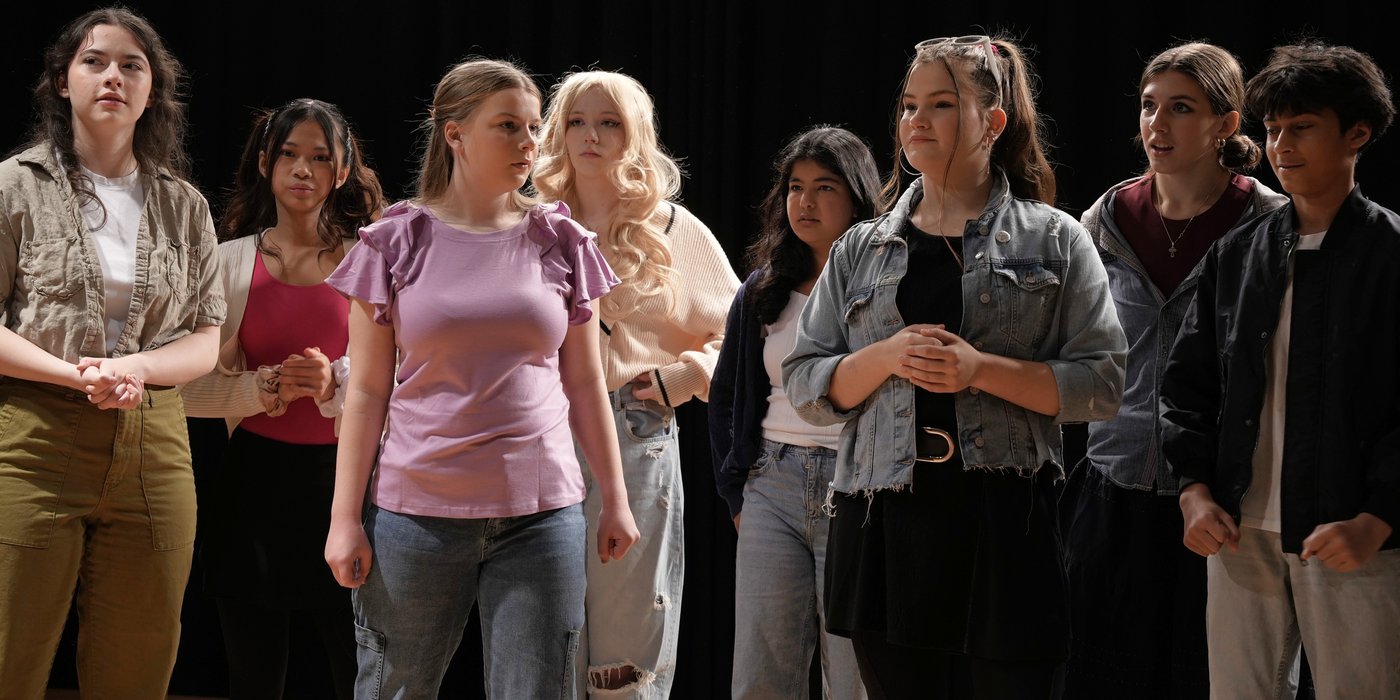
The directors described the production as the beginning of “an exciting new chapter for theatre at our school,” celebrating a year spent building skills, confidence, and a strong theatre community.
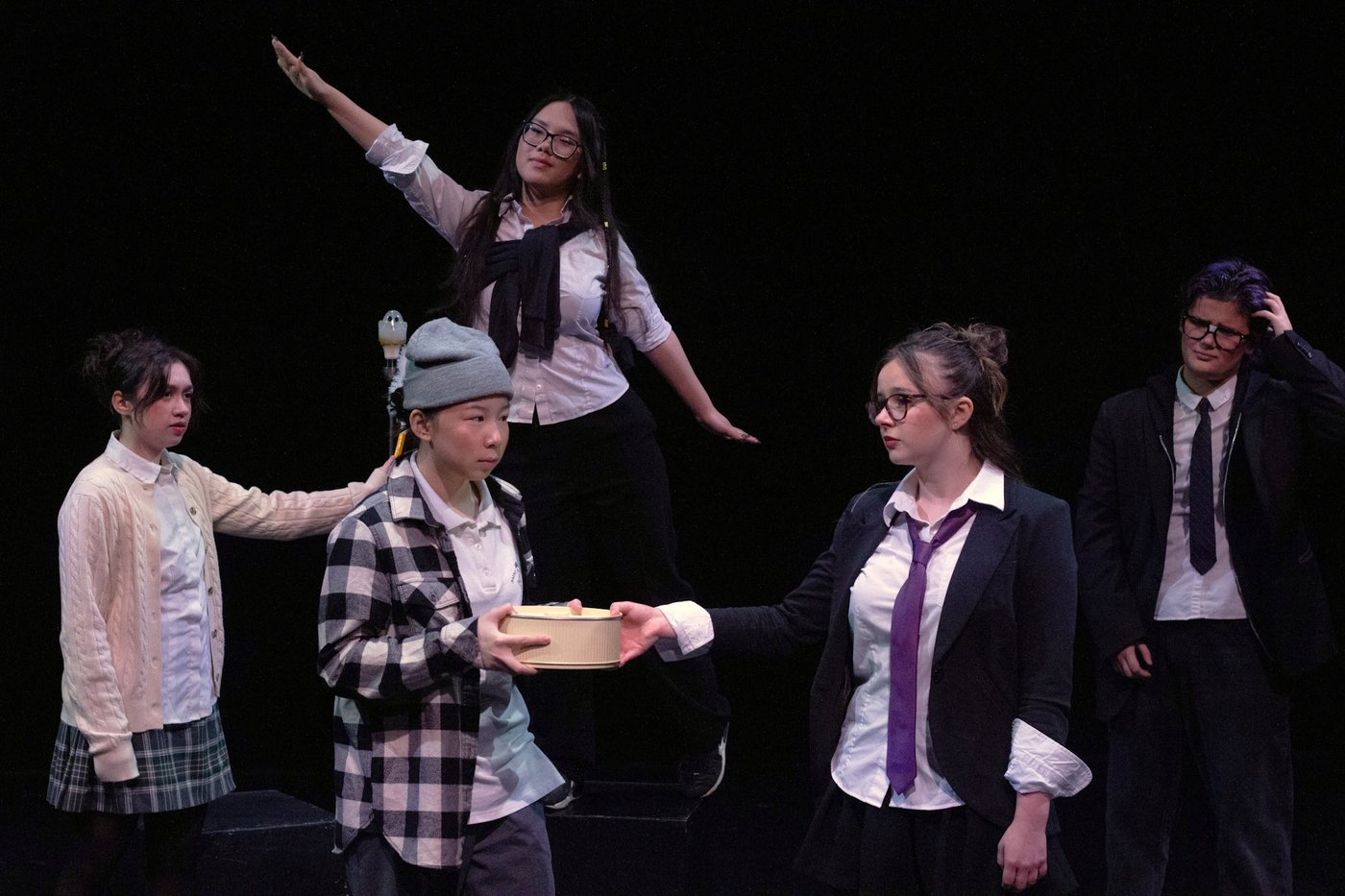
Meanwhile, St. Patrick Regional Secondary’s Theatre Department staged Ghostlight by Stephen Gregg. The production ran April 9-11 at The Cultch’s Historic Theatre in Vancouver, giving students the opportunity to perform on one of the city’s most recognizable stages.
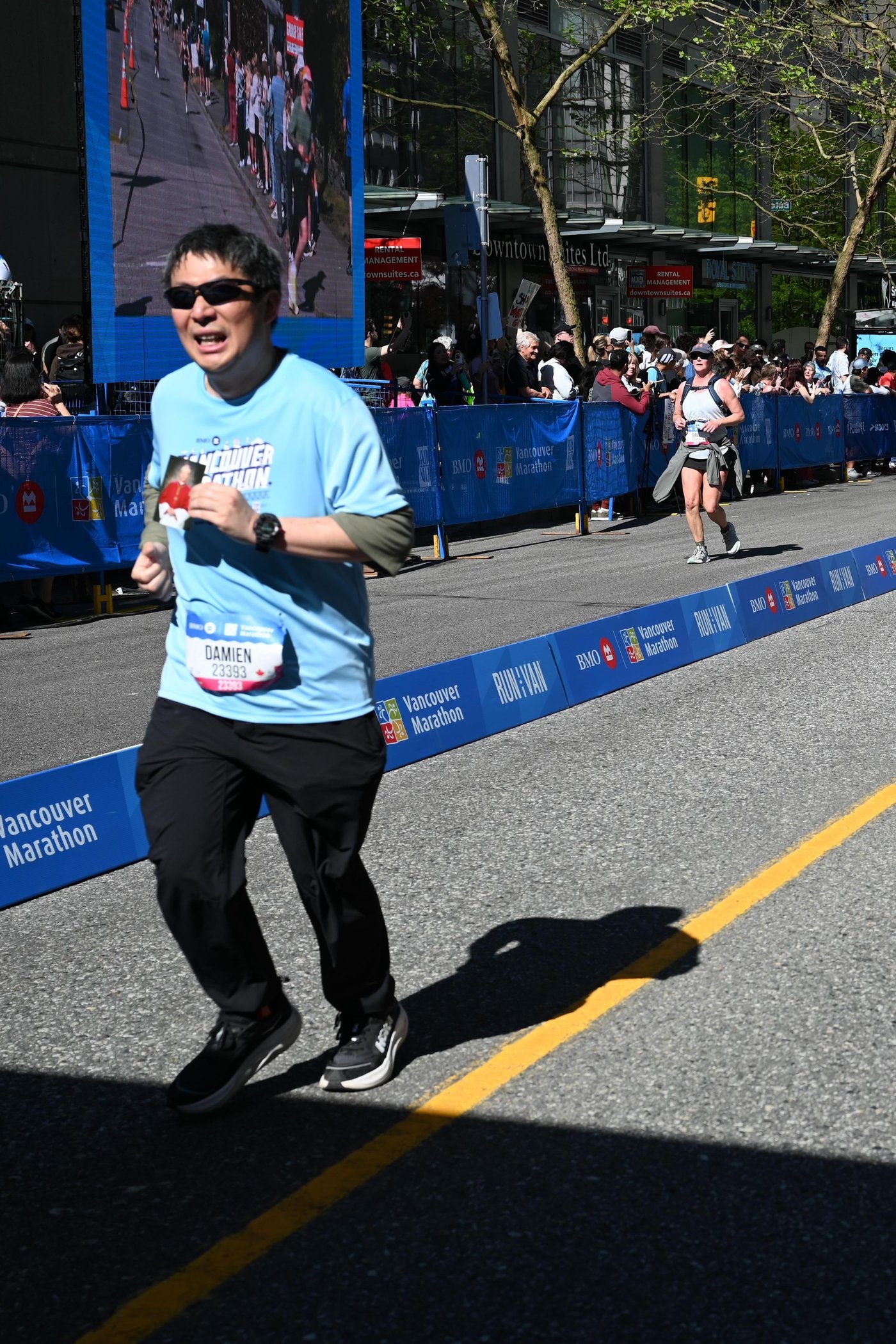
Damien Yu crosses the finish line of the BMO Half Marathon while holding a prayer card of Archbishop Richard Smith. Yu, a parishioner at Holy Cross Parish in Burnaby, took up running after being told he was pre-diabetic and said carrying the card inspired him during training as he worked toward a personal-best time. (Submitted photo)
Your voice matters! Join the conversation by submitting a Letter to the Editor here.
View original post at BC Catholic
Author: {authorlink}
Posted on May 28, 2026… Read more “Nota Bene: Catholic schools take the stage: Act II”
Mary doesn’t stand between us and Jesus
Growing up, I was taught to pray the Rosary, but I don’t think I truly understood the relationships it is meant to foster.
In university, a Protestant friend found my rosary beads a little intimidating. I didn’t have the words to properly explain the prayers to her and, admittedly, I think her questions and feelings planted some doubts in my own mind as well.
Later, a Catholic friend commented that she didn’t want to “go through” Mary to have a relationship with Jesus. She respected Mary but didn’t think it was necessary to pray to her; she preferred to communicate directly with Jesus. Also wanting to prioritize my relationship with Jesus, I again began to doubt the need to pray to Mary regularly.
As a young mother, when I was invited to attend a mother’s Rosary group, I was unsure. I declined the invitation a couple of times and then finally surrendered and attended. I found that I loved the way these women of faith looked to the life of Mary through the Mysteries of the Rosary for guidance in their own lives. I attended weekly for several years and, through it, came to see the Rosary in new ways.
First, I realized that since my Protestant friend did not know the “Hail Mary” prayer, she may have found it strange to hear a prayer repeated over and over. For me, though, while pondering stories drawn directly from the Bible to the rhythm of familiar words, I found myself imagining Mary’s point of view in the events of her life with Jesus. As a result, I came to understand that I can turn to her when dealing with situations of my own, as a mother and as a woman seeking God’s plan for my life.
I also realized that I am in no way compromising my relationship with Jesus by reaching out to his mother. Mary was a woman who worked, worshipped, and raised a child, just as I have. She faced challenges, pain, and joys while always trusting in God’s plan for the world and her role in that plan. Mary is someone I can identify with because she is not God; she was a human woman, with the experiences of a woman and a mother. She “gets” me, and she wants me to turn to her, not instead of Jesus, but alongside him, as my heavenly mother.
This leads to something else people of other faiths say about Catholics and their relationship with Mary. Because we pray to Mary and even sing songs about her, we are accused of worshipping her. The reality is that we believe in the Ten Commandments and worship only God.
Letters: Mary’s motherly support
Re “Behold your mother” in the May 12 B.C. Catholic:
For me, praying the Rosary deepens my relationship with Mary. Mary and the Rosary are inseparable in my spiritual life as I grow in holiness and closeness to our Lord. Mary’s love for me calls me to respond to her invitation to draw closer to her Son. I do not believe I could draw closer to the Son without the support of the Mother.
When I was young, I found the Rosary a bore, because the Rosary without Mary felt empty to me. She brings us closer to Jesus and, in doing so, truly offers us her motherly support.
May the month of May remind us that each day can be like a flower offered into the loving arms of Mary, ever ready to receive us and present us to her Son.
Rita Castillo
St. Jude Parish, Vancouver
The framing of Alan Charlton’s May 11 column around “proving Timothée wrong” is very bizarre if you take the time to research and understand his words in context.
He clearly did not literally mean “no one cares,” and frankly, he was not even speaking about the merit or quality of ballet and opera whatsoever. His comment was about not wanting moviegoing to become niche in the way those art forms have, which should not be controversial to admit.
I suppose the point of using his name was to get clicks, but misrepresenting what he said and meant is unfortunate.
Gilly Moore
Toronto
Did you know that British Columbia has a Catholic Physicians’ Guild, a community of doctors who support one another in living out their Catholic faith within the medical profession?
The guild is led by Dr. Tim Kostamo, a deacon at Christ the Redeemer Parish, and brings together physicians from across the Archdiocese for fellowship, ethical formation, prayer, and mutual support. It is a place where Catholic doctors can connect with peers who understand the unique challenges and responsibilities of practicing medicine today.
If you are a physician in B.C., we warmly encourage you to consider joining the Catholic Physicians’ Guild. Your presence strengthens the witness of Catholic health care in our province, and the guild offers a meaningful way to integrate faith and professional life.
This year, the Canadian Catholic Physicians’ Guild conference is being hosted by our local Vancouver chapter.
“Restoring Medicine Through the Sacred Heart of Jesus” will take place May 28–31 at the Pinnacle Hotel in North Vancouver.
More information about the guild and conference can be found through the Catholic Physicians’ Guild of Vancouver and Canadian Catholic Physicians’ websites.
Lizette Bell
On behalf of the Catholic Physicians’ Guild of Vancouver
Bill C-9 is now before the Senate, and if it passes further review and a final vote, it will become law.
Anima Christi: the perfect prayer for Corpus Christi
One of my favourite prayers is the Anima Christi. I love it in both Latin and English. I find myself returning to it every time I receive Holy Communion and when I attend adoration of the Blessed Sacrament. It seems especially appropriate as we get closer to the annual Solemnity of the Body and Blood of Christ, or Corpus Christi, on June 7.
This prayer is a cry from the heart. It uses intimate, pleading language and the tangible images of Christ’s Body and Blood to draw us closer to Jesus.
The first half of the prayer reads: “Anima Christi, salva me. Corpus Christi, sanctifica me. Sanguis Christi, inebria me. Aqua lateris Christi, lava me. Passio Christi, conforta me.” In English: “Soul of Christ, sanctify me. Body of Christ, save me. Blood of Christ, inebriate me. Water from the side of Christ, wash me. Passion of Christ, strengthen me.”
The imagery used in this appeal to Christ is powerful. The plea of the penitent to the divine should remind us that we ought always to desire intimacy with Christ. he has poured out his lifeblood for us, which we receive every time we receive the Eucharist. But how often do we take this intimate act for granted? This prayer emphasizes that we do not merely receive Christ, but should yearn to be saved, inebriated, washed, and strengthened by him.
The idea of being “inebriated” by the blood of Christ is striking. We tend to associate inebriation with drunkenness and therefore see the word in a negative light. However, to be inebriated with the blood of Christ is to be filled with him, absorbed in his grace and love, even joyful in it. One might say we should hunger for the blood of Christ as an endless source of love and mercy.
As we approach the Solemnity of Corpus Christi, the Church asks us to focus especially on the Body and Blood of Christ. Even though we have just reflected on Christ’s bodily sacrifice during Holy Week and have recently concluded the Easter season, the Church brings us full circle with Corpus Christi, renewing our focus on the Eucharistic body and blood.
According to The Story Behind the Feast of Corpus Christi by Gretchen Filz at catholiccompany.com, the Church has celebrated this solemnity since 1264, when Pope Urban IV established it following a Eucharistic miracle in Bolsena the year before. A German priest, struggling with belief in the real presence, stopped in the small Italian town to celebrate Mass. As he spoke the words of consecration, the host began to bleed, dripping onto the altar and the corporal.
World Cup trafficking fears spur safeguards in Vancouver and Toronto
Prestige, patriotism, and spectacle are coming to Canada with the 2026 FIFA World Cup starting June 11, but history shows a seedy underbelly will accompany the world’s biggest single-sport competition: a significant surge in human trafficking.
That concern carries particular relevance for Vancouver and Toronto, the two Canadian host cities that will stage 13 of the tournament’s 104 matches, seven in Vancouver and six in Toronto.
The Canadian Centre to End Human Trafficking says major sporting events can create conditions that increase the risk of labour exploitation and sex trafficking, as infrastructure projects, temporary service-sector jobs and large influxes of tourists create opportunities for abuse.
Nearly three years ago, the Canadian Centre to End Human Trafficking developed recommendations to curb exploitation and abuse, particularly labour exploitation, that it disseminated to the federal government, the Ontario and B.C. provincial governments, and the municipal leadership of Toronto and Vancouver.
Ashley Franssen-Tingley, director of partnerships for the centre, said conversations have already taken place with Vancouver’s frontline responders as officials prepare for the crowds expected during the tournament.
“We were thinking about all the training that all the staff, volunteers and police have had (about detecting trafficking),” said Franssen-Tingley. “Do the paramedics who are going to be responding in the crowds and fan zones have the proper training? Are we ensuring that the Canadian Human Trafficking Hotline number is included in the training?”
Franssen-Tingley said governments and law enforcement will not be alone in raising awareness and disrupting trafficking, as non-governmental organizations are also stepping up.
The Canadian Centre to End Human Trafficking has urged policymakers to “apply an anti-human trafficking lens when designing processes and contracts to ensure that safeguards are put in place at every step.” Recommendations include proactively informing workers of their rights and streamlining reporting systems so abuse and exploitation can be reported more easily.
Catholic organizations are also stepping up awareness efforts ahead of the tournament. The Mary Ward Centre, a ministry of the Loretto Sisters in Toronto, recently participated in an international webinar examining trafficking risks connected to the World Cup and lessons learned from previous tournaments, including the 2014 World Cup in Brazil.
Eva Rodriguez-Diaz, the Mary Ward Centre’s program manager of trafficking, migrants and refugees, said churches, schools and community organizations all have a role to play in educating the public about trafficking risks and warning signs.
“It is up to us, as civil society, through our organizations, churches, schools, projects, activities and community spaces, to promote education, raise awareness and discuss the risks — how to identify them and how to prevent them,” said Rodriguez-Diaz.
Sister Sandra Ede of the Adrian Dominican Sisters said Brazil’s “A Cry for Life” network of 100 religious congregations launched a “Play in Favor of Life” campaign ahead of the 2014 World Cup, distributing educational materials in airports, hotels, bus terminals, schools and community centres, and holding public marches, prayer gatherings and prevention training.
Yet more scams… this time it’s the bank inspector!
We’ve been covering scams in this column for more than two decades. Thank goodness for the opportunity to be able to cover them in this paper, whether they are electronic, based on emails, text messages, or fake websites, or whether they depend on the old-fashioned landline phone call.
Fortunately, as we covered in a recent column involving a reader who unwittingly permitted their webmail account to become compromised, many of us are quick to recognize a scam and brush aside emails, text messages, or phone calls seeking to perpetrate harm. However, there clearly remain enough potential victims for these schemes to remain profitable.
Recently, the Vancouver Police Department put out an alert on the “fake bank employee – fake police officer” scam in which victims are duped into believing they are aiding their bank to combat some sort of suspicious activity involving their account. Variants of this scam have existed for years.
Let’s take a look at the entire VPD release on this. Read it carefully.
#VPDNews: Vancouver Police are warning the public to be cautious of an ongoing scam involving fake bank employees and fake police officers working together.
In these cases, a victim gets a call from someone claiming to be from their bank, saying there’s suspicious activity on their account. The caller asks for the victim’s help with an “investigation,” sometimes mentioning a bank employee.
While still on the call, the victim receives a second call that appears to come from the Vancouver Police Department. The victim switches over, and the caller claims to be a police officer investigating the same issue. The “officer” tells the victim to keep cooperating with the bank and says they’ll follow up later.
The victim then goes back to the “bank” caller, who says money has been deposited into their account. They instruct the victim to go to a bitcoin ATM, buy bitcoin for that same amount, and send it to them.
Days later, they contact police for a follow up and realize they have been scammed. In total, some victims have lost approximately $10,000.
“We want to remind people that no police officer will ever recommend you send money or bitcoin to someone you don’t know,” says Constable Megan Lui. “A bank will not ask you to help them with an investigation, and they will never ask you to send bitcoin. If you receive a call like this, please hang up and contact your bank directly.”
If you believe you have been a victim to this scam, or you know someone who has, please call the VPD non-emergency line at 604-717-3321 to make a report.
Repeat after me: “I will not act on a call from a bank involving the movement of money.
‘God is on the move’: Archbishop Smith at Victoria March for Life
Hundreds of pro-life witnesses gathered in Victoria for the annual March for Life in the provincial capital, marching through downtown streets carrying pro-life signs and banners before rallying at the legislature to hear speakers, including Vancouver Archbishop Richard Smith.
The Victoria event drew families, clergy, students, and supporters from across British Columbia for speeches, prayer, and music focused on the protection of unborn life and care for vulnerable people. Organizers also highlighted concerns surrounding euthanasia and assisted suicide.
In a change from the custom of the Vancouver Archbishop having a pre-march Mass in his own diocese, Archbishop Smith celebrated at St. Andrew’s Cathedral in Victoria.
In his homily, Archbishop Smith acknowledged that many pro-life advocates can feel discouraged by what he described as “a powerful juggernaut moving forward and expanding in a manner that appears irresistible,” pointing to abortion and the expansion of euthanasia in Canada.
But he urged participants not to lose hope, saying, “God is at work, God is on the move, and God is an unstoppable force. His saving will simply cannot be thwarted by human iniquity.”
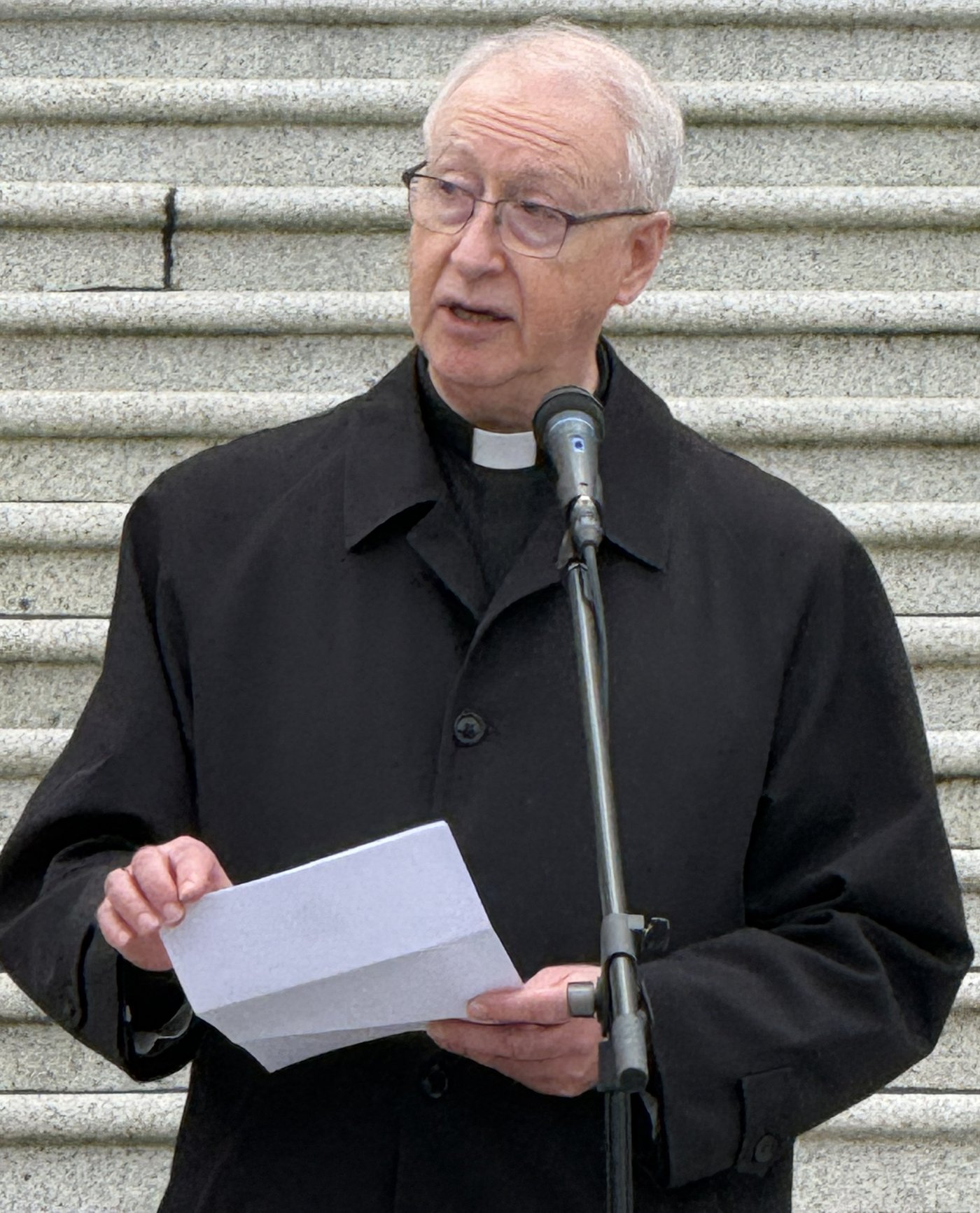
“This is why we march,” he said. “It is incumbent upon all of us to look for any and every opportunity to witness to the truth of God’s own love for life.”
Speaking later in front of the legislature, Archbishop Smith said the annual March for Life was part of a broader effort to build “a culture of life” through speaking, celebrating, and serving.
“Our march is a very peaceful event, and a great occasion for us to witness to the beauty of all life,” he said, quoting Pope Benedict, that every human being is “willed, loved and necessary.”
He also said society needs “radically transformed human relationships, defined no longer by an extreme individualism and a false notion of freedom, but by a self-giving love that welcomes the other as gift.”
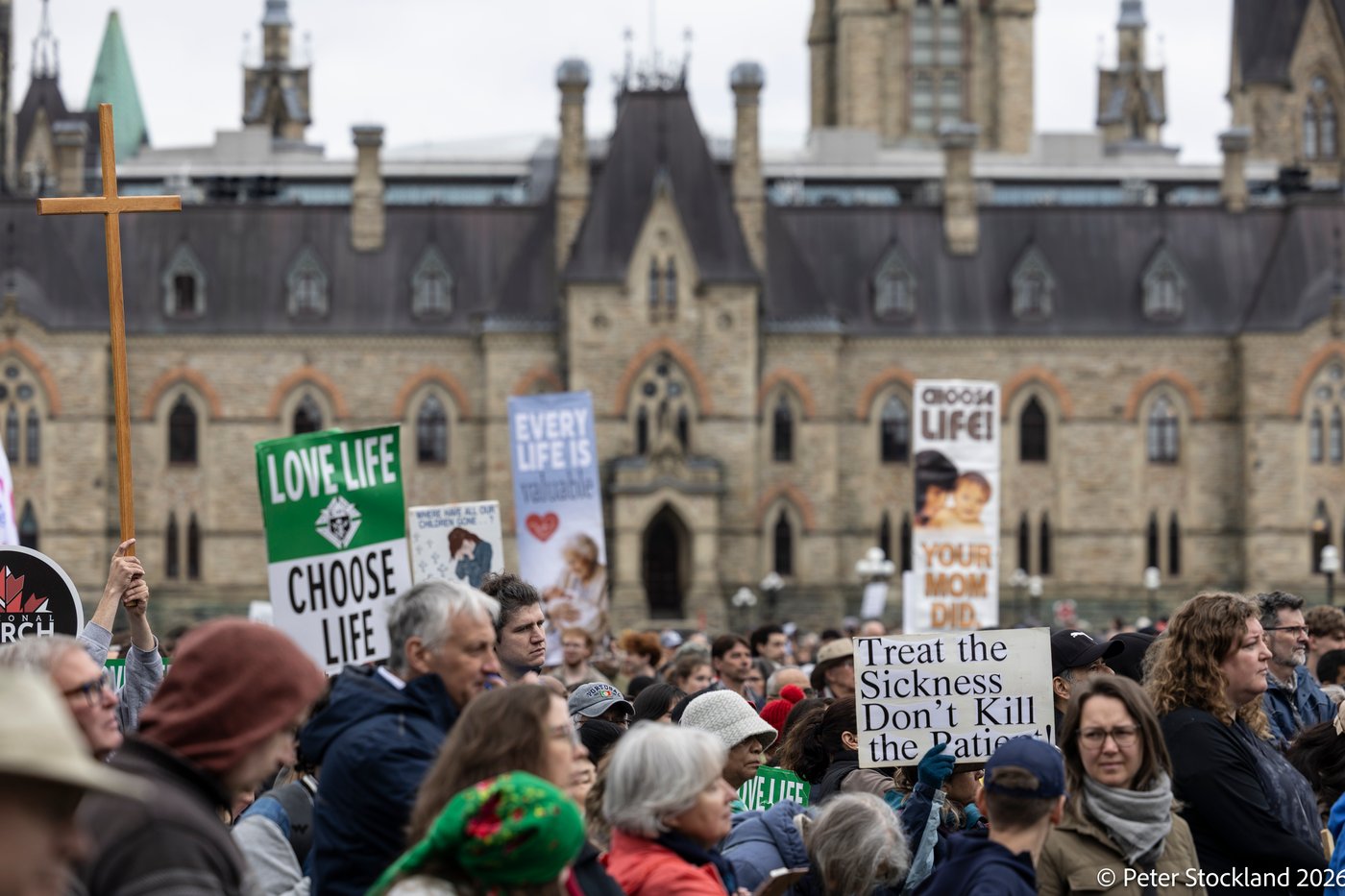
Meanwhile in Ottawa, it took almost 25 minutes for a crowd organizers said numbered in the thousands to inch its way from Parliament Hill down Wellington Street to Elgin Street during the National March for Life .
At a rally before the march, organizer Debbie Duval told the crowd, “We march on a Thursday, in Ottawa, because that’s when our legislators are sitting in the House of Commons. We want them to hear us. We want them to know we’re here.”
Matthew Wojciechoski of Campaign Life Coalition said participants were calling on Parliament to enact legal protections “for all human beings from conception up to natural death.”
Pro-life supporters rally on Parliament Hill at National March for Life
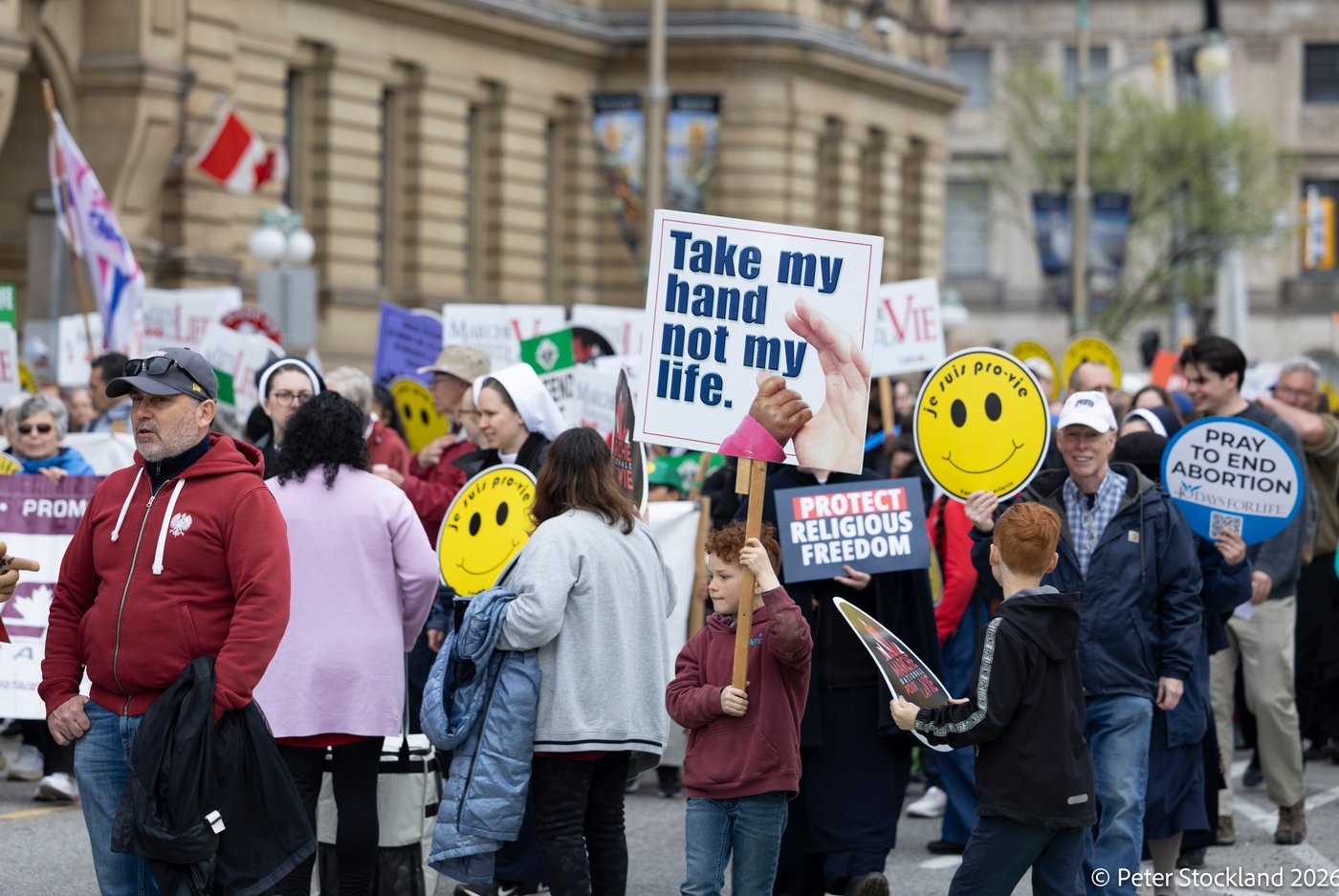
It took almost 25 minutes for a crowd that organizers said was in the thousands to inch its way from Parliament Hill down Wellington Street to Elgin Street during the National March for Life in Ottawa.
Members of every ethnic background, young and elderly, priests, families and church groups carried pro-life signs and walked the streets of the Canadian capital to press for an end to abortion and euthanasia in Canada.
The day began with liturgies celebrated at Notre Dame Cathedral, St. Patrick’s Basilica, and St. Clement. Ottawa-Cornwall Archbishop Marcel Damphousse was the main celebrant at the cathedral, joined by papal nuncio Archbishop Ivan Jurkovič, Ukrainian Catholic Bishop Bryan Bayda, and some 30 priests and deacons.
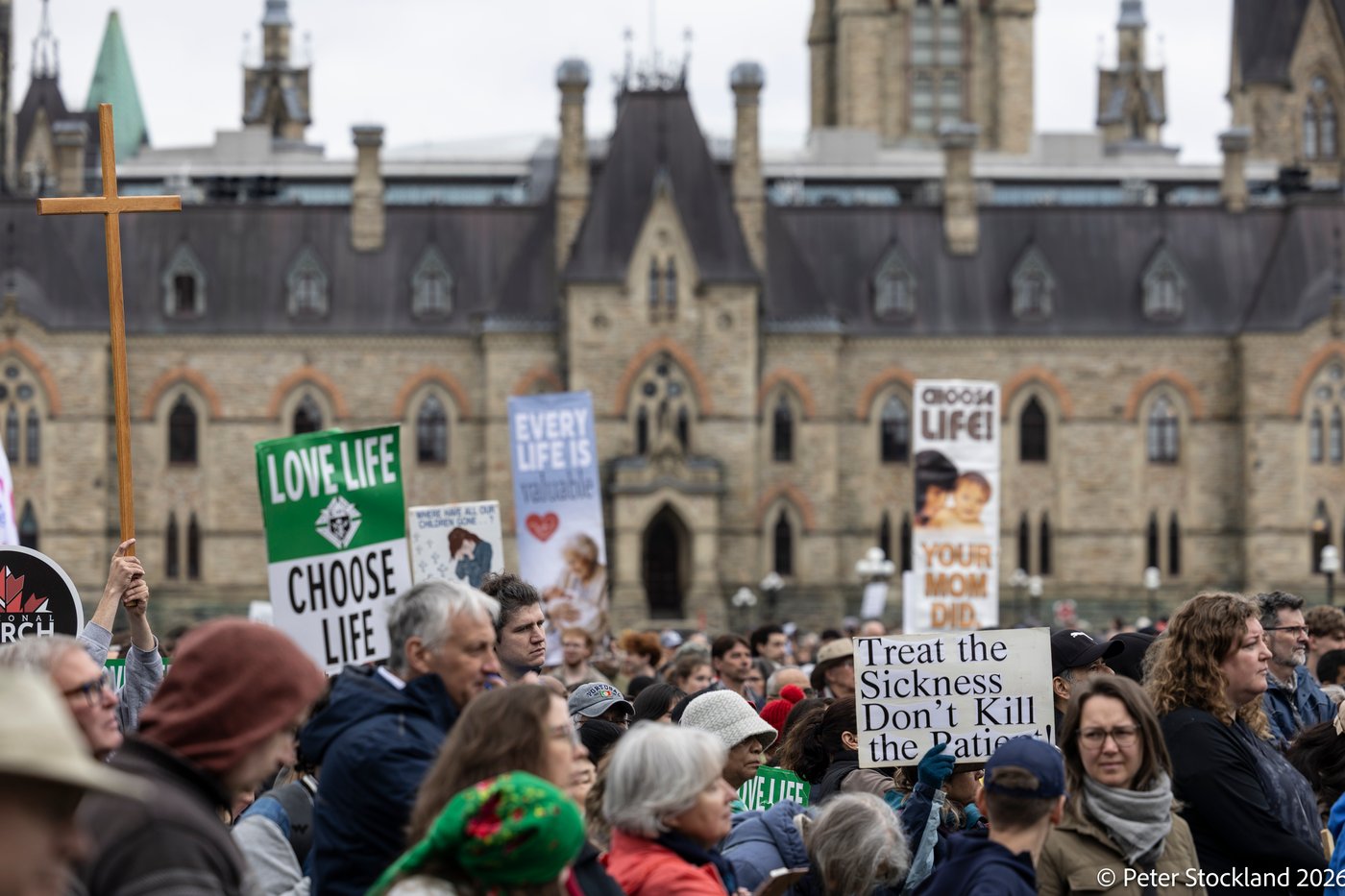
At a midday rally before the march, organizer Debbie Duval told the crowd, “We march on a Thursday, in Ottawa, because that’s when our legislators are sitting in the House of Commons. We want them to hear us. We want them to know we’re here.”
Matthew Wojciechoski, Project Manager at Campaign Life Coalition (CLC), which organizes the annual event, told the crowd, “We are here to call upon the members of Parliament to enact legal protections for all human beings from conception up to natural death. To remind Parliament of four simple words, ‘Thou shalt not kill.’”
The March for Life takes place in May to mark the month in 1969 when the omnibus bill that decriminalized abortion in Canada was passed.
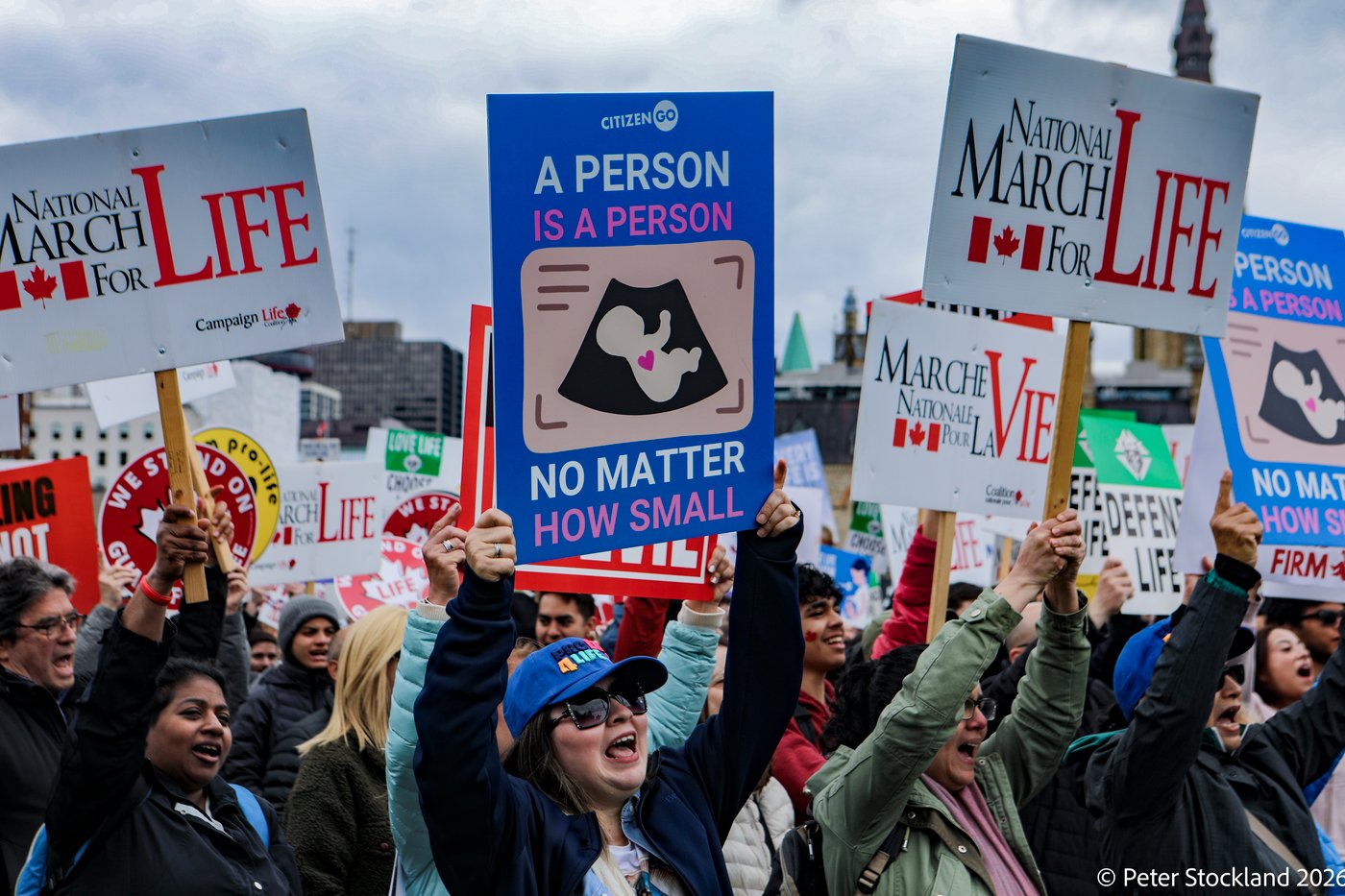
This year’s march fell on the very anniversary of the vote and adopted as its theme Jesus’ command, “Follow me.”
CLC national president Jeff Gunnarson asked the crowd to pray for founder and former president Jim Hughes who is in hospital with pneumonia and “not doing well.”
“Jim devoted decades of his life to the unborn and building this movement in Canada. Many of us are standing here today because of sacrifices he made long before we arrived,” Gunnarson said.
The featured speaker was Aleš Primc, co-founder of the Slovenian political party Voice for Children and Families that recently forced a referendum to overturn the country’s assisted suicide law. He led pro-lifers in a series of loud “hellos” to people of all ages, from unborn children to “people with gray hair like me.”
“Saying “hello” is the start of recognizing our shared humanity,” he said.
Speaker Rebecca Kiessling, a U.S.