
Decluttering adds sparkle and shine, and calms the brain
Reading cleaning and decluttering blogs I’ve been inspired to go through my clothes and knick-knacks to get rid of anything I don’t need. Marie Kondo, a professional organizer and tidying expert, has a whole philosophy, “Keep only those things that speak to the heart, and discard items that no longer spark joy. Thank them for their service – then let them go.”
I have donated two bags of clothing, a box of books, and little items that no longer serve me. It has been an experience of letting go and embracing what I have. I know that the Lord provides for me. When I am buried in things, I can’t live freely. The books, clothes, and things are supposed to help me live in simplicity and freedom. My mental health improves when I clean, tidy, and declutter our house.
It starts to feel like I have more space in my mind to think and be creative. St. Josemaria Escriva, the founder of Opus Dei, spoke about forming a bright and cheerful home and in doing so God would help couples to be generous.
When I go to bed at night and the kitchen counters sparkle and shine, I feel more relaxed when I wake up to a beautifully clean room. Our environment has a role in maintaining good mental health. With lots of “stuff,” we can feel weighed down with all the decisions of what to do with it. It was my goal to remove what I no longer used or needed so I could be happier and healthier.
Taking the time to clean, tidy, and declutter gives me clarity of mind and spirit. I feel as if laundry and cleaning never end; it’s a constant movement of doing one thing at a time. This is just like the spiritual life. Prayer is meant to be a daily conversation with Jesus. Receiving the sacraments of confession and holy Eucharist is frequent nourishment for the soul in order to be holy. It is a good routine to clean house and soul to be one with the Lord who gives us every resource to do so.
When we reach for the goodness of a warm and organized home, it helps us grow in virtue and service for our family and any guests who come visit.
I love keeping checklists to show what tasks I have completed and what I still need to do. My list is always growing. With a home, a garden, and an adorable dog to care for, my little growing family is a busy ground for housekeeping and saint making.
Hard work is worth the effort in maintaining the home.
The Desires of Our Hearts
What does God mean by this promise?
Years ago, when I first became a Christian, there was a young couple at our church who took me under their wing. I was grateful for their friendship, encouragement and efforts to answer my many questions.
One day, the topic of unfulfilled hopes and dreams came up, to which the wife responded by quoting Psalm 37:4, “He will give you the desires of your heart.” The strong implication was that as a Christian, I could expect God to give me anything I wanted, if I would only ask.
At this point, most of the Scriptures were still terra incognita to me. But I did recall a verse, 1 John 5:14 as it turned out, which qualified that promise by insisting we ask according to God’s will. To my surprise, my friend waved this off by stating that most of the time, we don’t know God’s will, anyway.
Both of us would have greatly benefitted, I think, if we’d known the first rule for reading the Bible (or any text, for that matter): Context is king.
The promise in context
Sometimes it’s as simple as reading the complete sentence, rather than cherry-picking a single phrase for a theological sound bite. In its entirety, Psalm 37:4 reads, “Delight yourself in the Lord, and he will give you the desires of your heart.”
Taken as a whole, the meaning of the verse comes into sharper focus. It’s not a carte blanche, whereby God binds himself to provide whatever pops into the reader’s imagination: more money, better job, nicer home, exciting vacations. This isn’t the gospel according to Janis Joplin, who sang back in 1970, “Oh Lord, won’t you buy me a Mercedes Benz? My friends all drive Porsches, I must make amends.”
Nor is it the philosophy enshrined in Disney movies, which says, “Follow your heart. It will never lead you wrong.” In point of fact, Jeremiah 17:9 paints a starkly different picture: “The heart is deceitful above all things, and desperately sick; who can understand it?”
Delight yourself in the Lord
The key to Psalm 37:4 is found in the opening phrase: Delight yourself in the Lord. In essence, God is promising that for those who make him the object of their desire, he will fulfill that desire.
That’s not a tautology or an empty truism. It’s one of the most vital truths of Scripture, reflected in the broader context of the book of Psalms and beyond.
Psalm 16, in particular, addresses the theme of delighting in God more fully. Like Psalm 37, it too contains a verse that often gets yanked from its setting and made to stand on its own: “The lines have fallen for me in pleasant places.”
True love gives itself; lust aims to possess
Pope Francis shared a beautiful defence of true love at a general audience this year.
“We have to defend love, the love of the heart, of the mind, of the body, pure love in the giving of oneself to the other… that beauty that makes us believe that building a story together is better than going in search of adventures… that cultivating tenderness is better than bowing to the demon of possession,” he said in January.
“True love does not possess, it gives itself. That serving is better than conquering. Because if there is no love, life is sad, it is sad loneliness.”
This makes the vice of lust particularly odious, for at least two reasons.
“First, because it destroys relationships between people… chastity is more than sexual abstinence – but rather, to be connected with the will never to possess the other,” he explained.
“But there is a second reason why lust is a dangerous vice. Among all human pleasures, sexuality has a powerful voice. It involves all the senses; it dwells both in the body and in the psyche, and this is very beautiful; but if it is not disciplined with patience, if it is not inscribed in a relationship and in a story where two individuals transform it into a loving dance, it turns into a chain that deprives human beings of freedom. Sexual pleasure, which is a gift from God, is undermined by pornography: satisfaction without relationship that can generate forms of addiction.”
Many saints have offered insights about chastity, purity, and lust. Father Joseph M. Esper, author of Saintly Solutions to Life’s Common Problems, wrote, “how, then, are we to cultivate, preserve, or reacquire the virtue of purity? First, we must specifically and regularly pray for this grace; without God’s help, we’ll almost certainly fall, for it’s almost impossible to avoid sexual temptations in our highly immoral society.”
Then, relying on insight from St. Teresa of Avila, he said, “it isn’t possible for a person who prays regularly to remain in serious sin; because the two are incompatible, one or the other will have to be given up. Thus, if we remain faithful to prayer, God’s grace will one day be victorious in us, even if we have many setbacks along the way.”
Next, wrote Father Esper, we must form good habits. “We must form the habit of immediately resisting lustful thoughts and temptations. St. Francis de Sales advises us: ‘be extremely prompt in turning away from all that leads and lures to impurity, for this evil works insensibly and, by small beginnings, progresses to great mischief. It is always easier to avoid than to cure this.’”
Eat to live, don’t live to eat
Gluttony is one of the capital sins. Father John Hardon defined gluttony as “inordinate desire for the pleasure connected with food or drink.”
This desire may become sinful in various ways, he wrote:
“By eating or drinking far more than a person needs to maintain bodily strength; by glutting one’s taste for certain kinds of food with known detriment to health; by indulging the appetite for exquisite food or drink, especially when it is beyond one’s ability to afford a luxurious diet; by eating or drinking too avidly, i.e., ravenously; by consuming alcoholic beverages to the point of losing full control of one’s reasoning powers. Intoxication that ends in complete loss of reason is a mortal sin if brought on without justification, e.g., for medical reasons.”
The Baltimore Catechism states: “The Church commands us to fast and to abstain in order that we may control the desires of the flesh, raise our minds more freely to God, and make satisfaction for sin.” According to Sacred Scripture, “healthy sleep depends on moderate eating; he rises early and feels fit. The distress of sleeplessness and of nausea and colic are with the glutton.” (Sir 31:20)
Blessed Antony Grassi called abstinence “the mother of health.” He said, “a few ounces of privation is an excellent remedy for any ailment.”
Let’s never forget the proverb: “Eat to live, don’t live to eat.”
In the Gospel, Jesus declared all food clean (Mk 7:19) and thus eliminated the distinction between pure and impure foods. “Jesus clearly says that what makes something good or bad, let’s say about food, is not food in itself but the relationship we have with it,” said Pope Francis.
“We see this when a person has a disordered relationship with food; we see how they eat, they eat hastily, as though with the urge to be full but without ever being sated. They do not have a good relationship with food; they are slaves to food. This serene relationship that Jesus established with food should be rediscovered and valued, especially in so-called affluent societies, where many imbalances and many pathologies manifest themselves. One eats too much, or too little. Often one eats in solitude. Eating disorders – anorexia, bulimia, obesity – are spreading. And medicine and psychology are trying to tackle our poor relationship with food. A poor relationship with food produces all these illnesses.”
The Holy Father added: “Tell me how you eat, and I will tell you what kind of soul you have. In the way we eat, we reveal our inner selves, our habits, our psychological attitudes.”
Father Adolphe Tanqueray proposed three means to foster a serene relationship with food.
Serving up a little Raspberry Pi
If I use the term Raspberry Pi, many of you will think I’m making a spelling error, or possibly an attempt at being clever with the famous mathematical constant.
In this case it is neither. Raspberry Pi is the brand name of a class of ultra small computers, initially aimed at hobbyists but which have gained so much traction over the past decade that they are now being produced at around a million units a month.
Raspberry Pi units vary in size from credit card dimensions up to about the size of a small paperback book. They are also relatively inexpensive, from a few tens of dollars up to about a hundred dollars.
First introduced in February 2012 by the Raspberry Pi Foundation in the U.K., the small single-board computers were intended to introduce students to computer science. Their use quickly branched beyond education into fields such as robotics, weather monitoring, and earthquake detection. Within three years the Raspberry Pi was outselling the original U.K. domestic market record holder, the ZX Spectrum.
Just a dozen years after that initial launch, some 60 million Raspberry Pi units had been sold. Some of the heaviest demand came during the pandemic years, not just from work-at-home types having more time for hobbies, but also for industrial uses such as ventilators in hospitals.
In their initial decade the little computers became ubiquitous. Industrial demands, coupled with supply chain issues and chip production problems meant fewer of the small computers were available for hobbyist users. The net result is that reseller prices skyrocketed. Official sellers maintained their price points but had no stock for a couple of years.
Reseller operations such as Facebook Marketplace showed sellers setting Pi unit prices at double or in some cases at quadruple the nominal official prices. However, by May 2023 came the first word that the Pi Foundation expected to ramp up production by summer. Indeed, by July last year new Pi units were appearing at local outlets. Those who didn’t get their outlandish asking prices by then had to begin slashing, and by September the market was basically back to normal, although not necessarily with all models in the Pi lineup.
I’ve been a user of Raspberry Pi hardware for a number of years. Presently there are half a dozen Pi units (mostly model 3B+ and 4) running various radio-related applications at my house: two for weather satellite signals decoding and processing, one for aircraft tracking, one for marine vessel tracking, and two for a big-screen application displaying current space weather and radio signal propagation conditions.
Recently I decided to test the educational waters with a Raspberry Pi and a six-year-old grandson.
Letters: when killing becomes health care
Re MAiD in Canada Crisis, B.C. Catholic, June 10:
As a serious pro-life person, I am grateful that we have the Christian Heritage Party – CHP Canada and Christian Heritage Party of BC. As a Catholic, I have enough problems with my taxes being used to kill people as part of health care, so donating to a political party that supports killing as health care and a right is too much for my conscience.
We need to pray and act to get Christian values back in our government.
Nancy Peirce
Surrey
As long as the cost of euthanasia is a fraction of that for treatment or palliative care, there is danger, and the vulnerable and seniors must be on their guard.
How can one fully trust a system that considers homicide to be a medical treatment?
Gerry Hunter
Burnaby
It was timely to see an update on the situation with St. Paul’s Hospital and MAID access. Apparently, St. Paul’s is waiting for an update from Vancouver Coastal Health as to access and connection, as well as from the Ministry of Health on the land acquired to build a euthanasia facility.
The waiting and questioning of these government bodies would not be relevant if our Catholic moral stand had been taken seriously from the onset. We do not accommodate or accompany MAID. Providence would not be in a position of “attempting to make the best of a bad situation or facing “a conundrum.” Mary Wagner has been well quoted twice now in The B.C. Catholic as to maintaining the Catholic position.
What is the purpose of clearly stating this position many times in The B.C. Catholic but not carrying through to refuse MAID entry or connecting.
Cecilia von Dehn
Vancouver
Bravo to the Roy family for writing these books. Why are they not available at the Catholic bookstore or in the little shop in the cathedral?
Many people like me do not order online. We would like to see the book first before we purchase it. I am sure it would make a great gift, especially for grandparents to give to their children and grandchildren.
Marianne Werner
Vancouver
Your voice matters! Join the conversation by submitting a Letter to the Editor here.
Overcoming Envy
On which sin are we reflecting today? Envy. A young married woman gave me permission to share how she’s struggling so much with not being able to have children yet. Every time a friend gets pregnant, or someone talks about the beauty of children, her heart sinks. Why can’t she have children of her own? Why won’t God the Father give her something good, that we’re made to have? When some friends try to console her by saying, “God’s calling you to be a spiritual mother,” that does nothing for her whatsoever.
Her pain is real and normal. Let’s acknowledge the pain that many of us feel when we want something good and don’t receive it: wanting to get married, be healthy, have financial security. But then there’s the sin of envy we feel when we see others have what we desire and we’re not happy for them.
We can understand the experience of the older brother in the Gospel. He’s in the field working, and, while approaching the house, hears the celebration. A slave tells him that his younger brother, who is depicted in the parable as truly an awful person, is receiving the celebration. The older brother then tells his father, “Listen! For all these years I have been working like a slave for you, and I have never disobeyed your command; yet you have never given me even a young goat so that I might celebrate with my friends. But when this son of yours came back, who has devoured your property with prostitutes, you killed the fatted calf for him!” (Lk 15:29-30).
The experience of perceived injustice is painful. It would be one thing if the younger brother had received the same treatment as he did, but the younger brother receives more!
Here’s the first step in overcoming envy: Speak your pain. Never insult God, but do say exactly how you feel. The Father expects us to speak and listens to it.
The second step is to ask Him questions: “Father, why do You give good things to those who don’t deserve them? Why don’t You give basic good things to me? Why can’t I receive them?” Once we get it all out, then we’re ready to hear what He says.
The Gospel says that “his father came out and began to plead with him” (15:28). This father is actually not unfair; he cares about both his children equally. That’s why he humbles himself as a father and goes out to meet his elder son. And his words reveal his heart: “Son, you are always with me, and all that is mine is yours” (15:31). The word ‘Son,’ and of course, ‘daughter,’ reveals God’s love for us.
Digital Minimalism: How to Live Better with Technology
One of the defining struggles of our generation is to balance the way technology occupies our attention and desire with our calling to live intentionally and boldly. Digital technology certainly enriches our lives, but we all know that restless, distracted feeling it can leave us with, too.
Cal Newport’s most recent book, Digital Minimalism: Choosing a Focused Life in a Noisy World, offers a practical and convincing solution to those of us who feel enslaved by the dizzying swarm of our technological “conveniences.” Newport, a professor at Georgetown and a New York Times best-selling author, understands that what’s needed is not merely a list of helpful tips or theorized critiques regarding our relationship with digital technology, but an entirely new approach to living.
Such an approach, according to Newport, is summed up by the phrase “digital minimalism,” which he describes as a “philosophy of technology use in which you focus your online time on a small number of carefully selected and optimized activities that strongly support things you value, and then happily miss out on everything else.”
The key word here is “happily” — Newport isn’t proposing a way of life concerned with superficial outcomes like efficiency or utility, but rather one with greater happiness and fruitful relationships.
What I appreciate most about Newport’s insights (besides the fact that they are well-researched) is that he takes very seriously the issue of our addiction to technology. To be clear, Newport is no Luddite — he’s a computer science professor, after all — so he doesn’t fault the latest technologies in and of themselves, but rather their unintentional and aimless use. For Newport, a haphazard and unreflective relationship with the latest technologies ultimately hinders a well-lived life.
Here’s his main thesis: Our lives are cluttered with technologies that offer us little benefit in exchange for their cost. For example, it’s easy to justify maintaining platforms like LinkedIn or Twitter because of the benefit of possibly connecting to others who can introduce us to new opportunities. And while that can indeed be a benefit, if it comes at the cost of spending 20 hours a week on those platforms, then we need to reconsider the actual value of that benefit.
In other words, we need to be doing a cost-benefit analysis of the technologies we use and not overlook the hidden value of our time — something that we all have in limited supply. Such costs can come in the form of weakened relationships with loved ones, feelings of restlessness, and countless hours of lost time.
Newport also highlights that we tend not to think about how we use a given technology — only whether we should use it or not.
How Do We Avoid Tech Interfering With Our Humanity?
Throughout history, people have asked the question, what makes us human? Philosophers, scientists, and theologians have all tackled this question in different ways, and I won’t claim to have a new answer. But I have found that looking at humanity through the lens of technology — and the future we’re building towards with it — offers me new insights into the answer to that question.
In its simplest form, a human is a person as distinguished from an animal or (in science fiction) an alien. However, being human is much more complicated than that. We are rational beings capable of understanding and making decisions, we have curiosity about the world around us and we have a wide variety of emotions that affect both of the former. In a spiritual sense, we are beings that live for one another when fully cooperating with the Lord through our free will. He did not want to make slaves or clones but instead, those who are in His likeness. Due to this, we are meant to be creators and not solely consumers of the things around us.
The rise of technology
In the last two decades, technology has been a significant part of people’s lives. From the increase in household use of the World Wide Web to the unveiling of the iPhone in 2007, the world has been increasing its use of technology in daily life. Facebook changed the way we share information with friends and family, initiating the start of social media.
Today, AI tools are capable of writing papers, creating realistic images, imitating people’s voices, and much more. Robot vacuums clean our houses for us. “Alexa” turns on our lights, sets reminders for us, and changes the temperature in the room with a simple voice command. We have increased people’s ability to talk with those on the other side of the world as well as enabled clearer communication for those who are nonverbal through keyboard or eye-scanning communication devices.
Along with these benefits of advanced technology, there have also been drawbacks. Technology has pushed society towards more consumerism. Not only do we consume media through our phones and televisions, but we are also bombarded by advertisements in our social media feeds, encouraging us to buy more using an algorithm that pushes ads individually suited to our tastes and habits.
Technology shapes our lives
Since the rise of social media and the widespread use of the internet, scientists have been interested in the effect of technology on the brains of both young and old individuals. One study found that most adults use the internet daily, and nearly one out of four report being online most of the time.
Serrans share their vocation stories
Serra International is an organization created by Catholic laity whose objective is to foster and promote vocations to the priesthood and all religious vocations in the Catholic Church, as well as encouraging the laity to fulfill their Christian vocation to service. Serra is named after St. Junipero Serra, a Spanish Franciscan missionary who played a leading role in early missionary work in Mexico and the United States. Below, local Serrans share their experiences.
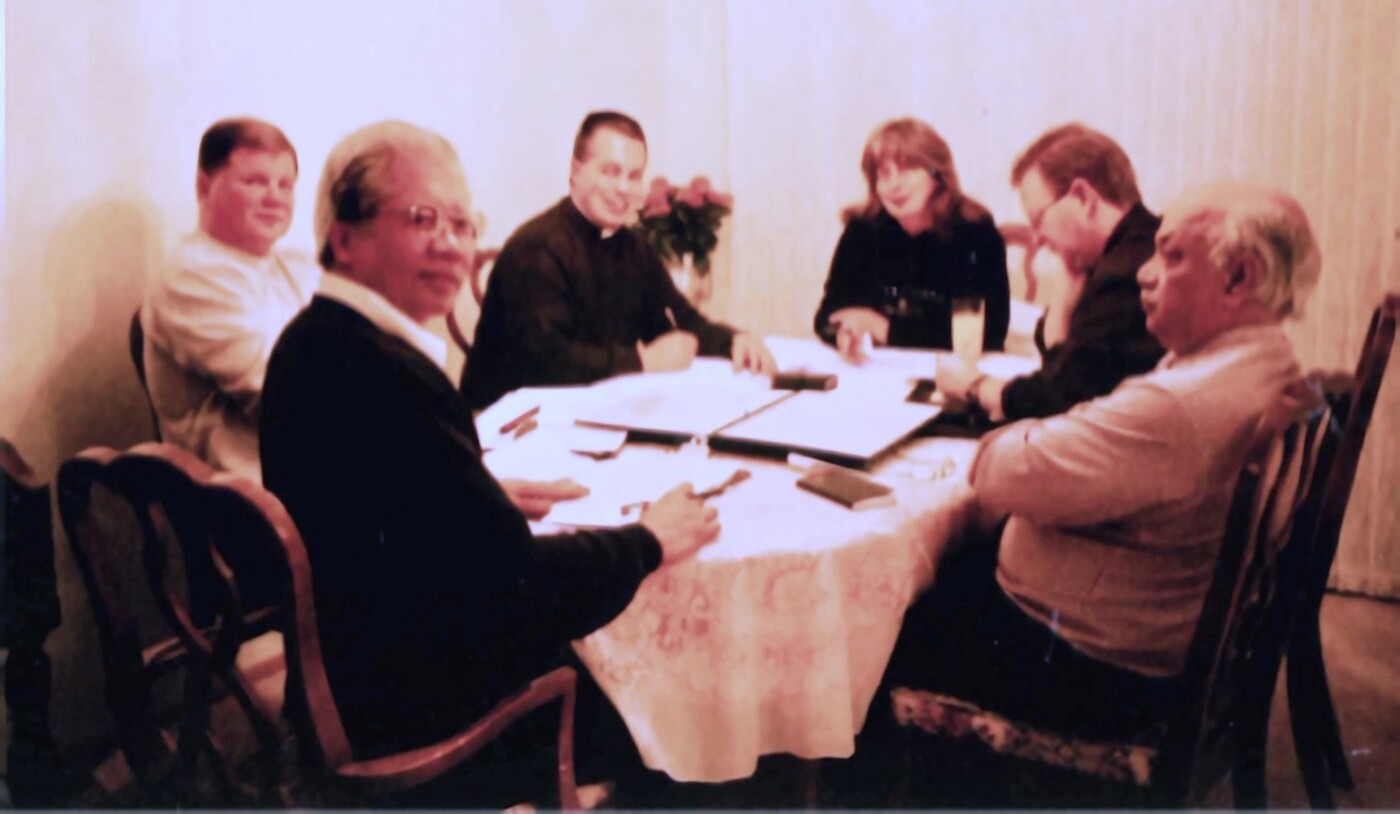
“I joined Serra over 20 years ago, wishing to be a part of those eager to promote vocations. The outcome is the opportunity to know seminarians in their place at the abbey, the several times we can convene at Holy Rosary Cathedral to support our faith, and in our activities to be together for the greater glory of God.” — Mike
“I joined Serra shortly after I was baptized and confirmed in the Church. The organization was instrumental in helping me to build my faith over the last 20+ years. The fellowship and purpose of Serra kept me engaged with the Church.” — Ben
“Just as a number of Catholic mothers pray, I too prayed that my son would have a vocation to the priesthood. When I realized the priesthood was not his vocation, I joined Serra so that I would have Spiritual Sons who would become priests – thereby making me a Spiritual Mother of priests.” — Ethelyn
“After many years of struggling with my two sons, they decided not to pursue the priesthood and my heart was broken. I lost all my desires in my life until I joined Serra Club where I encountered seminarians. Therefore, I am not only a mother of two sons but also a mother of all the seminarians, to whom I share my heart, and pray for their vocations.” — Cathy
My passion now is to promote vocations, particularly to the priesthood, so when my time comes I may have a priest to celebrate my funeral Mass.
What I have been doing with the Serrans: Since 1981, I’ve been instrumental in starting the club in the Fraser Valley West, started the Serrans in Kelowna, established a Kamloops chapter, organized Stations of the Cross in the Fraser Valley West every Friday of Lent for the FVW deanery (Surrey), and got the traveling Chalice for Vocations that goes to homes promoting vocations to the priesthood, diaconate, and consecrated religious life.
As a result of the above experiences, I am at St. Ann’s Abbotsford re-establishing a parish vocations committee/ministry. — Leo
“I know that the celebration of the Eucharist can only be done through a priest, and as the Holy Eucharist leads us to eternal salvation, praying for priests is a priority.