
Johnny Cash and D-Day: nostalgia on stage and screen this summer
As we travel life’s journey, most of us gather warm memories of entertainment icons. For those of us of a certain age (and older!) there is now a welcome opportunity to revisit and delight in memories, by way of both stage and screen, of some such icons.
While I have never been an avid fan of country music, I readily admit that I often find it has a simple and direct appeal. Its love songs, often tinged with sadness or regret, its comments on the simple and sometimes difficult moments of daily life, and its straightforward embrace of the basic tenets of Christianity all speak directly and tunefully of the familiar experience of ordinary people like ourselves. This is certainly true of the music of Johnny Cash.
Now the Arts Club on Granville Island is providing a delightful chance to visit and revisit a number of Cash’s songs in a thoroughly engaging production. While not in any way a straightforward biography of the singer-songwriter, Ring of Fire, through the songs, both familiar and unfamiliar, traces the general trajectory of his life, from his poverty-marked childhood on a cotton farm, through his meteoric rise to stardom as a country singer, and on to his checkered adult life. The songs bear testimony both to the man and his talent.
Director Rachel Peake and choreographer Nicol Spinola help the talented cast of six actor-musicians bring to memorable life the lively toe-tapping, tuneful melodies as they exhibit an impressive ability to sing well, play a range of instruments, and deliver the entire show with infectious and engaging good humour.
For Cash’s numerous fans, and for those who are not, this is a perfect show for a summer entertainment. It is an engaging, infectiously spirited production and one not to be missed.
In an entirely different vein, the film The Great Escaper (available in theatres and on a wide range of streaming services) is one which will doubtless appeal to filmgoers of all ages, but which will have a particular resonance with more senior viewers.
Based on a true story, it tells of Bernard Jordan, an almost 90-year-old veteran, who, determined to attend the 70th anniversary celebrations of D-Day in Normandy, managed to “escape” from his nursing home, get across the channel, and pay homage to his former World War II colleagues. By the time he returned to his nursing home in the U.K., he had become a media sensation.
Script-writer William Avery has fleshed out this story by including a number of imagined episodes, so that the film becomes a meditation on the waste of war and the brutality of D-Day (especially as it was experienced by forces on both sides of the conflict); a beautiful asseveration of the need always to live life to the fullest, no matter what age one is; a tender tribute to devoted marital love; a timely reminder of the multitude of people in our daily lives, regardless of nationality, race, or sex, who are caring, thoughtful, and supportive; and above all an inspiring tribute to the human spirit of those who truly know how to live, no matter how old they are.
Evaluating the Effects of Social On My Own Soul
We become like the things we spend the most time with.
At the beginning of this year, I made a goal for myself to stop reading journalism with shallow or narrow perspectives. I didn’t like the way it was forming me to think and I wanted to be more proactive about the things I let into my mind. I canceled my news subscription and signed up for a print magazine. I don’t agree with everything this magazine publishes but I like the way it makes me think.
I’ve had a habit for a little while now of checking their top stories each day and reading them. Over time, I’ve noticed that the more I read their articles, the more I start to embrace their way of thinking. Their view of the world, culture, and social issues has impacted how I consider and evaluate issues in my own life and I appreciate the way it’s deepened my ability to think critically.
We become like the things we spend the most time with.
This reality was something that the Hebrew educational system in Jesus’ time seemed to take very seriously. An ancient Hebrew proverb says something to the effect of “may you be covered in the dust of your Rabbi.” The image here evokes someone who follows so closely behind their teacher that the dust from his feet is kicked up onto them and covers them. This was the educational system Jesus chose to invite His followers into, one where the dust from His feet would cover them as they followed Him ever more closely.
This image of discipleship has been top of mind for me over the last few years as I’ve considered the things that I allow to shape and form me. I’ve been led to ask myself the difficult question: “is there anything or anyone I allow to ‘disciple me’ more than Jesus does?” If I’m honest, there is one thing that competes most successfully for my attention.
The global daily average for time spent on screens is 6 hours, 58 minutes. Statistics such as this one are often presented in an alarming way. I don’t believe this is always warranted – it’s a fact of life that in our digital age, we will spend much time working, communicating, and recreating through digital devices. At the same time, I fear that many Christians who hope to seriously follow Jesus, have not given enough thought to how these digital devices are forming and shaping them. In other words, do I ever consider what kind of person my technology is making me into?
Here are some of the questions I have used over the last few years to evaluate the impact technology is having on my life, as well as a practice recommended by my spiritual director that has been instrumental in helping me make room for Jesus to be the one who forms me first.
For Grandparents
We are told to honor our mother and father…but what about our grandparents? Well they get a special shout-out today, in the readings, and in our lives. Preached on a mission at St. John the Baptist Church in Oklahoma City, Oklahoma on March 11, 2015.
© 2024 Busted Halo®, All rights reserved.
5 Ways to Embrace Your Vocation as a Grandparent
I stepped through the door of the newborn intensive care unit (NICU) trembling. When I found my daughter’s son, Allen Joseph, I froze. It was the first time I had ever seen him. I’d never expected a moment like this, his premature, tiny body swaddled in a blanket and connected to machines all around him. As I placed my finger on his cheek, tears streamed down my face. Welcome to the world, Allen Joseph.
That’s when it happened. My heart stretched and grew a whole new chamber. From the very first moment I saw him, I loved every single ounce of my first grandson. And I knew I would never be the same.
Today we have four grandsons, and we have dreams for each one: Allen, Sam, Matthew, and Michael. Our deepest desire is that they each will lead great lives. We want them to be happy. We pray each will find life in Jesus and his Church.
God has great dreams for each child. And he calls grandparents to help our grandchildren achieve them. God has given us this new vocation, the life of a grandparent.
Here are five simple ways to play a significant role in shaping your grandchild’s life and faith:
1. Love lavishly
Children value and follow those they trust and love. If you want to help shape your grandchild’s life, they will have to trust you first. To trust you, they will first need to experience your love.
This love is experienced most of all in time spent being fully present with your grandchild. Hug your grandson. Tell your granddaughter you love her every time you talk to or see her. Let your home be a place of refuge and security. Send cards or gifts. Make video calls. Text messages of love. Visit as often as you can. Play together. Listen attentively to everything they say.
Your undivided attention shows children that they matter and are loved, and secure love lays the foundation for faith.
2. Pray passionately
Just imagine what your family would look like if you made it your one goal to pray each day for their faith and their lives. Every family needs a prayer champion. Imagine the confidence your grandson or granddaughter will feel throughout their life by simply knowing that their grandparent prays for them each day by name.
3. Dream deeply
Dreams are powerful, and each of us has them. Kids dream naturally. In those dreams, they find their purpose for life and their passions for living.
How do you help your grandchild to dream? Ask questions. Ask them about what they want to be, what they hope for, or what makes them excited.
Questions to Ask Elderly Loved Ones
Your grandparents, aunts and uncles, and older loved ones have a lifetime of wisdom to share. Why not carve out some time to sit down and ask them about it?
We’ve put together this list of questions that you can print out and jot down their answers about their childhood, favourite things, and life lessons. And don’t feel like you need to stick to the handout — the questions can serve as conversation starters. Your loved ones will likely have more to share than we could even think up!
Download the worksheet by clicking the link below:
©2024 Grotto Network
About St. Anthony
by Lyndon Little
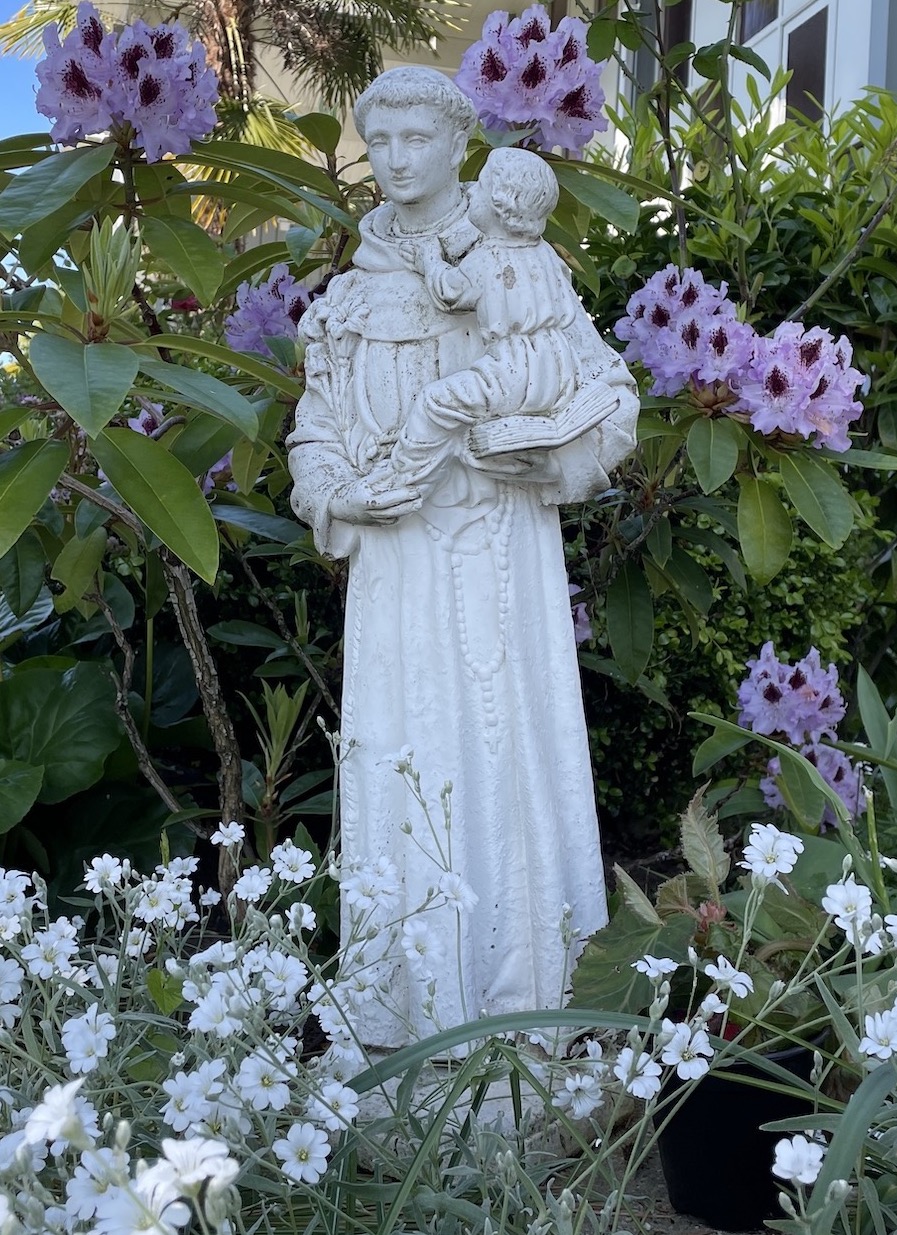 St. Anthony of Padua — a Franciscan friar and the patron saint after whom our parish is named — is a man worthy of serving as an inspiration to all of us for his selfless devotion to our Lord in his preaching of the gospel and service to the poor.
There is actually another famous St. Anthony celebrated by the Catholic Church — St. Anthony of Egypt, who lived about nine centuries before the one who has lent his name to our parish. When St. Anthony’s, West Vancouver, was first established as a mission in 1921 a wealthy patron from Eastern Canada requested our church be named after his favourite saint.
St. Anthony of Padua is known as one of the most celebrated followers of St. Francis of Assisi, founder of the Order of St. Francis.
Our St. Anthony was born in 1195 in Lisbon into a rich and powerful Portuguese family. His life, which lasted only 36 years, can be divided into three distinct phases. He lived 15 years with his parents, 10 years as a Canon Regular of St. Augustine — primarily at Coimbra, Portugal — and 11 as a member of the Order of St. Francis.
During his time in Coimbra, Anthony was so impressed by some of the Franciscan monks who visited there before being martyred in Morocco that soon after in 1220 he asked to be allowed to join the Friars Order, taking the name by which we know him today (he had been baptized at birth as Ferdinand).
After joining the Franciscan Order, Anthony sailed for Morocco in hopes of continuing his mission with his new order. Unfortunately, he was soon struck by illness and was forced to return to Portugal. During the intended voyage home, his ship was driven by a storm onto the coast of Sicily where he remained for some time until he recovered his health.
St. Anthony eventually made his way to Assisi in Italy where his knowledge and contemplative nature attracted the attention of St. Francis himself, who chose him to teach theology to the friars in Bologna and Padua. Whether St. Anthony and St. Francis actually met face-to-face is a matter of debate among religious scholars. However, what is known is that St. Anthony was sent to France a few years later where he began preaching and teaching. It was during this period of his life that his reputation as a charismatic orator began to spread. His fame was such, it is said he drew crowds so large he often spoke in market places rather than in churches.
He was especially noted for attacking the vices of luxury, avarice and heresy.… Read more “About St. Anthony”
Don’t be possessed by possessions
Greed is a sickness of the heart. Pope Francis called greed “that form of attachment to money that keeps a person from generosity.”
He continued, saying, “to heal from this sickness, the monks proposed a drastic, though highly effective method: meditation on death. As much as one can accumulate goods in this world, we can be absolutely sure of one thing: they will not enter the coffin with us. We cannot take property with us! Here, the senselessness of this vice is revealed. The bond of possession we create with objects is only apparent, because we are not the masters of the world: this earth that we love is in truth not ours, and we move about it like strangers and pilgrims.”
Life is a journey, and it is very important to set our hearts on our eternal destination. St. Gregory the Great put it this way: “whatever you possess must not possess you; whatever you own must be under the power of your soul; for if your soul is overpowered by the love of this world’s goods, it will be totally at the mercy of its possessions. In other words, we make use of temporal things, but our hearts are set on what is eternal. Temporal goods help us on our way, but our desire must be for those eternal realities which are our goal.”
He also said, “be not anxious about what you have, but about what you are.”
Greed is frequently mentioned in the Scripture. Of Christ’s 38 parables in the Gospels, 16 are concerned with the handling of money and possessions. St. Paul wrote, “For the love of money is a root of all kinds of evils.” (1 Tim. 6:10)
Wealth can create a false sense of security; we can only find true security in our faith in Christ. Pope Francis called greed “an attempt to exorcise fear of death: it seeks securities that, in reality, crumble the very moment we hold them in our hand.”
We are created for God and material wealth can never satisfy us. St. Bernard used a very vivid image to describe this. “Suppose you saw a starving man inhaling great deep breaths, filling his cheeks with wind to stay his hunger; would you not call him mad? And it is just as mad to think that blowing yourself out with earthly goods can satisfy your hunger.”
Wealth can’t satisfy our hearts. St. Isidore of Seville observed: “Cupidity never knows how to be satisfied. The greedy man is always in need; the more he acquires, the more he seeks, and he is tortured not only by the desire of gaining, but by the fear of losing.”
Archdiocese and First Nation pledge ‘meaningful steps towards healing’ through Sacred Covenant
Looking to the future with hope was the clear message presented by the Archdiocese of Vancouver and the Kamloops First Nation (Tk’emlúps te Secwépemc) as the two signatories of the Easter Sunday Sacred Covenant held a press conference Wednesday.
The full document was released in English and Chinook for National Indigenous Peoples Day, June 21, with a promise to answer questions at Wednesday’s press conference.
Archbishop J. Michael Miller and Kamloops Chief Rosanne Casimir addressed the release of the covenant, saying they are committed to focusing on the future and moving forward together.
The covenant “affirms that all the signatories seek to build on official Catholic teaching support” for the rights and the freedoms of Indigenous people, said Casimir.
“It’s about relationships,” she said. “It’s about making some meaningful steps towards healing. We can’t do that alone, we have to do it in partnership.”
Answering a reporter’s question about whether the covenant has set a precedent for future engagement between the Catholic Church and Indigenous communities, Casimir said she believes “that it sets a lot of precedents.”
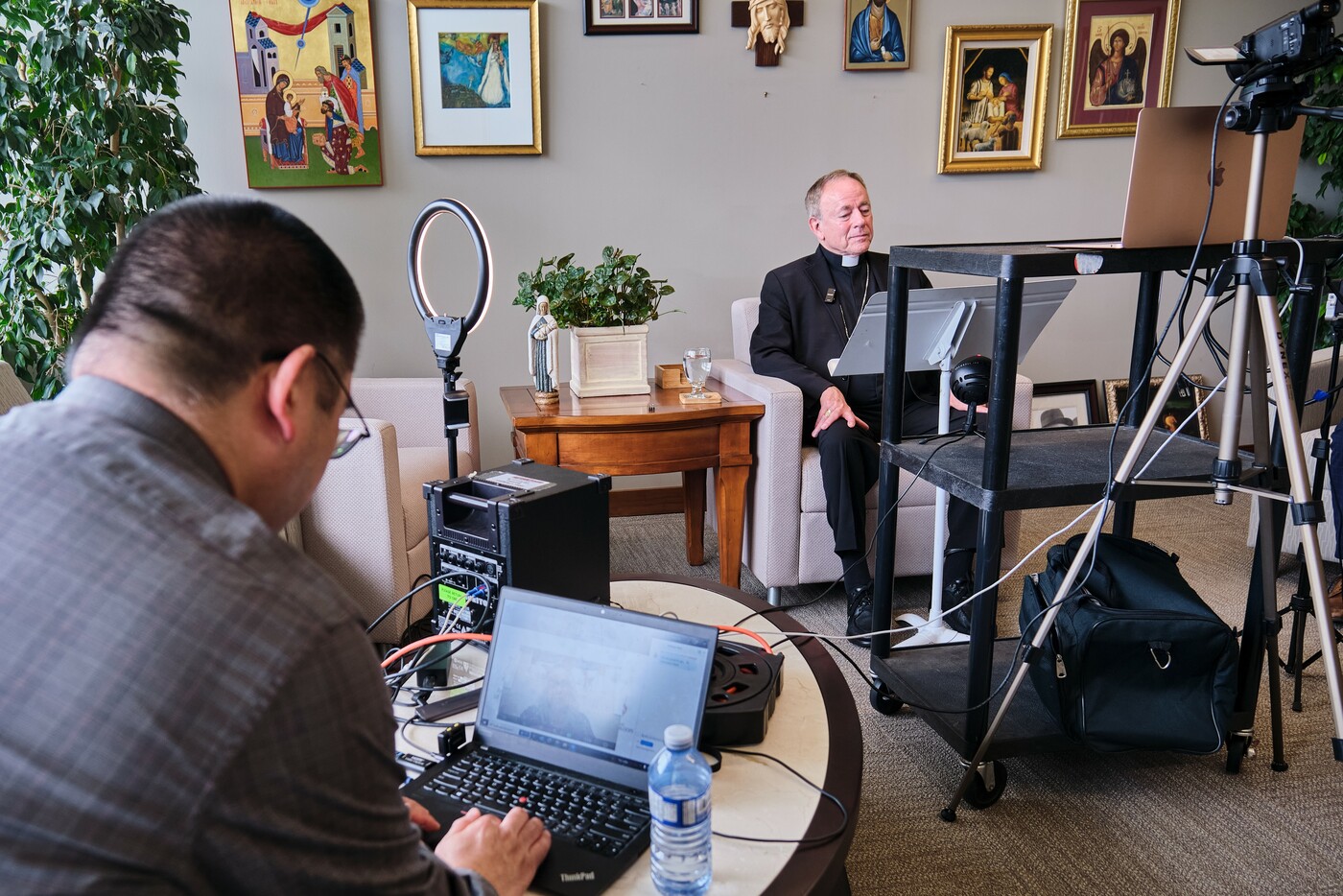
“We also need to take those meaningful steps to provide opportunity for those to find justice, but also to find healing. It takes everybody at every level to be walking that path and journey together,” she said.
“I would encourage others to build and establish those relationships to take those meaningful steps,” said Casimir.
Archbishop Miller agreed, saying Canada’s bishops are looking for ways to make the covenant a possible template to help the Church “enter into healing relationships with the First Nations communities of which they form a part. We have a lot to do.”
He reiterated the acknowledgement of harm to the First Nation from the Indian Residential School system. “The Church was wrong in how it complied in implementing a government colonialist policy that resulted in the separation of children from their parents and their families. Even the most ardent skeptics must know that a system requiring or pressuring the separation of families would have tragic consequences.”
In answer to a question about making possible financial reparations, the Archbishop said that while the covenant is meant to help heal the spiritual and communal rift between the church and First Nations, monetary support is ongoing across the country through truth and reconciliation grants, with nearly 20 approved in the Archdiocese of Vancouver.
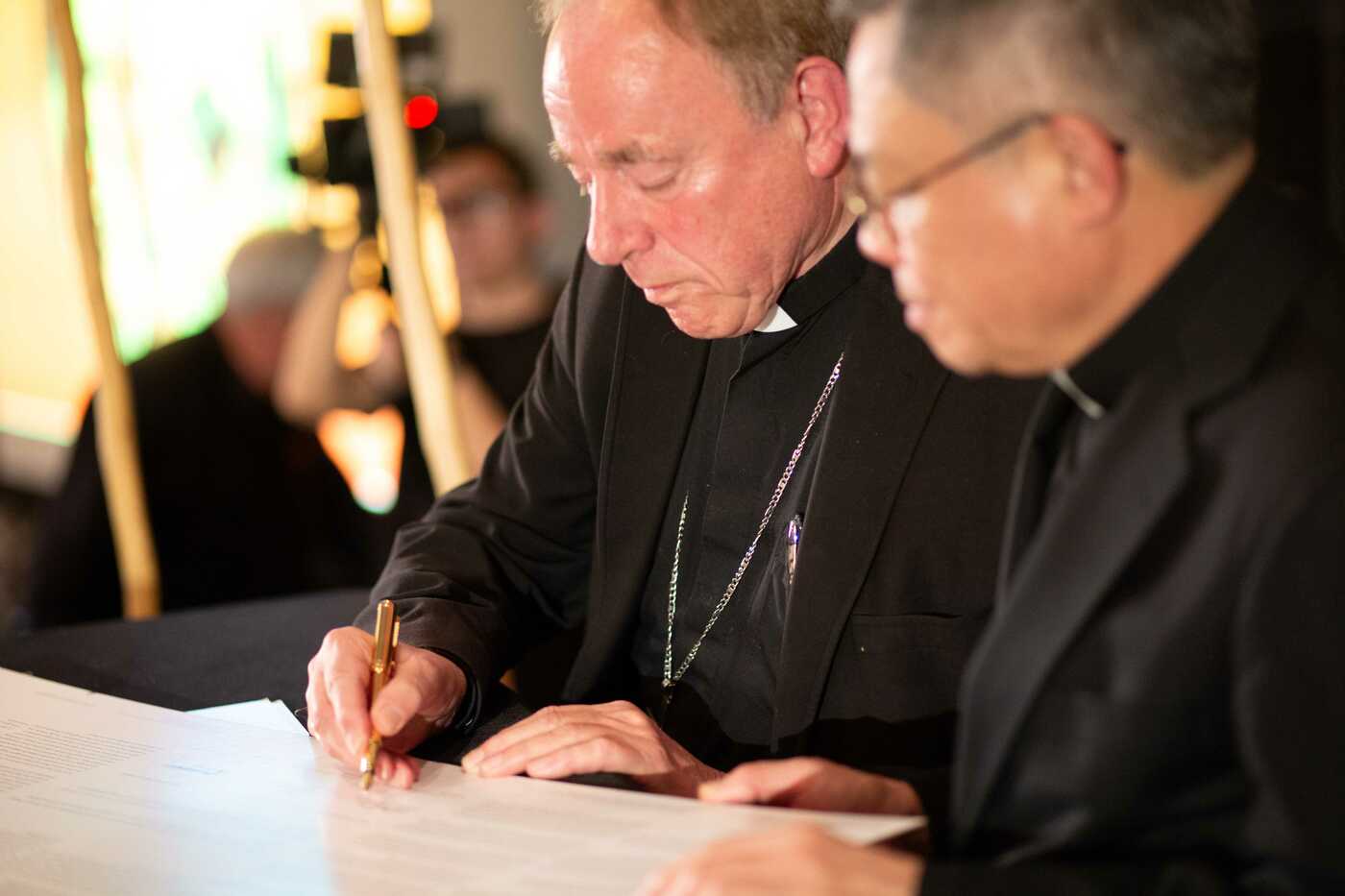
Interfaith call for greater protection for religious institutions is timely, says Vancouver rabbi
Vancouver Archbishop J. Miller and a Vancouver rabbi are welcoming the call by an alliance of faith communities for more robust protection of religious institutions.
At a June 18 news conference on Parliament Hill, the Canadian Interfaith Conversation (CIC), an alliance of faith communities working to combat hate based on religious identity, issued an urgent call to action for the protection of all faith groups from such attacks.
Archbishop Michael J Miller told The B.C. Catholic “the CIC statement takes a strong stand in its recommendations to the Canadian government. At bottom is the need for citizens and governments at every level to ensure the safety and security of adherents to every faith tradition as well as recognized the positive role that religion plays in the public life of our nation.”
A Vancouver rabbi says the interfaith declaration is timely.
“I think that in a time period in which the Jewish community and synagogues have been under attack physically in Canada, it is important that the entire interfaith community comes together to call for the protection of all houses of worship,” Rabbi Infeld of Vancouver’s Synagogue Beth Israel told The B.C. Catholic.
Highlighting the role of religious communities in building bridges, Aakash Maharaj, ambassador-at-large of the Ottawa-based Global Organization of Parliamentarians Against Corruption and member of the executive council of CIC, said: “Faith communities share a deep reverence for and commitment to the dignity of every human being and for the sacredness of humanity and creation. Hate ignores and undermines that dignity and sacredness, and has no place in Canada.”

Attacks against religious communities are “only a Jewish community problem,” said Richard Marceau of the Centre for Jewish and Israeli Affairs. “All other faith institutions deserve as much protection.”
Shaila Carter, co-chair of CIC and interfaith specialist at Islamic Relief Canada, said Canada should be a safe environment for people to practice their faith freely and happily.
“As the daughter of (Bangladeshi) immigrants I am here to build bridges between people, to combat hate in solidarity with other faiths and to promote love. As women, we should be able to wear our head scarves if we choose to.”
The CIC statement, signed by 60 representatives of Christian, Jewish, Muslim and Baha’i communities, outlined four recommendations for the government of Canada. In addition to stepping up security measures for all religious institutions including houses of worship, schools, daycare centres, community centres and cemeteries, it called on the government to:
- support Canadian interfaith efforts to provide non-sectarian medical and humanitarian aid to victims, especially child victims, of international conflicts through reputable and trustworthy organizations as a means of advancing peace-building efforts abroad and social solidarity in Canada;
- introduce a comprehensive strategy to foster understanding about online hate based on religious identity; and
- ensure, in collaboration with other levels of government, that hate crime units are informed about hate based on religious identity in every law enforcement service, so that targeted groups can feel safe, heard and respected.
Archdiocese and Kamloops First Nation release Sacred Covenant on Indigenous Peoples Day
The Sacred Covenant signed on Easter Sunday by the Archdiocese of Vancouver and Kamloops First Nation was made public on Friday, National Indigenous Peoples Day.
In a statement, the Archdiocese and the Tk’emlups te Secwepemc said the date was chosen to share the document in English and Chinook, “an important common language among First Peoples and settlers arriving from many countries.”
Chinook was a trade language promoted by Father Jean-Marie Raphael Le Jeune, OMI, and Tk’emlups and other elders, according to the statement.
Father Le Jeune was an Oblate missionary priest who supported BC First Nations in the 19th century and is referenced in the covenant. Kamloops Chief Rosanne Casimir said the nation had the goal of “fostering healing and reconciliation and countering targeted skepticism and denial” when it chose to work with Catholics and allow Church leaders to publicly acknowledge past wrongs, especially those from the Catholic Church’s role in administering many of the residential schools. She said the Tk’emlups te Secwepemc remain “steadfast in their sacred duty as guardians to and advocates for the children who died and were harmed while they were students at the Kamloops Indian Residential School.”
With staff working on a “multidisciplinary investigation” and on construction of a Healing House for Survivors, she said she is “committed to ensuring Survivors and Intergenerational Survivors are supported on their healing path.”
An online press conference has been called for Wednesday, June 26, where representatives of the Archdiocese and the First Nation will be answering questions.
The text of the document follows.
SACRED COVENANT
between
TK’EMLÚPS TE SECWÉPEMC NATION
ROMAN CATHOLIC ARCHDIOCESE OF VANCOUVER
ROMAN CATHOLIC DIOCESE OF KAMLOOPS
ON THE 31ST DAY OF MARCH
2024
WHEREAS the people of the Tk’emlúps te Secwépemc Nation desire that the historical truths regarding the Kamloops Residential School be shared and that a path to healing be set out clearly in this sacred Covenant.
WHEREAS the Archdiocese of Vancouver and the Diocese of Kamloops acknowledge the deep flaws in the Residential School system, their part in the resulting tragedies and the desire to journey with the people of the Tk’emlúps te Secwépemc Nation on a path to healing and understanding.
WHEREAS all Parties seek to build on official Catholic teaching supporting the rights and freedoms of Indigenous people and the promising historical relationship held between Fr. Jean-Marie-Raphael Le Jeune, Chief Louis Clexlixqen (Xlexléxken) and Chief Johnny Chiliheetza (Ts̓ elcíts̓ e7).
WHEREAS the purpose of this sacred Covenant is to establish our shared path to reconciliation and to reflect our mutual belief that honour, truth, justice, and healing are necessary to guide our future.
Therefore, the Parties agree as follows:
HISTORICAL PRECEDENT FOR A SACRED ACCORD
1.