
Thousands of errors found in B.C. MAiD cases, internal report shows
VANCOUVER (CCN) — An internal B.C. government document obtained by Canadian Catholic News through a freedom of information request shows doctors, nurse practitioners and pharmacists in the province made thousands of errors in managing euthanasia in 2024.
According to the report of the Ministry of Health, more than half of all MAiD cases in B.C that year were found to have had errors requiring government follow-up.
Page 3 of the “Medical Assistance in Dying (MAiD) Oversight 2024 Year End Report” states 4,169 individuals requested MAiD in 2024 — a nearly 10 per cent increase since 2023.
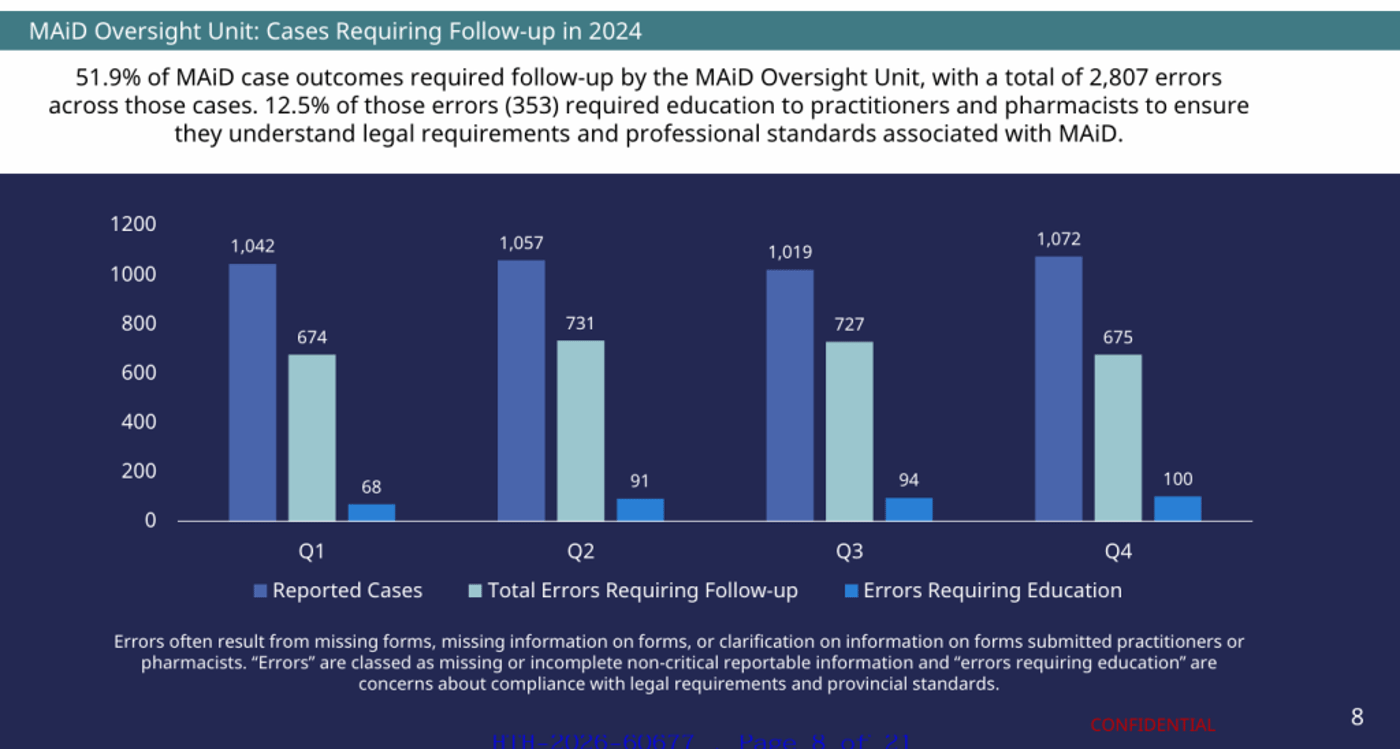
However a bar graph from the report, included with this article, indicates a total of 4,190 MAiD cases in 2024. It also indicates the MAiD Oversight Unit found 2,807 errors among 51.9 per cent of “MAiD case outcomes” requiring corrective “follow-up.” The report says “follow-up” means obtaining missing information or clarifying existing information.
Among these thousands of errors, 353 cases — or about 12.5 per cent — raised compliance concerns and “required education” of practitioners and pharmacists “to ensure they understand legal requirements and the professional standards associated with MAiD,” the report says.
Other data associated with 4,169 total MAiD cases indicate 72 per cent of these individuals died by MAiD; 23 per cent died of other causes, and 4 per cent were found ineligible to access MAiD. Only 1.4 per cent of individuals withdrew their request.
The 2024 findings closely mirror those from 2023, which included 2,833 errors in the management of 3,808 MAiD cases, as reported in The B.C. Catholic last year. These findings suggest that concerns identified in 2023 persisted in 2024.
“It’s all very shocking that you have such a large amount and percentage of errors in British Columbia,” said Alex Schadenberg, executive director of the Euthanasia Prevention Coalition, based in London, Ontario. “It’s clear there are huge problems.”
The situation is particularly acute because B.C. leads the country in percentage of deaths caused by MAiD, Schadenberg told CCN. In 2024, 6.5 per cent of B.C. deaths were attributed to euthanasia, compared with the national average of 5.1 per cent.
Amanda Achtman, ethics director of Canadian Physicians for Life, said the report has troubling implications, indicating MAiD is not medical care “but rather abandonment.”
“The staggering level of errors surrounding the practice of euthanasia in Canada betrays a level of indifference and callousness toward Canadian patients at end of life,” Achtman said in an interview.
‘It feels sort of surreal’: Seminarian prepares for diaconate ordination
With great joy, the Archdiocese of Vancouver has announced the diaconal Ordination of Jerome Robles. The ordination will take place through the laying on of hands and the invocation of the Holy Spirit by Archbishop Richard W. Smith on Friday, October 16, at Holy Rosary Cathedral.
Robles, who currently serves at Corpus Christi parish in Vancouver, told The B.C. Catholic, he is excited for the diaconal ordination. “It’s been a long time coming for me,” he said. “So it feels sort of surreal.”
“I have a lot of gratitude to God, to the archdiocese and to my formators,” he said. Adding that he appreciates the contributions of all the communities he has been blessed to serve through his time as a seminarian.
The faithful are warmly invited to attend the ordination and join in prayer for Jerome as he prepares to serve the Church as a deacon.
View original post at BC Catholic
Author: {authorlink}
Posted on July 8, 2026… Read more “‘It feels sort of surreal’: Seminarian prepares for diaconate ordination”
Former Freemason and Catholic convert celebrates Nordic bishops’ clarification on Freemasonry
Before his conversion to Catholicism, EWTN Norway’s editor-in-chief, Pål Nes, was a Freemason. But when he joined the Catholic Church, he left Freemasonry behind.
The Nordic bishops, as well as the Church’s hierarchy, agree: A formal association with Freemasonry is incompatible with Catholicism.
But this issue, which has come up in public conversation among Catholics around the world, is often controversial in the Nordic countries of Denmark, Finland, Iceland, Norway, and Sweden, where some mistakenly believe that there is an exception to the Catholic Church’s instruction.
This week, the Nordic Bishops’ Conference clarified the teaching.
“We write to you at this time as shepherds to clarify a matter that for many years, if not decades, has generated uncertainty, speculation, and diverging opinions in our countries: the question of whether or not Catholic faithful in the Nordic countries may be Freemasons or belong to a Masonic lodge,” the bishops wrote.
In the June 29 letter to parish priests signed by Nordic Bishops’ Conference president Bishop Erik Varden of Trondheim and others, the bishops stated that there is “no exception” for Catholics in Nordic countries from the “universal law of the Church” regarding Freemasonry.
The Nordic bishops had met with officials from the Dicastery for the Doctrine of the Faith during a plenary assembly in Rome from Sept. 1–5, 2025, to discuss the matter. The dicastery’s response was unequivocal.
The bishops said the Church’s teaching applies “in full and without exception in the territory of the Nordic Bishops’ Conference.”
The letter is not to detract Freemasonry but rather a clarification that its principles clash with those of the Church, according to the bishops.
“We wish to stress that the Catholic Church’s firmness on the question of adherence to Freemasonry is not a negative judgment on the goodwill or good works of individuals,” the bishops wrote.
“The Church’s position springs from awareness that the theological and philosophical principles of freemasonry are incompatible with confession of the Catholic faith,” the bishops said.
Nes told EWTN News the bishops’ statement helped give clarity on the issue in his home country of Norway.
“Their statement gives priests and lay faithful the clarity that many of us have needed for a long time,” he said.
Nes has seen confusion in his home country, largely because of “a myth developed that the Scandinavian form of Freemasonry was somehow an exception, and that Catholics in the Nordic countries could belong to a lodge without contradicting the teaching of the Church.”
Canadian aid groups mobilize Venezuela earthquake relief
Disaster response teams are continuing to deploy to Venezuela and ongoing relief efforts from organizations around the world is pouring in as the death toll from the devastating earthquakes surpasses 1,450, with tens of thousands reported missing and more than 12,700 people finding themselves displaced.
Canadian organizations have launched fundraising appeals to aid survivors of the two June 24 earthquakes that struck northwestern and central Venezuela, specifically in the city of San Felipe in Yaracuy. The first shock was measured as a 7.2, followed a minute later by a 7.5 mainshock. Both caused widespread damage across Venezuela, namely throughout La Guaira and Caracas, with 46,600 currently reported missing.
Today, rescue efforts for survivors are still taking place. While promising reports are emerging, including a 21-year-old man having been pulled from rubble in Venezuela’s La Guaira state after being trapped for 106 hours according to acting president Delcy Rodríguez, rescuers remain in “critical hours” to save lives, says national assembly head Jorge Rodríguez.
Just two days after the initial tremors, Canadian Jesuits International launched an appeal for donations to support humanitarian relief efforts in the region. It was reported that Jesuit Refugee Service, Fe y Alegria and other CJI Jesuit partners in Venezuela were already on the ground to provide emergency support to individuals and families affected with temporary shelter, relief items, protection services and psycho-social support.
While the CJI team continues its rapid assessments in the affected areas to identify most urgent needs through their long-standing partners in the country, further donations will allow for a quick response toward life-saving assistance and accompaniment toward affected communities.
The Government of Canada released a statement of solidarity for the people of Venezuela, saying that “while the full scale of the tragedy is still unknown, it may affect hundreds of thousands of people, and humanitarian efforts must be urgently scaled up to ensure life-saving assistance reaches those most in need.”
On June 25, Minister of Foreign Affairs Anita Anand and Secretary of State (International Development) Randeep Sarai announced Canada would provide an initial $5 million in humanitarian assistance funding to support emergency relief efforts in Venezuela — building on the $4.5 million in ongoing humanitarian assistance funding allocated by Sarai earlier this year to respond to the needs of the country.
The release confirmed that the Canadian government will continue to monitor the situation and remain in contact with its partners to “assess and respond to evolving needs over the coming days and weeks ahead as the needs become clearer.”
A day later, Development and Peace – Caritas Canada announced its initial contribution of $50,000 to help local partner Caritas Venezuela respond to the emergency, while calling on Canadians to give generously to ongoing support ventures.
The Priest Who Had to Lose Golf to Find God
A little over a century to the day, golfer Bobby Jones prepared to hit an iron shot out of the rough on the 11th hole of Worcester Country Club during the first round of the 1925 U.S. Open. During his routine, Jones felt his club move the ball slightly from its set position. While no one else seemed to notice, the amateur golfer, sure that he had committed a foul, chose to penalize himself.
The decision would go on to cost Jones the title, giving way to the now infamous line, “You might as well praise me for not robbing a bank,” a line he dropped when thanked for his morality. Today, Jones’ decision during the major tournament remains one of the most celebrated examples of fair play in all of sport, let alone golf.
Some may note Jones’ integrity as a reflection of his faith, having been raised a devout Baptist in his family tradition. Three days before his death in 1971, he converted to Catholicism and received the sacraments as an act of love for his wife, a devout Catholic.
In more ways than the faithful might realize, the game of golf has long held rich parallels to the faith — whether in its unique rhythms and rituals, constant patience, radical honesty with oneself or even moments of grace in Jones’ case. As the 126th edition of the U.S. Open teed off on June 18, Fr. Richard Conlin shared his insights on the comparison as someone with a truly unique read of it.
“ Growing up, golf became the most important thing in my life. It was the one thing that was truly all-consuming. It was an idol or a god in my life, and my whole world revolved around the game of golf,” Conlin said.
“If golf was good, life was good, but if golf was bad, my life felt horrible. My identity and my purpose and my mission, everything revolved around the game of golf.”
Thanks to his all-consuming commitment to the sport, Conlin would eventually go on to play high-level college golf at St. Mary’s College in California on an NCAA Division 1 scholarship as well as for Team Canada’s National Golf Team. Despite a strong final college year — where he was St. Mary’s top finisher in four of the 10 events he played in — and a strong consideration to turn pro, Conlin was slowly coming to terms with the truth of “what we idolize, we eventually despise.”
“ I started to realize that God never wanted me to view the game of golf in that way, and I remember one of my retreat directors said with a big smile, ‘Rich, don’t you know that God had to ruin your golf game?’
Our Lady’s Sentinel: Tales of Churchill, thunderstorms, and a roast pig
The first edition of Our Lady’s Sentinel reached its readers in September 1943 just as the Allied invasion of Italy was commencing, and the Soviets were pushing ever deeper into Ukraine. On the first page, there is an editor’s note which reads:
“This little effort is to let you know that you are in our thoughts and prayers daily. We hope that you will find it interesting as it brings you each month a glimpse of [Our Lady of Perpetual Hope].”
That “little effort” lasted twenty-seven months, and the publication only stopped when the war had been won and the men were on their way home. All twenty-seven issues can now be found in the digitized print collection of archives of the Archdiocese of Vancouver.
Our Lady’s Sentinel was the brainchild of Jim O’Loane and pastor, Redemptorist Father James Farrell, C.Ss.R., who, in August 1943, decided the deployed enlisted men from Our Lady of Perpetual Hope in Vancouver needed something to keep their spirits up. Additionally, their mothers were worried, and everyone was anxious for news about their whereabouts and safety.
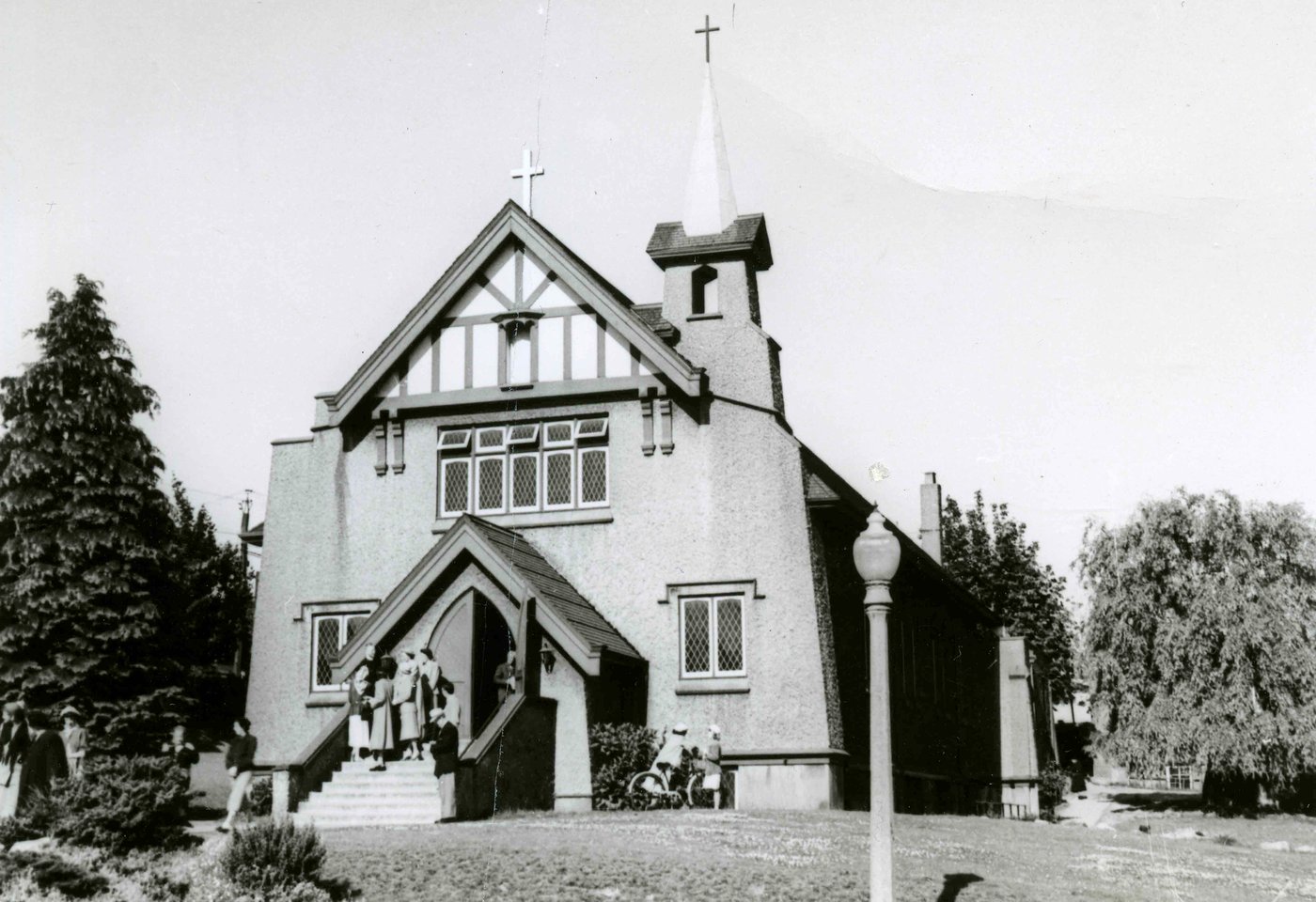
“Every mother was comparing with every other mother about what was going on, and where their sons were,” O’Loane’s daughter, Patricia Lambin, told The B.C. Catholic. Rather than having them confer amongst themselves, “he thought they should just contact him,” she said. “My dad took that on as a real project for the parish.”
With that, their family house became a news office, with the network of parish women serving in place of dedicated reporters. Phone calls and ringing doorbells would announce the arrival of more news: “so-and-so was stationed here; so-and-so is being deployed over there.” Mothers talking to mothers fed the paper a steady stream of intel which would be the envy of any wartime intelligence agency.
Lambin, nearly ninety-nine, remembers working on the paper—at fourteen years old, she and the other girls from the parish would crowd into their basement ping-pong room to help cut the latest issue.
Father Farrell was the driving force behind the paper. “I remember from the time I was about 13, he was gathering news,” Lambin said. “He almost camped at our house!”
Lambin remembers how he used to care for the young women of the parish. “With the young women left behind, he was either comforting them or taking them roller-skating to get them some entertainment,” she said.
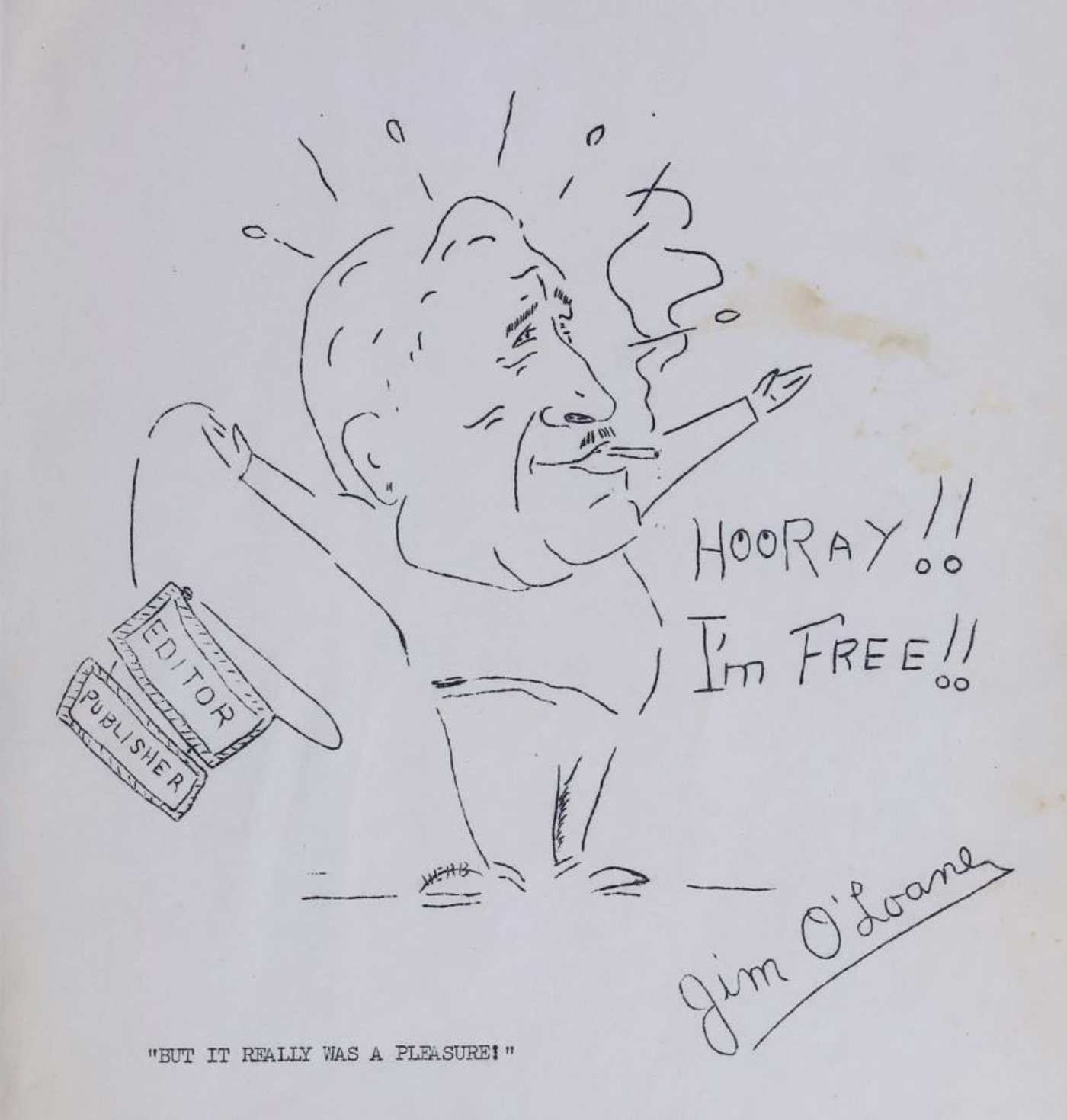
In his final editor’s letter, published December 1945, O’Loane pays homage to the energetic priest: “To Father Farrell,” he writes, “that tower of strength, without whose willing and able assistance at all times, the Sentinel would never have flourished as it did.”
Archdiocese of Vancouver and The B.C. Catholic win 22 Catholic Media Association awards
The Archdiocese of Vancouver has received 22 awards from the Catholic Media Association, recognizing the work of The B.C. Catholic and the communications team’s excellence in print, digital media, photography, social media, video, and fundraising communications.
The B.C. Catholic earned top honours, receiving multiple first-place finishes and recognition across reporting, photography, and editorial work.
The B.C. Catholic placed second for best diocesan newspaper, and Judges praised the paper’s strong reporting, clear writing, and engaging presentation, noting its ability to make complex topics accessible to readers.
“The B.C. Catholic serves its audience very well,” wrote the judges. “Where others lean more heavily on wire copy, this staff produces an array of relevant new and interesting features that resonate with its readers.” Judges also singled out the quality of the paper’s writing and photography.
The paper won awards for its Lunar New Year’s supplement and Christmas edition.
Among the individual recipients, The B.C. Catholic’s Terry O’Neill won first place for the Gerard E. Sherry Award for Best Analysis/Background/Round-Up News Writing for his coverage of Medical Assistance in Dying in Canada, and first place for Best In-Depth News/Special Reporting — Diocesan Weekly.
O’Neill also earned second place and third place in Best Investigative News Writing for his reporting on the financial incentives behind euthanasia and the broader MAiD system in Canada.
O’Neill was praised for his “well-investigated” and “well sourced” reporting. Judges were impressed, noting his tremendous understanding of the proliferation of euthanasia in Canada and British Columbia.
O’Neill also earned an award for the work he did through the Canadian Catholic News service, reporting on St. Paul’s Hospital.
Paul Schratz received third place for editorial writing on a local issue for his piece, ‘Silent Night at City Hall’.
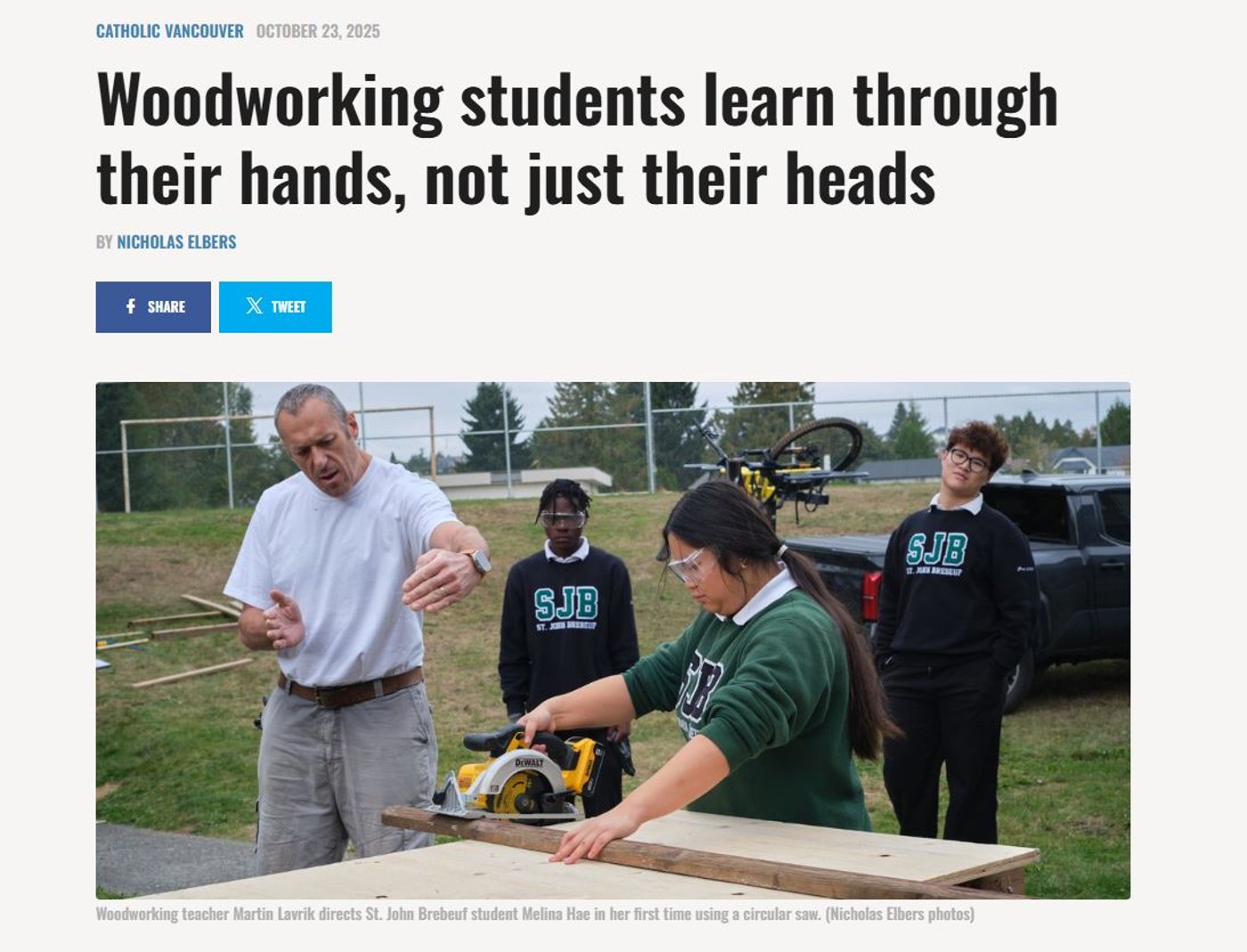
In the photography categories, The B.C. Catholic’s Nicholas Elbers won first place for his photo package documenting the annual Our Lady of Fatima Grotto pilgrimage in Mission and second place for a combined story and photo feature on St. John Brebeuf Regional Secondary School’s woodworking program.
Elbers also received two honourable mentions: one for a portrait of Sacred Heart Parish pastor Father Ray Smith and another for a photograph of a young altar server in training during a Catechesis of the Good Shepherd event.
The Archdiocese of Vancouver’s communications team was also recognized with eight awards. The team received first place for the Vancouver Archbishop social media account, which documented the transition from Archbishop J. Michael Miller to Archbishop Richard Smith, as well as first place for its coverage of the Jubilee Year.
The communications office also received second place for the main Archdiocesan social media account, along with several third-place finishes in digital communications, video, and fundraising categories.
One Sword, One Angel: The God Who Chooses Differently
St. Luke is consistently fond of presenting events in pairs and contrasts. The Gospel of Luke pairs the Annunciation and the birth of John with that of Christ; it pairs Simeon and Anna at the Presentation; it balances Stephen the martyr-deacon with Philip the missionary-deacon (chapters 7-8); it sets the conversion of Paul alongside the conversion of Cornelius (chapters 9-10). Now, in chapter 12, two apostles are set before us: James and Peter — one martyred, one miraculously delivered. The contrast mirrors that between the martyrs who shed their blood and confessors who spent their lives giving witness; both are paths of apostolic fruitfulness, chosen differently by the same God.
Herod Agrippa — the third of the Herod dynasty to persecute God’s holy ones (after Herod the Great, who massacred the Holy Innocents, and Herod Antipas, who beheaded John the Baptist) – had James, the brother of John, executed by the sword. James thus becomes the first of the Twelve to be martyred.
Tradition holds that before returning to Jerusalem, James had preached the Gospel in Spain. After his martyrdom, his body was transferred there and eventually discovered by a hermit; the site of his burial became one of the three great pilgrimage destinations of the Middle Ages, alongside Rome and Jerusalem. The Camino de Santiago, walked by millions to this day, is the living legacy of that tradition. St. James is the patron saint of pilgrims.
This is fitting: the Lukan theme of ‘the Way,‘ of life as a journey and pilgrimage, finds expression in all three of the great medieval pilgrimage sites. Jerusalem and Rome are both settings of the Acts of the Apostles. Spain enters the story through the martyrdom of James in chapter 12. Life is indeed a pilgrimage, and our final destination is heaven.
Seeing that James’s execution pleased the opponents of the apostle, Herod arrested Peter during the days of Unleavened Bread. Peter was held under maximum guard: four squads of four soldiers, chained between two guards, with two more at the door. The scene is deliberately Passion-like: as Christ hung between two criminals, Peter lies between two soldiers; as Christ was in the darkness of death, Peter is in the darkness of the dungeon.
The Church’s response to this darkness is instructive. There was no plan, no human strategy. What did they do? They prayed — earnestly, persistently, together. St. Luke’s Gospel already gave us the pattern: ‘Being in agony, he prayed the more earnestly‘ (Lk 22:44). This is the model for every Christian facing darkness: not distraction, not despair, but more earnest prayer.
The angel’s action is also laden with symbolism.
Creativity As a Spiritual Discipline
The Book of Genesis begins with a sweeping picture: God, in His grandeur, breathes life into the universe. Mountains and hills are formed, seas are poured out, skies are fixed in place, and all of it is filled with swarms of life. It’s into this creative symphony that God forms human life from the dirt – Adam and Eve, the first humans we meet in the Bible. Genesis records God giving these people a surprising command: “The Lord God took the man and put him in the garden of Eden to till it and keep it” (Genesis 2:15 NRSV).
This command is interesting because there’s a subtle implication behind it – the garden requires tilling and keeping. In other words, the world that God made for man and woman is beautiful, majestic, perfect even, yet also raw and wild. The garden is good, certainly, but it hasn’t been brought to its fullest expression. It requires cultivation – for people to bring something out of it.
Later, when Adam and Eve rebel and fall to the temptation of the serpent, God tells Adam that his work will be cursed, that he will have to toil painfully to get anything from the ground. He doesn’t say that his work is bad. The command to cultivate and create came before the curse, not after. What does this mean for those of us who consider ourselves to be “creatives?”
In his book Garden City, pastor and theologian John Mark Comer paints a picture of salvation history that feels a little bit different than what many of us are used to hearing. He begins with the raw material of Eden and the command to cultivate and finishes the book by describing the Heavenly City in the last book of the Bible, Revelation. Comer notes that there are several similarities between Eden and the Heavenly City: both feature a river of life, a tree of life, precious stones and gold, and as being on top of a sacred mountain.
In Comer’s reading, it would seem that the Heavenly City is the Garden of Eden in its cultivated state – the fulfillment of God’s command to till and keep the earth. What matters for creatives is the work that occurs in between.
It may be difficult, yes, even cursed, but it is more significant than many of us give this work credit for. It can be easy to fall into the belief that creative work (or any work for that matter) doesn’t have anything to do with our spiritual lives. Nothing could be further from the truth. If we take this reading of Scripture to be true, then our creativity is in fact a fulfillment of one of God’s first commands to the human race.
Parliament passes Bill C-9 into law
The Combatting Hate Act, the controversial piece of legislation that abolishes the longstanding sincere religious text defence from Canada’s hate speech laws, completed final passage on June 17.
After teaming up to vote down the Conservatives, NDP and Green Party MP Elizabeth May’s final attempt to discard Bill C-9, the Liberals and Bloc Québécois jointly approved the lone Senate amendment to the bill.
The only change the upper chamber made was adding the noose to the list of hate-motivated symbols that will be prohibited in the civic square 30 days after Bill C-9 receives royal assent. The other core provisions of the Combatting Hate Act are creating indictable offences for acts of intimidation and obstruction outside places of worship and establishments used by an identifiable group for a specific purpose.
These central measures have been overshadowed in the public discourse about Bill C-9 since early December when the then minority governing Liberals agreed to a late-breaking Bloc Québecois amendment to scrap Section 319(3)(b) of the Criminal Code, a narrow safeguard that stood since 1970.
Faith groups fear someone could be prosecuted under the new law for holding a sincere religious belief based on their faith’s teachings.
Upon reflection, the encapsulating quote of the Combatting Hate Act’s nine-month journey through the corridors of power in Ottawa may belong to Senator Andrew Cardozo of the Progressive Senate Group.
“If people of good faith and people of goodwill hate the law to combat hate, have we failed as a Parliament and can we not do better,” asked Cardozo on June 4 during the debate preceding the Senate’s third reading vote.
The expungement of the religious text defence indeed attracted widespread backlash from faith leaders, legal experts, civil society organizations, labour groups and concerned citizens.
Paul Lawton, director of grassroots action for the Association for Reformed Political Action (ARPA) Canada, expressed displeasure at how the government ultimately disregarded the wishes of this unprecedented coalition.
“We are disappointed by the government’s insistence on removing the religious defence clause in the face of so much public opposition,” said Lawton. “Canadians logged hundreds of thousands of phone calls to MPs and Senators, sent them hundreds of thousands of postcards and attended countless rallies and events to express their opposition to Bill C-9. This is a sad day for freedom of speech and freedom of religion, not just for Christians, but for all Canadians.”
Minister of Justice and Attorney General of Canada Sean Fraser has strived to downplay the significance of Section 319(3)(b)’s removal by asserting that “freedom of religion is already fully and robustly protected under the Canadian Charter of Rights and Freedoms.”
Many have challenged that statement by suggesting freedom of religion and expression Charter rights were undermined during the COVID-19 pandemic (parish restrictions) and the 2022 Freedom Convoy protests.