
How leadership and conflict shape the Church
Acts 15 gives us one of the most important chapters in the New Testament, not because it is dramatic, but because it shows us something we might not expect: the Church growing the way any human community grows, through conflict that has to be worked through. The Church is both divine and human, and it is precisely in moments like this that the Holy Spirit leads her toward maturity.
By the time we reach chapter 15, the Gospel has spread well beyond Jewish Jerusalem, and more and more Gentiles are becoming believers. A group insists that these new believers cannot be saved without observing the Jewish ceremonial law: circumcision, the distinction between clean and unclean foods. Paul and Barnabas argue strongly against this, and the dispute is serious enough that it has to be settled in Jerusalem.
Even at the Council itself, there is real debate. In the end it is Peter who resolves the question, appealing not to his own opinion but to what God has already done: God, “who knows the heart,” bore witness by pouring out the Holy Spirit on the Gentiles just as he had on the Jewish believers, making no distinction between them. To insist on circumcision now, Peter argues, is to place a yoke on the disciples’ shoulders that neither their ancestors nor they themselves had been able to bear. We are saved by the grace of the Lord Jesus, Jew and Gentile alike, in exactly the same way. After Peter speaks, the whole assembly falls silent.
This matters because of who is speaking and how. Peter is not offering one opinion among several; he is speaking as the head of the Church, the first Pope, exercising an authority that Christ himself entrusted to him. As the Catechism explains, the Magisterium exercises this authority most fully when it defines a truth that must be believed by the whole Church (CCC 88). Something similar happens centuries later: around A.D. 417, after Pope Innocent I upholds a decision of the African bishops, St. Augustine can say, in effect, that the case has already gone to the Apostolic See and come back settled — would that the error, too, would now end. Later writers summed this up simply: Rome has spoken; the case is closed.
It’s worth being precise here about what “infallibility” actually means, since the word gets thrown around loosely. It is not that popes cannot err — in their day-to-day, personal, even administrative decisions, popes are as capable of mistakes as anyone else. Something similar is true of the human authors of Scripture itself: Paul made mistakes; Peter erred seriously enough that Paul had to correct him face to face; Solomon, David, and Moses were all flawed men who made grave mistakes.
The Warnings of the Tower of Babel: A Reflection on Magnifica Humanitas
Since its release in May 2026, I have been delving into Pope Leo XIV’s first encyclical, Magnifica Humanitas (Magnificent Humanity). This document, subtitled “On Safeguarding the Human Person in the Time of Artificial Intelligence,” provides much-needed reflection and information for our current times.
This is not a document for those who regularly use AI in their work or social lives, or an article to be shelved for “later”; it is an encyclical for everyone, and an encyclical for “now.” As Matt Meeks states, Magnifica Humanitas “is not really a document about technology. Technology is certainly its subject, but humanity is its heart. More than anything, this is a profound meditation on what it means to be human and on the spiritual mission God has entrusted to us.”
There is no denying that, today, we are all affected by modern technology to varying extents. Likewise, there is no denying that, since the dawn of time, we have been human beings created in the image and likeness of God (Gen. 1: 26).
Pope Leo begins his document by comparing and contrasting two Old Testament stories, namely the Tower of Babel (Genesis 11: 1-9) and the Rebuilding of the Walls of Jerusalem (Nehemiah 2-6). The document proceeds with reflections on how we can use these stories inherent in salvation history, as both warnings and suggestions for how to seek God’s plans for us, as human beings living in this age of technological advancement.
As a Confirmation teacher, I often refer to the story of Babel in lessons with my students. As the children ponder the story of people in one community, working together to build a tower to reach all the way to heaven, they note that the people had become motivated by personal gain. Commonly, their reflections include references to “the same language,” the fact that people aimed to “make a name for [them]selves,” and the reality that God “confused their language.”
One of the most insightful comments I heard from a student was, “Just because we can do something, doesn’t mean we should.” To me, this statement alludes to the kind of understanding Pope Leo is intending to promote within his encyclical.
Regarding the Tower of Babel, Pope Leo states, “It was an impressive project conceived without reference to God, supported by a uniformity that eliminated diversity and that chose homogenization over communion. When a city is built on pride and the claim to self-sufficiency, communication breaks down, languages are confused and people no longer understand each other. The result is not unity, but dispersion. Babel thus reveals the limits of any effort that, however grandiose, arises from self-affirmation, sacrifices human dignity for efficiency and aspires to reach heaven without God’s blessing.”
I am Thirsty for More in my Prayer Life – What Should I Do?
In our human relationships when we ‘get closer’ with someone, it can feel genuinely lovely. We begin to feel more trust and more openness to vulnerability and emotionality. We may share more experiences and invest more time in these relationships. Our human psyche is wired for connection and love; we are wired for intimacy because of who our Creator is.
I believe this is also why when we have a growing relationship with God, we desire even more closeness with Him. And also why I think it can really hurt, even feel defeating at times, when it seems like He isn’t returning that closeness. Sometimes, I start to believe the lies that sound like: “God is not listening or speaking to me as a punishment for something because He’s mad me”, or “ He doesn’t have time for me”, or “He is holding out on me”.
Most recently, in this season of new motherhood, I have felt my prayer life do a complete 180. My son was an anomaly at first, sleeping through the night until he was about four months old. During this time, I still got up before him, prayed for an hour like I did before and loved every second of it. Then came the sleep regressions. The teething. The growing out of his bassinet. And all that came to a halt. I could not wake up before my baby. I was in survival mode. I remember crying and missing prayer, missing God, asking Him why I have this desire to be with Him but can’t seem to have the time. If I took an honest look at myself, I did not like who I was without time with God. And yet, I did not even try to open my Bible, I was on my phone more than anything else. I told myself I was too exhausted to pray. I was grumpy and content staying that way because I felt I had every justification to.
Yet my desperation moved me to surrender. There was a certain desperation for Jesus that I have never felt before. I tried praying during nap times. But sometimes my son wouldn’t nap or I had a work deadline to complete. I tried when the day was done, but sometimes I was so exhausted that I fell asleep putting my son to sleep. The promise to wake up before my son even for just ten minutes meant he woke up too.
How am I supposed to pray, contemplate, take time for silence when my days are filled with tears, a little child always needing me and I am never alone? Or even once I nailed a routine, the next developmental leap occurred and I had to pivot…again!
Celebrating 125 years of ‘The Marthas’
For all of my life, the Sisters of St. Martha have been a comforting presence.
In the small town of Antigonish, Nova Scotia, the Motherhouse, known as Bethany, was a quiet, constant beacon on a hill overlooking the harbour, just on the outskirts of town. The large, brick building was a favourite place to meet a Sister for tea in one of the visiting parlours. The austere look of the building from the outside was no match for the kind-hearted, jovial and welcoming Sisters on the inside.
The St. Theresa Garden, just behind the convent, was another special spot where a Sister or two could be found walking the trail, often with rosary in hand. One of the first activities in spring, when our kids were younger, was to take them up to the garden and search the pond for frogs. We could never leave before making a visit to the statue of Our Lady of Fatima or walking the outdoor Stations of the Cross.
The Marthas, as they are affectionately known locally, founded the regional hospital, other community hospitals, a nursing school, the largest nursing home in our town, the local radio station, and led many other educational and community-based initiatives. Their lives of service, modelled after the New Testament story of St. Martha serving Christ himself, not only had a profound impact on my own faith story but on the faith stories of so many others far and wide.
The Sisters have been celebrating their 125th anniversary this past year, having arrived at the Antigonish train station in July 1900. The small band of women, dressed in those days in full black habits complete with veils, had been invited by the local bishop and the rector of St. Francis Xavier University to provide housekeeping and food services for the all-male student body at the school. The Sisters, several of whom were originally from the Antigonish Diocese, had left their convent home with the Sisters of Charity in Halifax, to begin a new order and certainly a new adventure.
Within six years of their arrival, the townspeople asked the Sisters to open a hospital, which led to a long and admirable legacy of service not only to the world of education and nursing but also to medicine in general. My oldest sister is a graduate of the St. Martha School of Nursing, which has since closed but graduated hundreds of nurses over several decades. The Sisters also helped staff the School of Nursing at St. Francis Xavier University, from which two more of my sisters graduated.
The Sisters were part of so many aspects of life in rural communities in our diocese that their contribution is impossible to measure.
Stoned, left for dead, and walking back in
Persecution, in the Acts of the Apostles, is never the end of the story. It is a doorway to the next city, the next hearing of the word. Driven from Pisidian Antioch, Paul and Barnabas simply moved on to Iconium, where they spoke so persuasively that a great number of both Jews and Greeks came to believe.
Opposition arose there too, but St. John Chrysostom observes that they had been attacked, not yet driven out — and so they stayed on “for a considerable period, speaking out boldly for the Lord, who confirmed the word about his grace.” Their boldness flowed from the certainty that the Gospel truly is the word of God’s grace, sustaining their preaching from within.
It is worth pausing on why people resist the Gospel at all. Beneath many of the intellectual objections raised against the Church lies something quieter: an unwillingness to let grace touch one’s life. It is not uncommon that once a person makes a sincere and complete confession, the supposed difficulties with the faith dissolve like smoke, because those difficulties were serving chiefly to conceal a moral struggle rather than a doctrinal one. Archbishop Fulton Sheen, soon to be beatified, spoke often from his own experience of exactly this pattern.
At Lystra, the story takes an unexpected turn. Paul heals a man crippled from birth, and the crowd declares the two missionaries gods, come down in human form. The scene deliberately echoes an earlier healing, in chapter 3, when Peter cured a man crippled from birth at the Temple gate.
St. Bede draws out the parallel: “Just as the lame man whom Peter and John cured at the door of the Temple figured the salvation of the Jews, so too this sick man figured the salvation of the Gentiles, who were for a long time remote from the religion of the Law and the Temple.”
Since Lystra lay in pagan territory, the healing there prefigures salvation extended to the nations, just as the Temple healing had prefigured salvation for Israel. Luke also notes that Paul had discerned this man’s faith beforehand — the physical healing follows upon a faith already awakened in the heart.
Yet the crowd errs immediately, turning worship toward the two men. St. John Chrysostom observes that just as the miracle dismantles idolatry at the front door, the devil tries to slip it back in through the back — this time aimed at Paul and Barnabas themselves.
The missionaries tear their garments in protest. Where Paul had earlier addressed a Jewish audience through salvation history, here he turns to the testimony of creation itself (natural theology): one Creator gives “rains from heaven and fruitful seasons, satisfying your hearts with food and gladness.”
Local theatres answer the question: what is worth doing?
When the great G. K. Chesterton paradoxically observed that if a thing is worth doing, it is worth doing badly, he may also have unintentionally prompted people to ask whether, if a thing is not worth doing, it is worth doing well. Certainly, this is my reaction to two local theatre productions.
The Arts Club, true to its mission of bringing contemporary theatre to Vancouver, has mounted a production of The Play That Goes Wrong.
The central idea behind this play is that it shows a rather inept theatrical group attempting to mount a murder mystery. Unfortunately, their efforts are hampered by a multitude of production difficulties, including doors that won’t open, set pieces which collapse in the course of the action, and props that get mislaid, and so on.
Now we have all witnessed moments in a theatre production when something has gone amiss – the result is usually comical, and performers and audience enjoy a moment of laughter. For me, however, the problem with The Play That Goes Wrong is that all the mishaps are scripted and contrived, so that I personally found the whole thing to be nothing more than the tedious repetition of the same joke.
However, let me say at once that the opening night audience laughed uproariously throughout the evening. More importantly, the Arts Club company has certainly given the play superb production values. Supported by an expert stage crew, the cast throw themselves (often quite literally) into the mishaps, pratfalls, and contortions that the script requires – often at apparent risk of life and limb.
As a production, it is every bit as good as that which I attended in London’s West End some years ago. Although even then I thought the play not worth doing. Still, as one has come to expect, the Arts Club has certainly done it well. But don’t take my word for it. Go and see for yourself. I am sure attendees, like those on opening night, will love it!
In a similar vein, Bard on the Beach is presenting, on its main stage, The Merry Wives of Windsor.
Most would agree that Shakespeare’s attempt to bring back his great comic creation, Falstaff, is a weak effort.
The Falstaff in this play is a faint shadow of the wily, self-deprecating, astute and richly comic character of the two parts of Henry IV.
Instead, Shakespeare made him the butt of a farcical and awkward plot as he attempts to seduce two married women. Faced with the weakness of the original play, director Rebecca Northan has chosen to lend the production a series of inventions. Set, in timely fashion, in a soccer clubhouse, patronized by middle-class suburbanites, we get such unexpected things as a spa, a yoga class, and even a life drawing class.
How I Share My Faith With My Daughter as Someone New to Christianity
I am a new believer of Christianity after being into more alternative, what some might call “new age” spirituality for most of my adult life. During 2020, I followed psychics and astrologers on YouTube, looking for some hope and reassurance in this tumultuous year.
However, my beliefs shifted when I started to doubt the truth of what they were sharing. It felt like a spiritual weather forecast with constant updates to keep me hooked, but lacked real substance. I found the movie “A Case For Christ” and realised there was real evidence for the existence of Jesus and his resurrection.
As I’ve embraced my newfound Christian faith, one challenge for me has been how to introduce the concept of the existence of God to my 10-year-old daughter. I am envious of friends who have parented with God in their family life from day one, how God is a constant presence in their family life, in conversation and in prayer.
My daughter grew up with me talking about the universe and suggesting white bubbles of protection. These were concepts shared with me by other spiritual-but-not-religious friends and read about in books like “The Secret.”
It felt like a leap to suddenly introduce the idea of a God she can talk to and get to know. I’m also well aware that at my daughter’s age, if I drag her to church, or force her to read the Bible, she will just rebel. Yet it’s very hard to relax and just let it go when salvation is at stake.
I still feel quite self-conscious about praying with others and wouldn’t have felt comfortable suggesting we pray together as a family – until one day, a few weeks ago.
Our family cat had disappeared and hadn’t been seen for 20 hours. It was the longest stretch of time she’d ever been away from home. My daughter was worried.
I said a few prayers on my own that day, asking God to please bring her back. I also realised I wanted to involve my daughter in the prayers but wasn’t sure how. So I asked God for help in bringing prayer into our family life.
By evening, my daughter was becoming more and more concerned, unable to think about anything else. At bedtime, I spontaneously found myself suggesting to my daughter that we pray. I thanked God for our lovely cats, saying that I knew he could do miracles and to please bring our cat back. Ten minutes later, my husband called upstairs to say that the cat was back, munching food! My daughter ran downstairs to greet her.
As parents we don’t have to do it alone.
Countering “Fake News” with the Good News
What is truth? Pilate’s question has come back to haunt us, and perhaps only the Church can rightly give answer.
“What is truth?” Pilate famously asked Jesus, when he was brought before him for judgement. The question was more rhetorical in nature because Pilate walked out to the crowds before Jesus could give him an answer. In fact, Truth in the flesh was standing before him, but Pilate’s eyes were closed to this reality. Jesus alluded to this when he told Pilate earlier “I was born and came into the world to testify to the truth. Everyone on the side of truth listens to me.” But Pilate was thinking of factual truths, not heavenly ones.
We are currently living in an era of “post truths” and “alternative facts.” The Oxford Dictionary defines post-truth as “Relating to or denoting circumstances in which objective facts are less influential in shaping public opinion than appeals to emotion and personal belief,” which means that, in 2017, emotion trumps objectivity; it helps the phenomenon of “fake news” become very real to individuals (and, sadly, some professional media) who need it to feed their appetite for ideology, malice, and the mayhem that helps it all to swell and grow.
The current mood of fakery may have ridden into society on the back of satire (Stephen Colbert’s faux Fox New take-off “The Colbert Report” regularly celebrated the merits of “truthiness”) but fake news is not a recent invention. In the 19th century, “yellow journalism” increased readership (and influence) by emphasizing sensationalism over facts, somewhat like tabloid journalism.
The Bible is not fake news in any way, but we do see the concept in a number of biblical events. Just to name one — and probably the most important — the disciples of Jesus were accused of spreading “fake news” when they claimed that Jesus had risen from the dead. Of course, the real “fake news” had been spread by the chief priests and elders in this instance to discredit Jesus and his followers (Mt 28:12-15).
A number of surveys have shown that people are losing faith in the “truthfulness and objectivity” of the traditional press. They are less likely now to believe what they read in the newspapers than a decade ago. The widespread and easy access to the internet has shown people that a story can be presented in many different ways, simply by what is emphasized or ignored, and that traditional media — which once held a monopoly on reportage — may not always have been telling them the whole story. Journalism, particularly when involving stories of political moment, too often seems to surrender objectivity in order to either support or defeat an object.
How the Young Evangelize the Young
St. Thomas Aquinas wrote, “Angels are appointed to the guardianship of men, that they may take them by the hand and guide them to eternal life, encourage them to good works, and protect them against the assaults of the demons.” As we grow in our faith, shouldn’t we do the same for others? Through his Instagram pages Marian Militia and Monk Mindset, George Jacobson is taking people by the hand. Join Dr. Tod Worner and George Jacobson on The Evangelization & Culture Podcast as we explore how, in an age of uncertainty, one Catholic college student is lighting the fires of faith in others.
View original post at Behold Vancouver
Author: {authorlink}
Posted on July 13, 2026… Read more “How the Young Evangelize the Young”
Capturing beauty in joy: Local Artist testifies to the power of the Holy Spirit
On the morning before Pentecost, Chiara Umali lost her voice. The young artist was preparing to share her testimony at the Fire & Wind faith night taking place later that day, and she was worried.
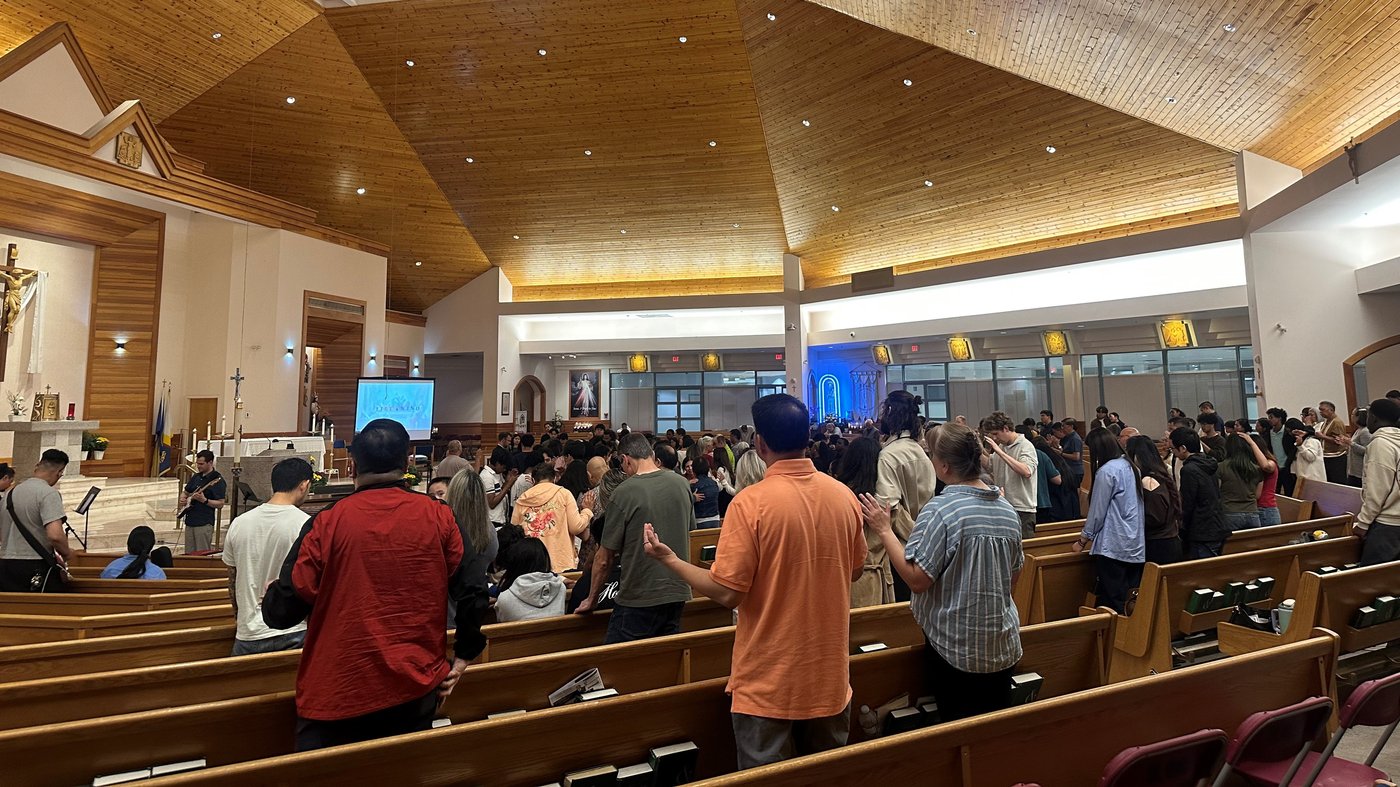
The event was held at her home parish, St. Matthew’s in Surrey, and organized by Catholic Young Adults of Surrey (CYAS) in celebration of Pentecost, the Church’s birthday. Activities focused on the renewing power of the Holy Spirit, and attendees were invited to participate in a Vigil Mass, enjoy a potluck dinner, and listen to personal testimonies (including Umali’s). The night ended with praise and worship music.
Umali prayed for the healing of her voice during the Vigil Mass. “Jesus, I can’t tell my story if I can’t talk,” she prayed. After receiving the Eucharist and asking to be healed, her voice was immediately restored. This moment of healing and trusting in God’s plan fits perfectly within a larger story of how he saved Umali “from the grave” and gave her “new life” through the Holy Spirit.
“For the past eight years, I’ve suffered from an illness called major depressive disorder also known as depression,” she told The B.C. Catholic, and described the experience as a distinct feeling of emptiness that she couldn’t fill.
By the beginning of this year, Umali was convinced that “God had made a mistake.” “I tried everything.” she said. “I tried prayer, years of therapy, so many medications, sleep studies, blood tests, specialists, and none of it worked.”
Then everything changed on Palm Sunday.
“I was at a restaurant with my Mom and Dad,” she said. “Then my Mom said she had something very important to tell me.” Over dinner, her mother told her about a phone call she recently had with a fellow parishioner from St. Matthew’s, in which her mother learned that God had revealed to her friend visions of Umali’s struggle with depression. She said she knew what the two of them needed to lift up in prayer.
For over three hours, the two prayed over the phone while Umali was in another room, completely unaware of the prayers being offered for her healing. After three hours of intercessory prayer, Umali’s mother said she heard “a victory cry” followed by “an overwhelming sense of peace.”
As Umali listened to this story, she felt confused and lost. “I remember being scared to put my hope in God because I had put my hope in doctors and medicine which disappointed me every single time.”