
Nineteen lay people and clergy named to receive papal honours
Nineteen lay people and clergy in the Archdiocese of Vancouver will be recognized for their outstanding service to the Church on Sunday, Sept. 8., at Holy Rosary Cathedral.
Archbishop J. Michael Miller, CSB, will confer the honours awarded by Pope Francis at a Papal Honours Mass at 11 a.m. Everyone is welcome to attend.
Sixteen people will be given the Benemerenti medal, awarded to benemerenti, “the well-deserving,” who have shown lasting and exceptional service to the Catholic Church, family, and community. Pope Gregory XVI instituted the award in 1832 for members of the military and civilians showing extraordinary courage. In 1925 it was extended to people who go to great lengths to serve the Church in 1925.
Three people will receive the Cross Pro Ecclesia et Pontifice. Established by Pope Leo XIII in 1888, it is the highest recognition the laity can receive from the Pope. The award is given for distinguished service to the Church by lay people or clergy.
This year’s recipients are:
Benemerenti Medal
- Gwendoline Allison
- Peter Bull
- Richard and Kathleen Cheng
- Dr. Thomas Cooper
- Timothy McKinnon
- Murray and Patricia Neilson
- Virginia Peters
- Henjie and Teresa San Juan
- Judit Spence
- Dorothy Van der Zalm
- Dick Vollet
- Betty Wilson
- Dr. John Yun
Cross Pro Ecclesia et Pontifice
- Dr. Felix Durity
- Mary Margaret MacKinnon
- Msgr. Bernard Anthony Rossi
Your voice matters! Join the conversation by submitting a Letter to the Editor here.
Top of the Class: Catholic grads earn scholarships to pursue post-secondary dreams this fall
As students return to school, two students from Vancouver Catholic schools will be starting post-graduate studies with the help of scholarships they earned in their graduate year.
Christel Mazzek, the founder of St. John Brebeuf Secondary’s Open Studio art community in Abbotsford, and St. John Paul II Academy graduate Elyse Kargl have each been recognized with significant scholarships that will support their post-secondary pursuits.
Christel was honoured with three scholarships for her outstanding volunteer work and academic achievement. Her passion for service and creativity has made a lasting impact on her community, from supporting the Abbotsford Arts Council to helping with the Vancouver Kindness Movement. Her initiative to keep classmates connected through art during the pandemic grew into a vibrant community of over 35 members. This commitment to her community, combined with her academic excellence, earned her the prestigious Terry Fox Humanitarian Award, which covers up to $28,000 over four years.
She also won the Trevor Linden Community Spirit Scholarship, which awards $2,500, and a B.C. Beedie Luminaries Scholarship, which awards up to $44,000 per recipient.
SJB academic counsellor Dan Fraser praised Christel’s accomplishments as extraordinary. “Winning three major awards like this is an exceptional achievement. This is well-deserved recognition for the impressive service work that Christel has done for the community,” he said.
The Open Studio group, which started in 2020 during the COVID-19 pandemic, provided a creative outlet for students feeling disconnected. With the support of art teacher Jacqueline Lindenbach, Christel and a friend designed take-home art projects that allowed students to create, share their work, and stay connected. The group has since grown to over 35 members and continues to thrive.
Reflecting on her time at SJB, Christel expressed immense gratitude for her teachers and the community. “The halls of the school are filled with compassionate role models and mentors, whose influence has shaped me significantly,” she said. This fall, Christel will be studying science at UBC.

Meanwhile, Elyse Kargl, a graduate of St. John Paul II Academy in Surrey, will pursue her nursing dream this fall with a $45,000 scholarship from the Cmolik Foundation. Elyse will be attending Trinity Western University, supported by the $45,000 scholarship. The scholarship recognizes students who have overcome significant challenges in their lives, and Elyse’s perseverance and dedication impressed the selection committee. The scholarship will help her achieve her lifelong dream of making a difference in the lives of others through nursing.
Elyse said she has dreamed of nursing since she was young and is excited about the opportunity. “Since the age of 11, I have been determined to pursue a career in nursing to make a difference in the lives of others,” she said.
God opposes the proud
Father Adolphe Tanqueray defined the sin of pride as “an inordinate love of self, which causes us to consider ourselves, explicitly or implicitly, as our first beginning and last end.”
He explained: “At times we forget that God is the source of these gifts, and we attribute them to ourselves. This constitutes a disorder, for it denies, at least implicitly, that God is our first principle. In like manner we are tempted to act for self, or to gain the esteem of others, instead of acting for God, and of referring to him all the honour. This is again a disorder, for it denies, at least in the same implicit manner, that God is our last end. Such is the twofold disorder found in this vice.”
He said many people “recognize in theory that God is their first principle, but in practice they esteem themselves beyond measure, as if they were the source of the qualities they possess.”
In like manner, many people behave in practice as if they consider themselves as their own last end: “They want to be praised, to be complimented upon their good works, as if they were themselves the principal authors, and as if they were responsible only to themselves… They are prompted by egotism, they act for their own ends, caring little for the glory of God, and still less for the welfare of their neighbour… There are devout persons who, without going so far seek self in piety: they complain of God when he does not flood them with consolations; they pine with grief when in the midst of dryness, and thus form the false idea that the aim of piety is the enjoyment of consolations, forgetting that the glory of God must be the supreme end of all our actions, above all, of prayer and spiritual exercises.”
A prideful person exaggerates his own qualities, examines the defects of others with a magnifying glass, and turns a blind eye to his own defects. Jesus said, “Why do you see the speck that is in your brother’s eye, but do not notice the log that is in your own eye?” (Mt 7:3)
According to Father Tanqueray, pride gives birth to presumption, ambition, and vainglory. “Presumption consists in an inordinate desire and hope whereby we want to do things which are beyond our strength,” he wrote; “ambition is the inordinate love of honours, of dignities, of authority over others,” and “vanity is an inordinate love for the esteem of others.”
The inordinate desire to receive praise from others can destroy the value of our good works. Jesus warns us: “beware of practicing your righteousness before other people in order to be seen by them, for then you will have no reward from your Father who is in heaven.”
Thousands continue century-old tradition at Marian pilgrimage
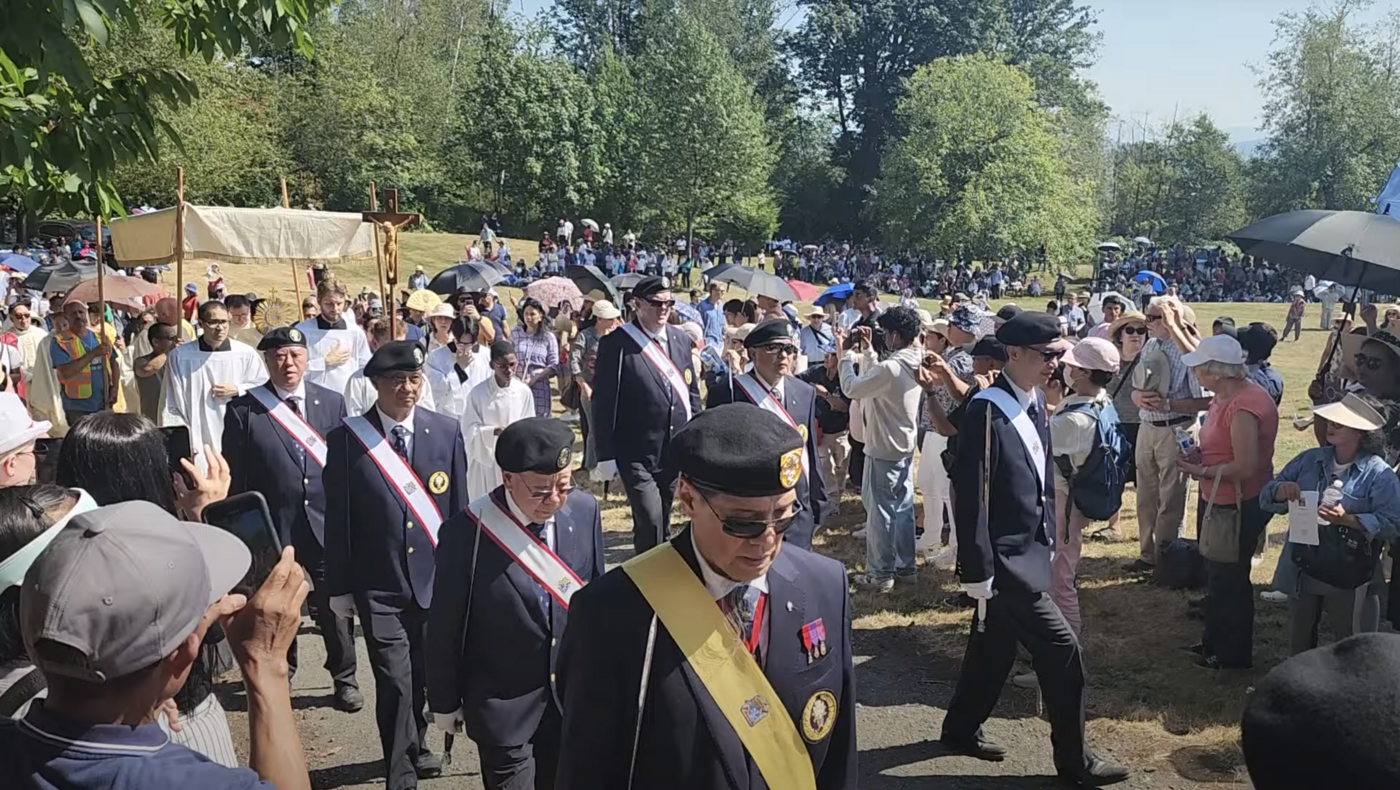
Archbishop J. Michael Miller looked out on the thousands of men, women, and children who in a few minutes would be winding their way up the hill to Our Lady of Lourdes Grotto in Mission in 30 degree heat. He offered them the example of Mary, who made “the first Eucharistic procession in history” journeying to the hill country of Judah to visit Elizabeth.
The Gospel reading for the Mass he was celebrating recounted the Visitation and presented Mary as “a woman on the move,” the Archbishop said. “She set out and went with haste” to help her cousin and “carried with her the living Son of God made flesh in her womb.”
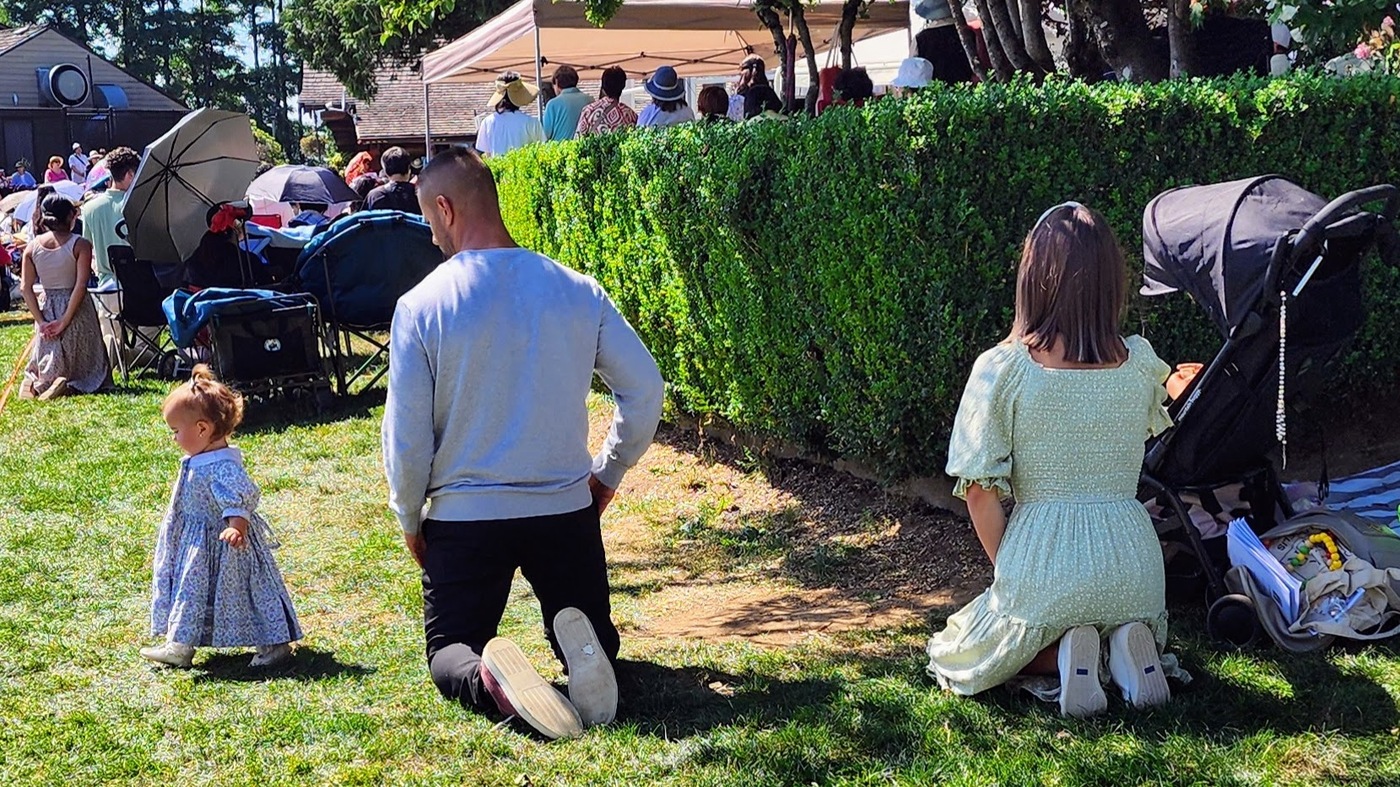
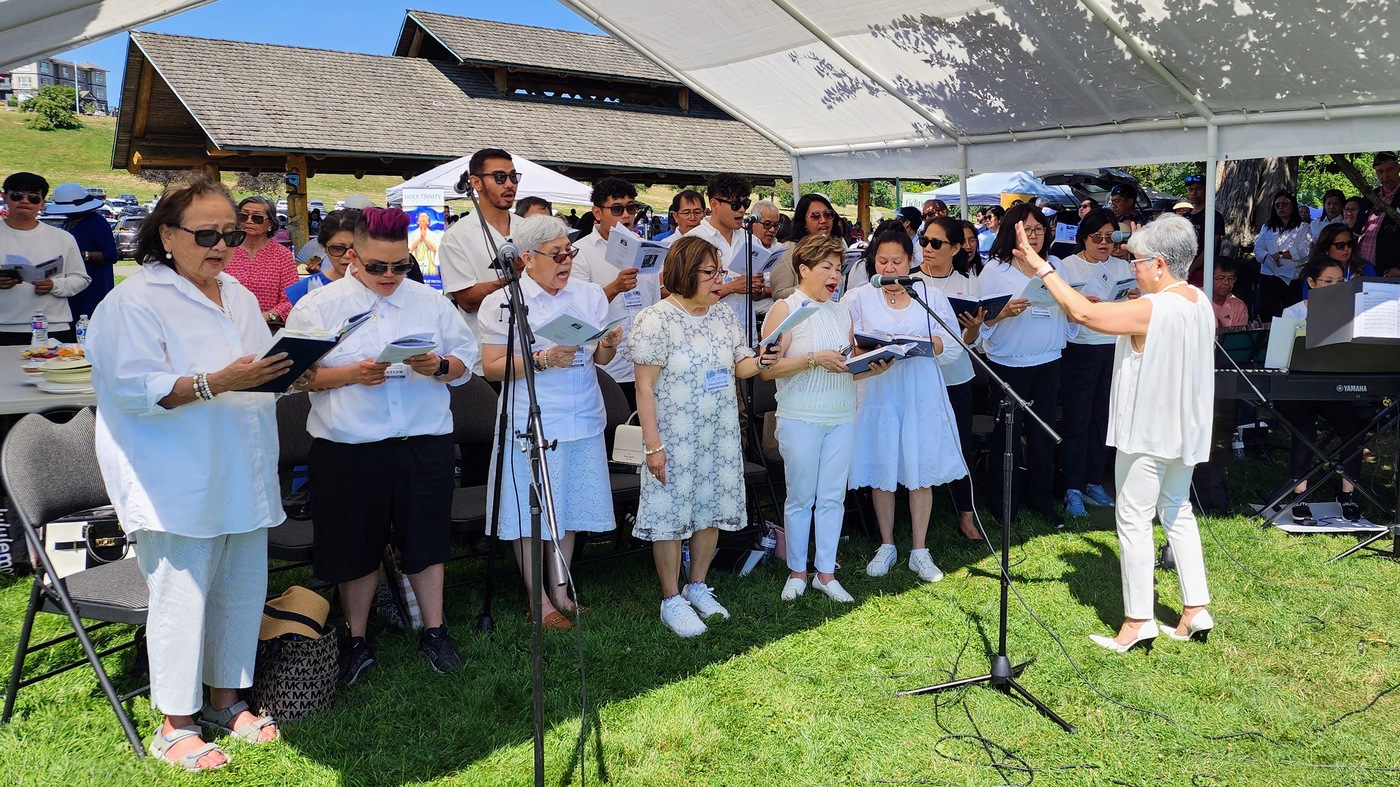
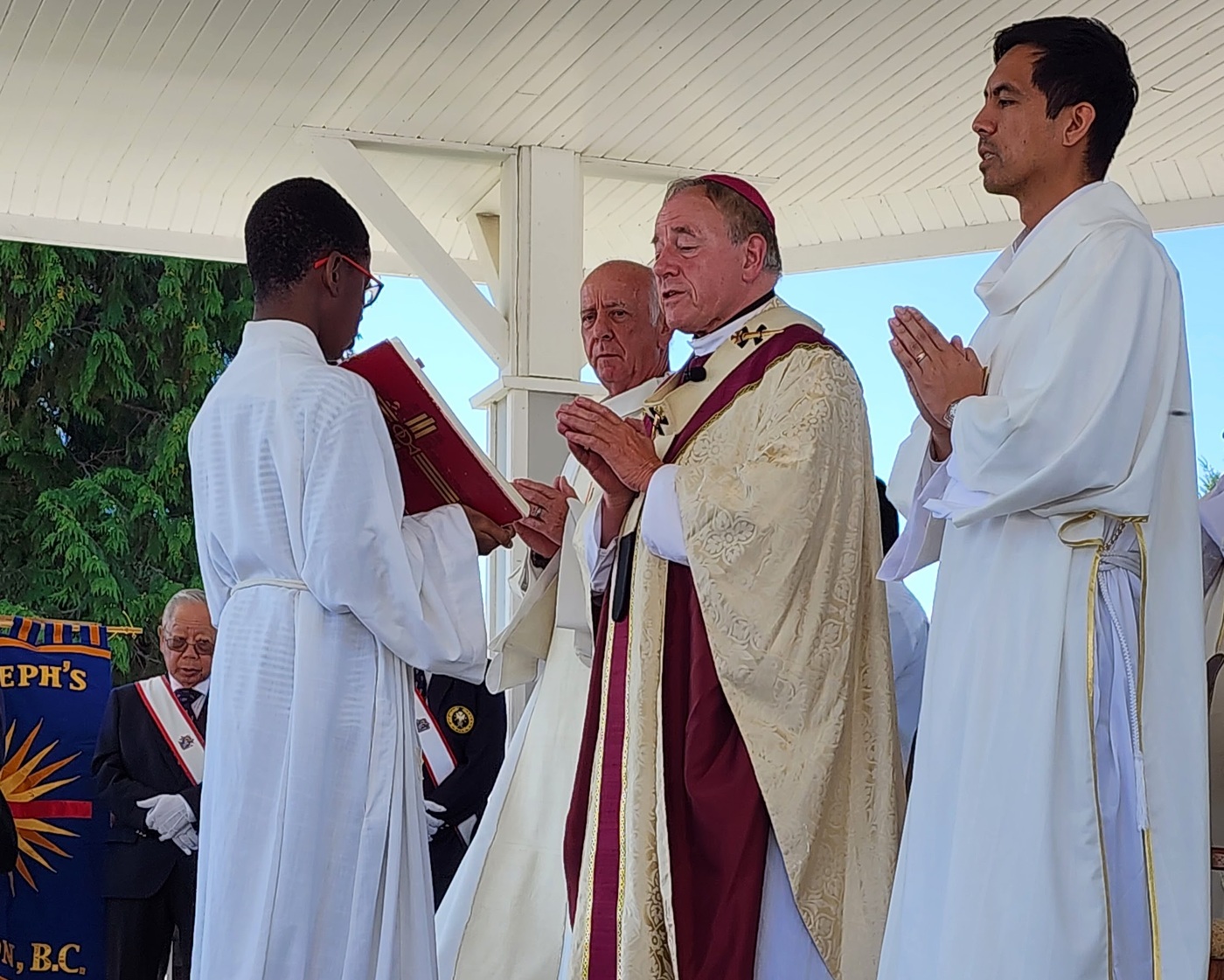
The crowd preparing for the Aug. 17 procession were “following a venerable tradition,” he said. “For over a century, these grounds have known not only a joyful outpouring of prayer to Mary but also great suffering because of the residential school once located here.”
The Archbishop offered his gratitude to First Nations for their “ongoing commitment to this pilgrimage” from its origins and for their “deep love of the Mother of Jesus. She has never ceased to accompany you in your joys and sorrows down through the years.”
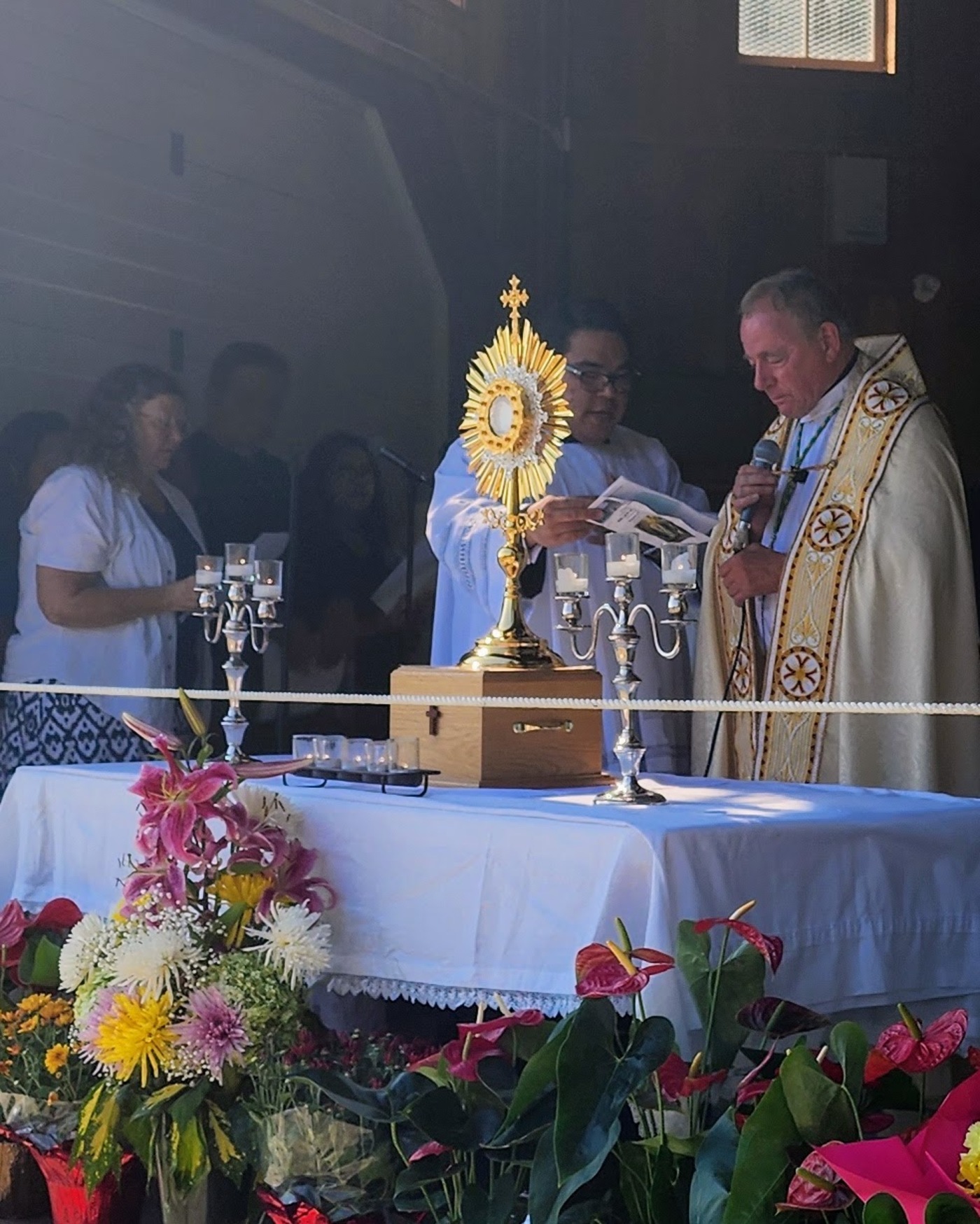
The pilgrimage is an answer to “the Lord’s call to honour the Blessed Virgin Mary as Patroness of our Archdiocese and to set her example before us as the perfect disciple of her Son.”
Quoting both Mother Teresa and astronaut Neil Armstrong, the Archbishop appealed for the faithful to respond with Mary’s “haste” to the urgent needs of others.
Mother Teresa once acknowledged that the good done by she and her Missionaries of Charity “is nothing more than a drop in the ocean. But if the drop were not there, the ocean would be missing something.”
The Archbishop connected her words with Armstrong’s famous quote from the moon, “That’s one small step for man, one giant leap for mankind.”
“By landing on the moon, humanity had crossed a historic threshold,” he said. “With Mary’s Assumption into heaven, however, we celebrate an infinitely greater conquest. Our Lady has crossed the threshold of heaven. She was assumed there not only in spirit but with her body as well, with her whole self. This step of the lowly handmaid of the Lord was a huge leap forward for humanity.”
Humility is to the virtues as the chain is to a rosary
Pride is one of the capital sins. Pope Francis defined it this way: “pride is self-exaltation, conceit, vanity… The proud man is one who thinks he is much more than he really is; one who frets about being recognized as greater than others, always wants to see his own merits recognized, and despises others, deeming them inferior to himself… In fact, within this evil lies the radical sin, the absurd claim to be like God.”
He added that a person “succumbing” to the vice of pride can have these physical characteristics: “the proud man is haughty, he has a ‘stiff neck,’ that is, he has a stiff neck that does not bend. He is a man easily led to scornful judgment: with no reason, he passes irrevocable judgments on others, who seem to him hopelessly inept and incapable. In his haughtiness, he forgets that Jesus assigned us very few moral precepts in the Gospels, but on one of them he was uncompromising: never judge… Salvation comes through humility, the true remedy for every act of pride.”
In one of his prophetic dreams, St. John Bosco saw the devil represented by a fierce bull attacking and killing as many people as he could—but he could not reach those who lied down humbly before God.
Father Alban Butler wrote about St. Anthony of Egypt: “once the saint saw in a vision the whole earth covered so thick with snares, that it seemed scarce possible to set down a foot without falling into them. At this sight he cried out, trembling: ‘Who, O Lord, can escape them all?’ A voice answered him: ‘Humility, O Antony!’”
Pride is the sin of the devil. St. John Climacus stated: “humility is the only virtue no devil can imitate.”
St. Melania the Younger said it this way: “for the devil can copy all our good deeds that we seem to do, yet, in truth, he is conquered by love and by humility. I mean something of this sort: we fast, but he eats nothing at all; we keep vigil, but he never sleeps. Let us thus hate arrogance since it was through this fault that he fell from the heavens and by it he wishes to carry us down with him. Let us also flee the vainglory of this age that fades like a plant’s flower.”
St. Vincent de Paul called humility “the most powerful weapon to conquer the devil.” Why? “He does not know at all how to employ it, neither does he know how to defend himself from it.”
Humility is the foundation of all other virtues and many saints have offered creative metaphors to describe it.
Catholic schools are living out a love story to the needy
This is a love story … a story of the love of Christ by our Catholic students, teachers, and principals, and the mission to live out that love by helping the disadvantaged and homeless in Vancouver.
All 40 of our Catholic elementary schools have lovingly agreed to help the Catholic Men’s Shelter and the Door is Open by providing them with gloves, socks, toques, coats, etc., as well as personal items such as toothpaste, toothbrushes, deodorant, small-size bath soap, shavers, shaving cream, lotion, earplugs, Q-Tips, shampoo, and other related items. This will serve the 35,000 homeless men who stay at the Catholic Men’s Shelter every year and the thousands of men and women who are fed by the Door is Open.
The initiative started simply enough when I met with Solomon Atta, the acting director of the Catholic Men’s Shelter. Solomon told me about the shelter’s needs, and I knew just who to approach.
For many years, through the Archdiocese of Vancouver’s prison ministry and the Office of Service and Justice, I’ve worked with our Catholic schools on cooperative projects, such as students sending hand-written Christmas and Easter cards to the incarcerated and to the disadvantaged on the streets. I’ve visited the schools to talk about the corporal works of mercy. We’ve worked on lesson plans for street ministry, prison ministry, anti-human trafficking, and environmental care. The schools have welcomed guest speakers from prison ministry who are doing joint ventures with correctional institutions and by making wrist rosaries.
So when Atta asked for help, I reached out to the schools, who have been very faith-filled and generous with their time and resources. I called on six schools in February (Immaculate Conception, St. Mary’s, and Our Lady of Sorrows in Vancouver, St. Francis de Sales and Our Lady of Mercy in Burnaby, and Queen of all Saints in Coquitlam) and asked if they could help.
Every single one said “yes.” Even though the schools are busy and many requests are made of them, their reverence for life and the love for all of God’s children shone through.
The B.C. Catholic profiled one of the pilot projects in the Aug. 5 issue.
Atta has also been working with some very generous and supportive parishes and their attached schools, including Holy Trinity, St. Anthony’s, St. Pius X, Christ the Redeemer, St. Anthony of Padua, and Our Lady of Fatima.
The parents, students and teachers opened their hearts to this pilot test, and the results were incredible.
‘You can not be lonely at this church’: St. Anthony’s in West Van celebrates 100 years
Thirty years ago, Trisha Andrew decided to return to church, and she discovered St. Anthony’s Parish in West Van. She has been a part of the parish ever since. Now, as the parish celebrates its 100th anniversary, Andrew has been reflecting on the significant role the parish community has played in her life.
A bit of a self-described hippie, Andrew said she only went at the behest of a friend, but community and sense of belonging surprised her. “St. Anthony’s has an incredible warmth to it,” she told The B.C. Catholic in an interview.
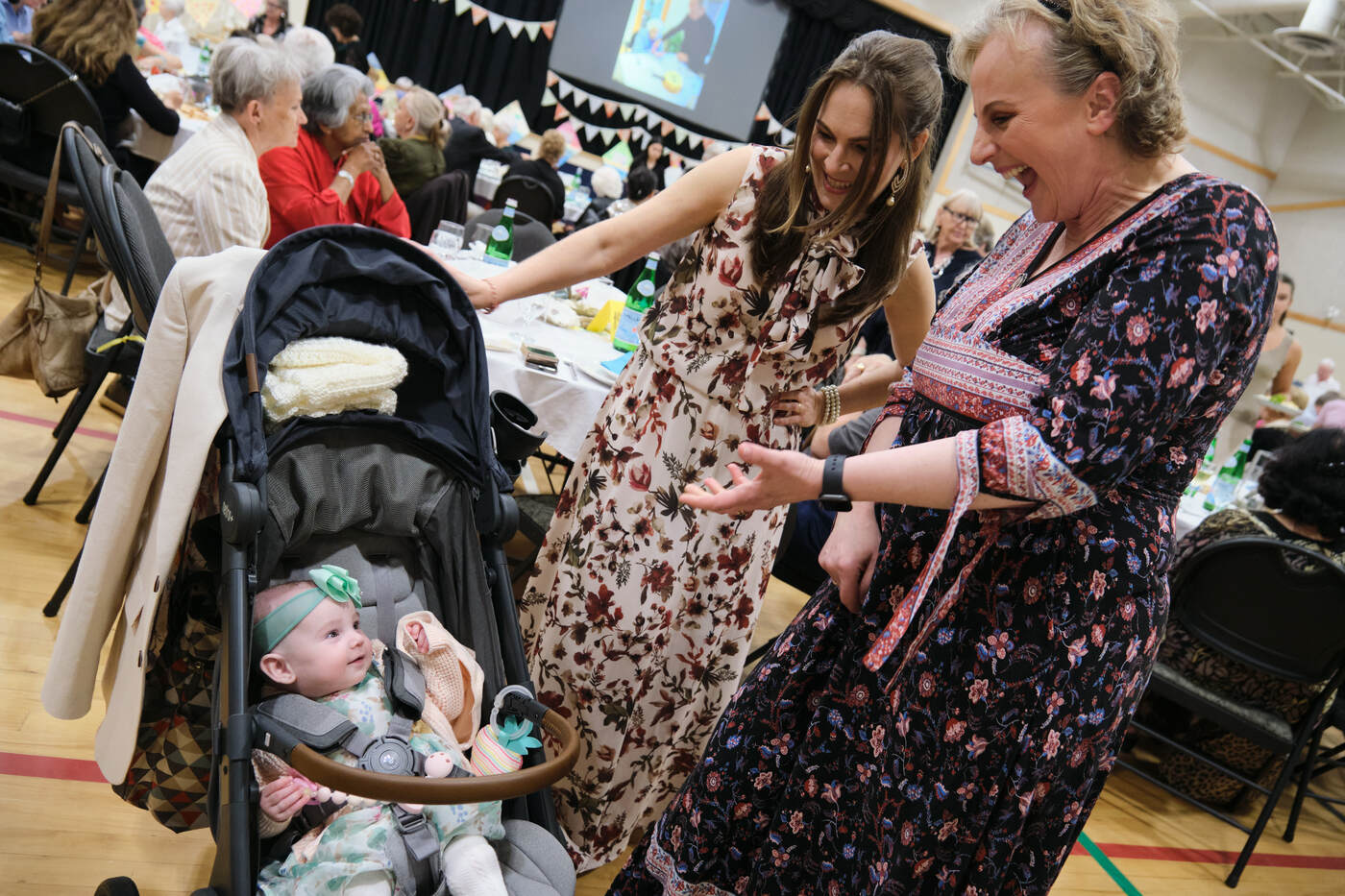
Since then, the parish has become her second home. “I’ve never been to a parish that felt like it was my home,” she said. “I felt accepted and supported – in general the whole community was very welcoming.”
After suffering from cancer several years ago, the parish community “embraced me in prayer,” said Andrew. “You feel like a person; people know you, and they say hello.”
Like many at St. Anthony’s, she has fond memories of all the priests who served during her time there. She especially appreciated the effort that their most recent full-time pastor, now Bishop Gary Franken, put into the community.
“He tried to make everybody fit,” she said. “If you liked to play cards, he would steer you towards someone else who played cards. If you had a special devotion, he would connect you with other people – he would help you find connection.”
“People are so lonely – you cannot be lonely at this church!” she said.
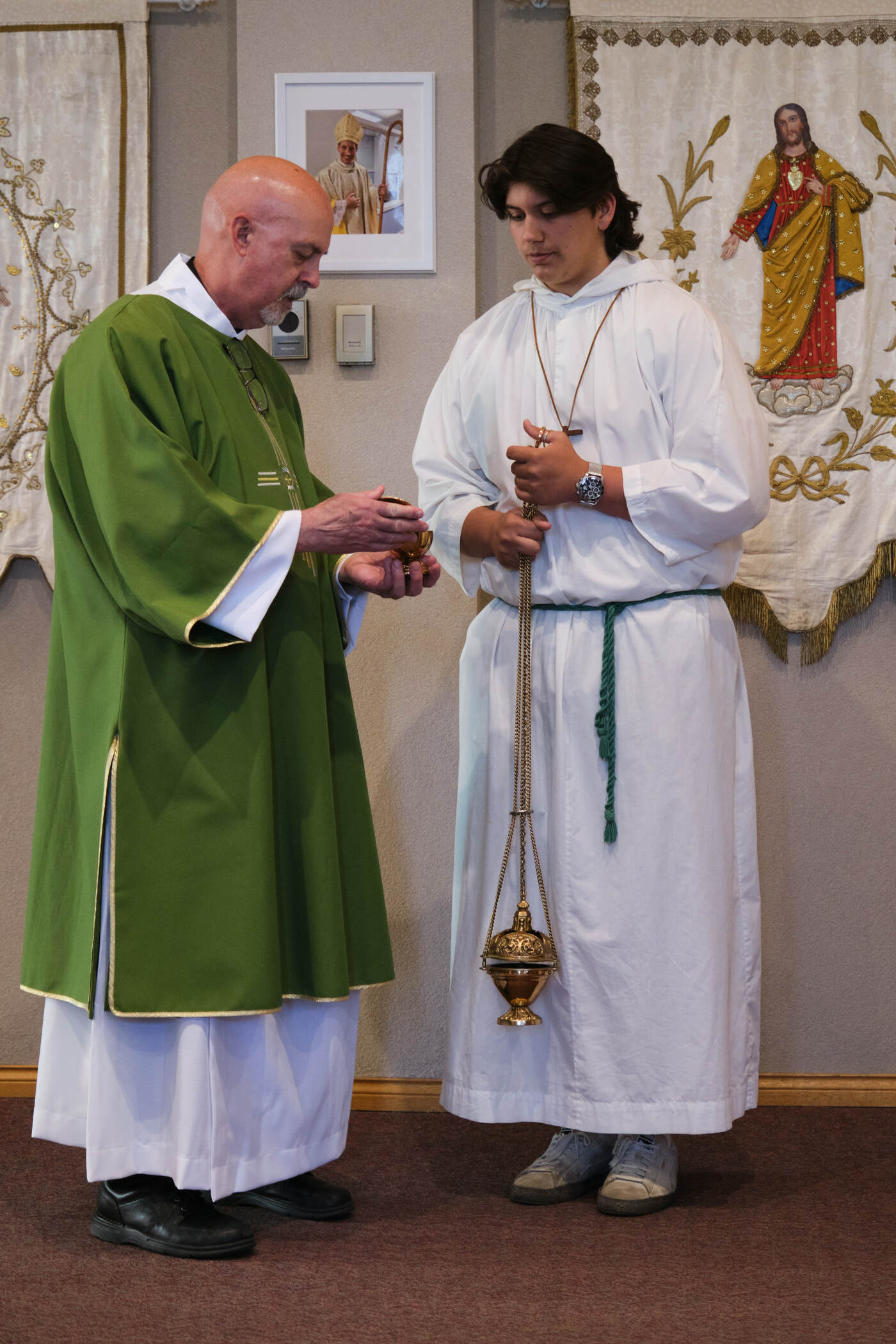
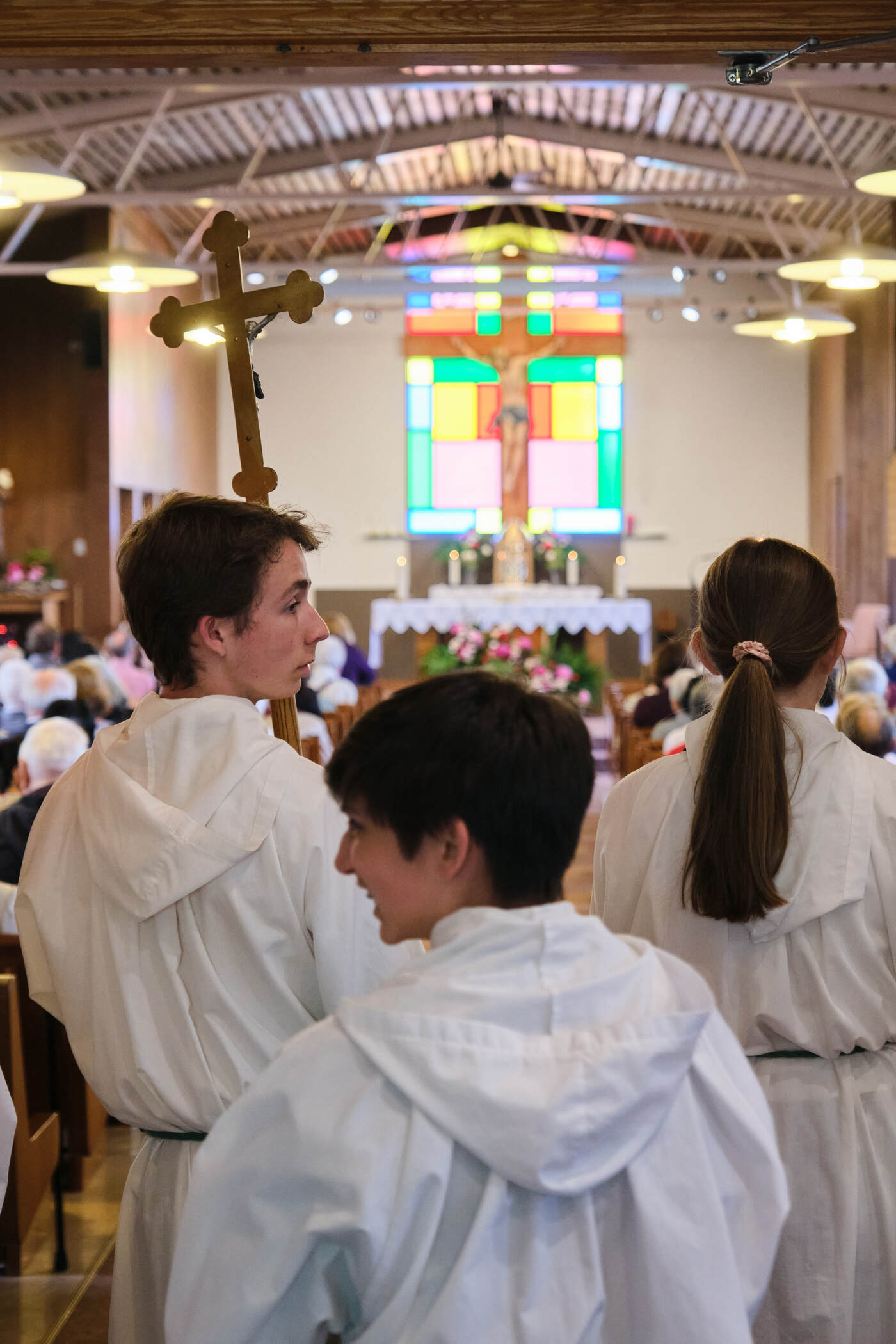
The centennial festivities started with Mass celebrated by Archbishop J. Michael Miller. Other priests and deacons with connections to the parish joined him, including recent parish administrator Father Paul Goo, administrator and one-time pastor of St. Anthony’s Father Vincent Hawkswell, and soon-to-be-installed pastor Father Arsene Dutunge.
Bishop Gary Franken, who served as St. Anthony’s pastor for 11 years, also concelebrated.
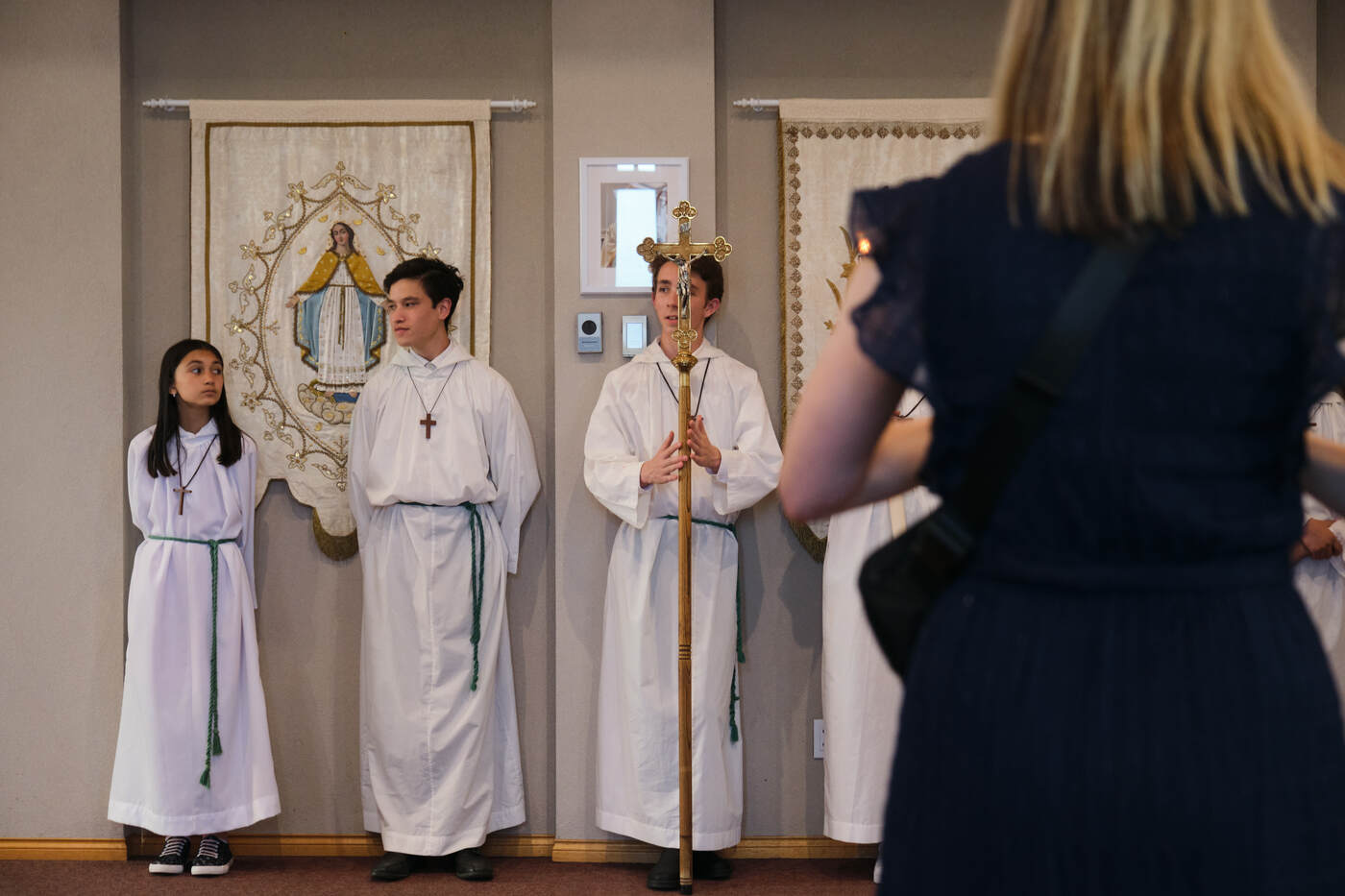
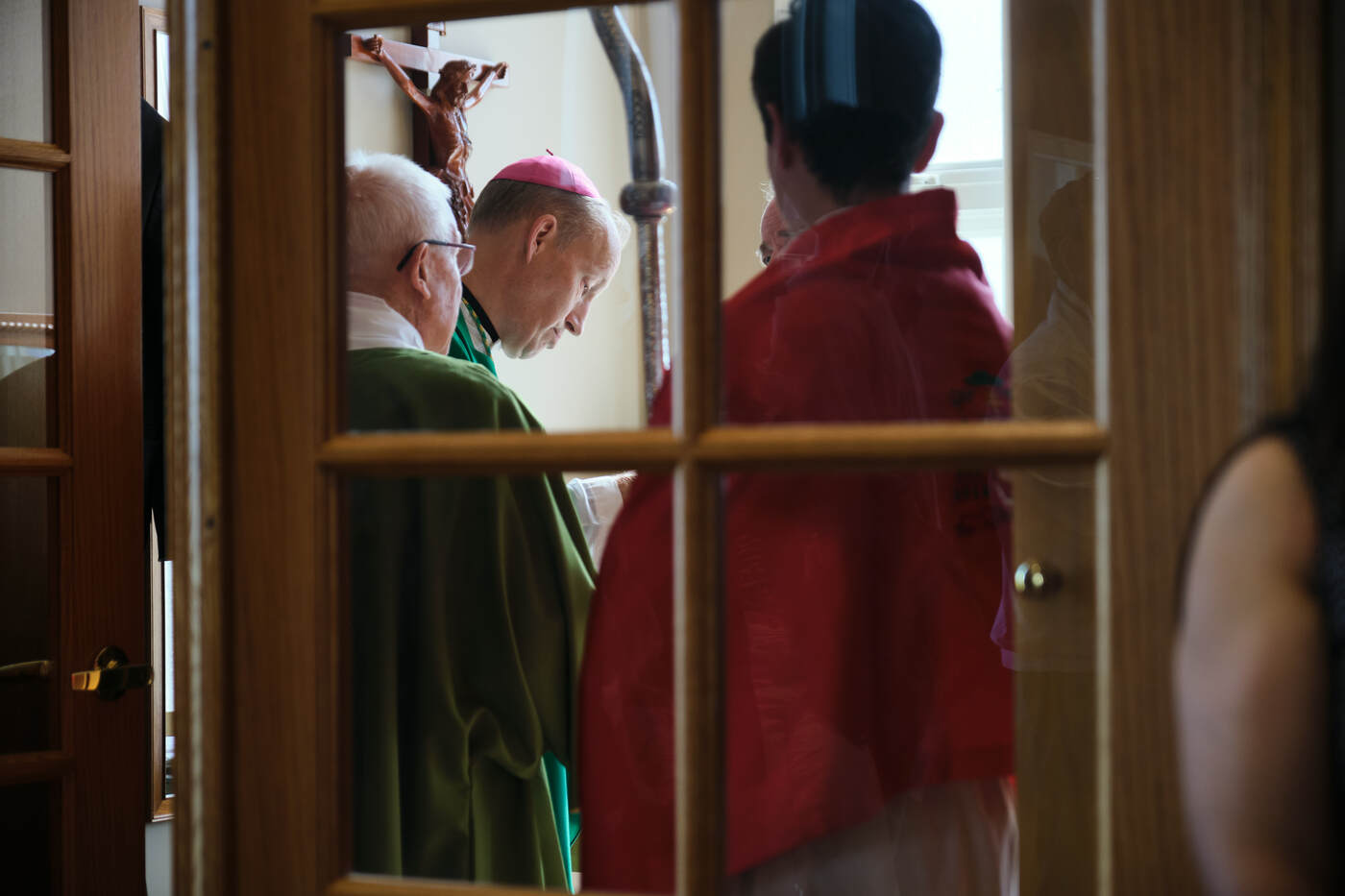
“As we commemorate the 100th anniversary of the founding of this parish erected to honour St. Anthony, this afternoon we rightly look to the past with gratitude,” Archbishop Miller said in his homily.
“What has taken place here in West Vancouver is not unlike what happened in the early Church,” saint the archbishop.
Abbot Peter Novecosky, former Prairie Messenger editor, dies at 79
Abbot Peter Novecosky, OSB, who for more than a quarter century shared the news, and the good news, with Catholics in Western Canada through The Prairie Messenger newspaper, has died at 79.
Abbot Novecosky died on Aug. 14, the Vigil of the Assumption of the Blessed Virgin Mary, in Humboldt, Sask., after battling cancer.
A prayer vigil will take place Monday, Aug. 19, at 7:30 p.m. at St. Peter Cathedral in Muenster, Sask. The funeral will be Tuesday, Aug. 20, at 11 a.m. at St. Augustine Church in Humboldt, followed by interment at St. Peter’s Abbey Cemetery.
In a statement, the Canadian Conference of Catholic Bishops said Abbot Novecosky’s life was a testament to faith, leadership, and dedication. “His journey, marked by a deep commitment to his faith and his community, reflects his motto, ‘My heart is ready, O God,’” the CCCB said.
He was born Wilfred Novecosky on April 17, 1945, in Burr, Sask., where he attended elementary school before going to high school at St. Peter’s College in Muenster.
In 1963, young Wilfred entered the monastic community of St. Peter’s Abbey as a novice. In 1964 he made his profession of vows as a Benedictine monk, changing his name from Wilfred to Peter. He would be the last vocation from the former St. Peter’s Abbacy, a diocese (abbey nullius) that existed between 1921 and 1998 when it became part of the Diocese of Saskatoon.
Peter studied philosophy and theology in the seminary at St. John’s Abbey in Collegeville, Minn., and was ordained to the priesthood in Humboldt in 1970 by Saskatoon Bishop James Mahoney.
After ordination, he became a prefect at St. Peter’s College in Muenster and taught there until the school closed in 1972. He also served as associate pastor of St. Augustine Parish in Humboldt from 1972 to 1977.
In 1972 he began working with The Prairie Messenger, published and printed by the Benedictine community of St. Peter’s Abbey in Muenster.
The Benedictines had been associated with the paper since 1923, when St. Peter’s Messenger was first printed. It became The Prairie Messenger in 1928, but its roots went back to its forerunner, the weekly German newspaper St. Peter’s Bote, which the Benedictines began publishing in 1904.
The Benedictine order publishing tradition dates back to its roots in the Middle Ages preserving books, texts, and culture. Education and printing have been a part of that tradition, and the Benedictine monks, within a year of arriving with German Catholic settlers from Minnesota in the Humboldt/Muenster area in 1903, were printing the German Catholic weekly St. Peter’s Bote (Bote meaning “the messenger” in Winnipeg.)
The Benedictines opened a printing press at Muenster the following year in September of 1905 and for decades they published two newspapers, ceasing publication of The Bote in 1947.
‘This isn’t a matter of compromise’: Bishops commit to goal of unity
The Canadian Conference of Catholic Bishops (CCCB) has unveiled a new strategic vision for enhancing and enlivening future ecumenical and interfaith initiatives.
Several weeks after the CCCB hosted the Triennial Forum for Dialogues with various partners at St. Augustine’s Seminary in Toronto in late June, the bishops unveiled the four ecumenical trajectories assented to by the assembly participants.
The findings of audits of various ecumenical and interfaith dialogues conducted by the CCCB informed this strategy of priorities. The bishops’ National Commission for Christian Unity, Religious Relations with the Jews and Interfaith Dialogue, chaired by Regina Archbishop Donald Bolen, then developed a proposal from the audit resolutions that anchored the discussions at the forum.
First, a commitment is to bolster ecumenical structures within the Canadian Catholic community. The CCCB envisions achieving this objective by launching commissions, hiring ecumenically focused personnel, establishing regional networks and even creating a unifying national syllabus to guide Catholics tapped to helm a diocesan inter-denominational department.
Archbishop Bolen said that inspiring the lay faithful, particularly congregants who are skeptical or indifferent to such pursuits, should be accomplished by informing them that “ecumenical enterprise is not the Church’s idea; it’s the Father’s idea.”
“It comes out of Jesus’ prayer for all his disciples to be one,” said Archbishop Bolen. “We are deeply committed to that goal of unity among Jesus’ disciples. I think framing it that way: this isn’t a matter of compromise; it’s not a liberal-driven agenda. This is about being faithful to the Lord’s desire that we be one and putting ourselves at the service of that in a way that Jesus did.”
The CCCB and its partners also desire an “ecumenism of truth” with Orthodox, Anglican, Lutheran, Jewish, Hindu and other faith communities. Dialogues and relationship-building programs will be at the heart of augmenting this interfaith pathway.
There was also a call to observe Pope Francis’ endorsement of the Lund Principle, which affirms that ecumenical partners should act together in all matters except when deep doctrinal or other significant differences compel the need for separate denominational approaches.
Finally, the bishops and their allies from other faiths seek a greater spiritual ecumenism through praying for unity at greater frequency, adding more ecumenical prayer services and identifying new opportunities for encountering Christians of different denominations.
Presenters at the forum included representatives from the Vatican Dicastery for Promoting Christian Unity, the Anglican–Roman Catholic International Commission (ARCIC) and diocesan/eparchial ecumenical officers across Canada. Roundtable discussions centred on “benefits and challenges of the dialogues, financial sustainability and the importance of making the dialogues more visible and engaging at the local levels,” stated the CCCB in a release.
Archbishop Bolen’s big takeaway of the Triennial Forum for Dialogues is “while we don’t see in the short term a path to full visible unity with our partners, we do see that there’s much that we can do together that we don’t presently do.”
In the Waters of Lourdes
Have you ever had one of those experiences that was a big turning point in your life? In the moment, perhaps you didn’t know how it was going to affect your future, but you knew you’d be different as a result of it?
Yeah, well that was me after I went on a nine-day pilgrimage to France this past Christmas.
A pilgrimage is a journey made to some sacred place as an act of religious devotion, but traveling to different holy sites in France with four friends of mine was so much more than an act of religious devotion — it was a spiritual adventure. I left life behind, logged off all my social media accounts, put my phone in my backpack, and embraced where I was.
Setting out on the trip, I had a few questions stirring in my heart. At 23, I was unsatisfied with my current career path, and wanted clarity on the future, so I left. I don’t know that I was searching for answers to those questions as much as just a greater depth and understanding of who I am, who God is, and what I’m being called to do with my life.
I knew by getting to know the One who created me more intimately, I would understand more about life, myself, and the questions on my heart. The trip gave me the opportunity to quiet my heart and just be. I went in with a wide open heart, and though I didn’t find any concrete answers to the question about where my life was going, I came back with a sense of profound peace.
While I experienced many beautiful blessings on the trip, the biggest ones occurred in Lourdes, a place in France people visit to seek healing because Mary appeared there.
Over several months in 1848, Mary appeared a number of times to a 14-year-old peasant girl named Bernadette. The young girl had little education and when she tried to explain what happened to her, everyone thought she was making it up. During one of the apparitions, though, Mary instructed Bernadette to start digging in the ground and drink from the spring that would appear. People became concerned as the young girl began digging, eating dirt, and drinking muddy water, but soon, a miraculous spring came forth.
That same spring continues to flow even today and has been the source of many miracles. The Church eventually approved Lourdes as an official Marian apparition siteand millions of pilgrims began journeying there each year seeking physical, spiritual, emotional, and mental healing.
And I get it. To many people in the world today, miraculous waters may sound like some kind of ploy to get attention or money.