
Couples find sacramental marriages ‘in God’s perfect timing’
Sometimes it just takes moving across the world to understand the value of a sacramental marriage. At least that’s what it took for Eddelyn and Mario John, two recent arrivals from the Philippines.
They were one of 19 couples whose marriages were sacramentally blessed at the Marriage Mass at St. Mary’s in Vancouver, one of three such events across the Archdiocese this year. In total 121 couples had their marriages convalidated this year, a remarkable increase from last years 42.
Eddelyn and Mario met almost two decades ago while Eddelyn was working at a farm supply store where Mario would come to purchase feed.

Things developed quickly, and the couple married after only three months of courting.
At the time, the couple embodied a certain cultural Catholicism. Mario’s family urged them to have a church wedding, but they declined.
“I always said we were good – it’s OK,” Eddelyn recalled. “As long as we always go to church every Sunday, it’s ok.”
Soon, they were pregnant, and their daughter was born before their first wedding anniversary.

Life continued apace, but something always felt like it could be better. They weren’t unhappy and had a good family life with their daughter. It wasn’t until they were apart that things clicked for Eddelyn and Mario.
In 2019, an opportunity arose for them to immigrate to Canada. One of Mario’s favourite uncles encouraged the couple to make the journey, but COVID delayed their plans, and he passed away before they made the move.
The pandemic delays complicated their applications. Eddelyn was finally accepted for a student visa last year. Because of delays with their daughter’s visa application, she made the trip alone, arriving in Canada in December 2023 to start her studies in business management.

At the first Canadian Mass she attended at St. Mary’s in Vancouver, someone announced that the Marriage Mass was coming up on Oct. 19 – the birthday of the beloved uncle who had passed away.
Eddelyn saw this as a sign, and she and Mario decided that if they could get their marriage sacramentally validated in Canada, they would.
“We want to be part of the seven sacraments of the Church,” said Mario.
As anyone dealing with Immigration Canada knows, getting the paperwork done can be a nightmare. Still, as fate would have it, everything was finalized in time for Mario to bring their daughter to Canada for the Marriage Mass.
Humility is nothing but truth
Pope Francis called humility “the base of Christian life.”
The Holy Father said, “This virtue is humility, the great antagonist of the most mortal of sins, namely pride.”
Pride and arrogance “swell the human heart, making us appear to be more than we are,” Francis said. Humility, however, “restores everything to its correct dimension: we are wonderful creatures, but we are limited, with qualities and flaws. From the beginning, the Bible reminds us that we are dust, and to dust we shall return (cf. Gen 3:19); indeed, ‘humble’ derives from humus, that is, earth. And yet delusions of omnipotence, which are so dangerous, often arise in the human heart, and this does us a great deal of harm.”
Father Gabriel of St. Mary Magdalen, OCD, pointed out that “charity is the essence of Christian perfection,” and “humility is to charity what the foundation is to a building.”
There are two very beautiful definitions of humility: the first is “humility is nothing but truth,” and the second is “humility is thinking less about oneself.”
St. Vincent de Paul wrote, “The reason why God is so great a lover of humility is because He is the great lover of truth. Now humility is nothing but truth, while pride is nothing but lying.”
Jesus said, “Learn from Me, for I am meek and humble of heart” (Mt 11:29). Humility in words and deeds must flow from humility of the heart. St. Thomas Aquinas wrote, “An interior disposition to humility puts its seal upon the words, gestures, and acts by means of which that which is hidden within is manifested on the outside.”
There are two doctrinal truths that serve as the basis of humility: nothing and grace. We are created by God out of nothing. Father Gabriel wrote, “If we take away from ourselves what is of God, we will find that of ourselves we are nothing, or rather less than nothing, for nothingness is incapable of offending God, while we have this sad capability.”
St. Therese, the Little Flower, said, “The remembrance of my weakness is so constantly present to me that there is no room for vanity.”
In the supernatural order we need the grace of Jesus, who said, “Without Me you can do nothing” (Jn 15:5).
Father Gabriel pointed out: “In order to perform even the tiniest supernatural act we need God’s help; we need actual grace which prevents us by its inspirations and accompanies us in the act until it is accomplished.”
St. Paul asked, “What have you that you did not receive? If then you received it, why do you boast as if it were not a gift?” (1 Cor 4:7).
Honouring Christ’s kingship: ‘Ruler of the kings of the earth’
Solemnity of Christ the King
First Reading: Dn 7:13-14
Second Reading: Rv 1:5-8
Gospel Reading: Jn 18:33b-37
The prophecy from Daniel in this Sunday’s First Reading is crucial to our recognition of Christ as King of the Universe, for Jesus used the term “Son of Man” to refer to himself about 80 times in the four Gospels.
The Church recognizes the “one who is Ancient of Days” as God the Father, and the “one like a son of man” as Christ who is God the Son made man for our salvation and who will come “with the clouds of heaven” to judge all “peoples, languages, and nations” at the end of the world.
Jesus himself said, just before he ascended to heaven, that “full authority” had been given to him “both in heaven and on earth.”
“Son of Man” is the title by which Jesus identified himself at his trial before the Jewish Sanhedrin. After his arrest, the council convened to try to frame a charge against him “so that they might put him to death.” Many “spoke against him falsely under oath, but their testimony did not agree,” for the authorities had had to arrest him hurriedly on hearing from Judas that he knew of their plot, and they had not had sufficient time to coach their witnesses.
The time before the Passover was growing short, and the Law of Moses did not allow the Jews to put anyone to death without the substantial agreement of two or more witnesses. So, in desperation, the high priest Caiaphas tried to force Jesus to incriminate himself.
“I order you to tell us under oath before the living God whether you are the Messiah, the Son of God,” he said. Jesus replied, “It is you who say it. But I tell you this: soon you will see the Son of Man seated at the right hand of the Power and coming on the clouds of heaven.”
Evidently, Caiaphas recognized the implication, for he said, “He has blasphemed!” In other words, he realized that by quoting Daniel, Jesus was claiming to be God the Son, to whom God the Father had given “an everlasting dominion.”
By the Law of Moses, the penalty for blasphemy was death. Like other subjects of the Roman Empire, the Jews were allowed to administer their own laws, but they had to refer cases involving the death penalty to the Roman governor.
The Sanhedrin knew that the charge of blasphemy would not impress a Roman governor, for Romans believed that their emperors became “gods” themselves when they died.
Accordingly, the council changed its charge: “We found this man subverting our nation, opposing the payment of taxes to Caesar, and calling himself the Messiah, a king.”
Letters: photo could have used a scalpel
I was shocked to see the graphic photo showing doctors in surgery accompanying the story about Dr. Tim Kostamo who operated on Father James Hughes.
I am left wondering who the patient was in the photo and why such a moment was chosen for a photo.
I urge you to reconsider using such images in the future, respecting both the dignity of the patient and the sensitivities of your readership.
Lisa Marquis
Burnaby
(We cropped out the gory part of the Page 1 photo both online and in print. Unfortunately, when The Busy Catholic newsletter went out, it pulled the full image off our server without our realizing it. We also should have cropped the inside photo more. We regret that it happened. The photos were taken of Dr. Kostamo when he was on a medical mission to Ecuador and the patient is unidentified. – Editor)
I read Paul Schratz’s article about Kelsi Sheren “Returning from war to take on MAiD” and was shocked, so I went to listen to the interview with Jordan Peterson (whom I have the utmost respect for).
I always try to understand both sides of the issue, even when I can only agree with one side.
I found an article about an anesthesiologist rebutting the claims made by Kelsi Sheren. I am not claiming to support MAID, but if we are to be against it, the stand needs to be based on fact.
A fair presentation of facts should include both sides of the issue. I do not support MAID, but I am disappointed by what appears to be fear-mongering on the part of someone who may not have the knowledge base to ask the right questions for a proper presentation of the facts.
Greg Neufeldt
Saanichton
(The rebuttal comes from Dying With Dignity, and its “debunking” of Sheren’s information comes from Dr. Stefanie Green, Canada’s foremost euthanasia physician. The author does not name the anesthesiologist and puts a great deal of emphasis on Sheren’s not being a medical professional or drug specialist. Following her interview with Jordan Peterson, Sheren interviewed Dr. Joel Zivot, who has given expert testimony on the effects of euthanasia drugs and how they can cause an experience “akin to dying by waterboarding or drowning.” He corroborates Sheren’s account. Readers are invited to read all the arguments and draw their own conclusions. — Editor)
I was pleased to see the Oct. 28 article about obtaining a plenary indulgence between Nov. 1 and 8, but it was incomplete. Besides visiting a cemetery, we also have to perform three other actions:
- Mass and Communion
- Confession within a week with no attachment to even venial sin and
- Prayer for the Pope’s intentions.
The stage is set to implement synod’s conclusions
For those who were expecting surprises to come out of the Synod of Bishops in Rome, the only the only surprise was the Holy Father’s acceptance of the final document on the last day.
That sets the stage for the direct implementation of the assembly’s conclusions.
The proposals, which include expanded leadership roles for women and greater participation in decision-making, will be good news for many. Increasing awareness of women’s roles, as noted in Canon Law, will help us move forward, reducing obstacles that may hinder women from fully living out their “charisms, vocation, and roles” within the Church.
Here in Vancouver, we’re already ahead of the curve. Archbishop Miller has long supported the Synod’s initiatives, from establishing a Synod Committee in 2021 to encouraging Vancouver’s Catholic community to embrace Conversation in the Spirit.
I’m confident that we will continue to promote this style of leadership through ongoing education and practical applications.
Now, we look forward to hearing from the Archbishop as he returns from the Synod and to implement the proposals and recommendations as he sees fit.
It’s important to remember that this is a global document. Not all countries and continents may be ready for these changes or recommendations. Keeping the synodal spirit at the forefront will be a challenge, but it’s one we must embrace.
A powerful quote from the final document describes synodality as “a path of spiritual renewal and structural reform that enables the Church to be more participatory and missionary, so that it can walk with every man and woman, radiating the light of Christ.”
The document states that “the model of synodality is Mary, because she listens, prays, meditates, dialogues, accompanies, discerns, decides, and acts.”
For us here in the Archdiocese of Vancouver, under the patronage of Our Lady, her example can be our guide.
Your voice matters! Join the conversation by submitting a Letter to the Editor here.
School found silver lining in seismic upgrade shutdown: staff catechesis training
Anyone who knows a teacher is probably familiar with the complaint that they don’t have enough time to teach.
Imagine, then, the consternation caused when a school is closed for entire weeks so seismic upgrades can be made.
Ecole Saint-Sacrement (Blessed Sacrament Elementary) in Vancouver turned the disruption into a blessing during its latest round of upgrades. The school used the lost week of classroom teaching as an opportunity to do some faith development in the form of staff-wide Catechesis of the Good Shepherd certification.
CGS is a Montessori-inspired approach to catechesis for young children that focuses on student-led engagement with materials and stories, guided by thought-provoking questions from the instructor. Typical questions are “What do you see?” “I wonder how that works?” and “Why do you think that is?”

The training at the end of the summer led to a delayed start for students in September, which the school made up for by adding 25 minutes to each school day.
A school wouldn’t normally be able to have its entire staff take so much time off for professional development, and certainly not together, but it was a “once-in-a-lifetime opportunity,” principal Renie Sader Mykyte told The B.C. Catholic.
Blessed Sacrament’s teachers are now receiving their certification in the Catechesis of the Good Shepherd (CGS), and with the help of Louise Fillion, a CGS instructor from Manitoba, they are even completing the course in French.
“I always want to carve out time for faith formation,” said Mykyte, who believes that faith formation for teachers will “trickle down to the students and their families.”

CGS, at its core, is a very intentional and slow method for teaching the faith to children, and it’s an approach Mykyte appreciates, since the methodical pace lessened any temptation to hurry back to the newly upgraded building.
The CGS training has helped the staff remain mindful of their mission and responsibility to support the spiritual growth of their students, Mykyte said, and having the entire staff train together presented a unique opportunity for collaboration. “I can see the wheels turning, I can hear the conversations.”
Teachers are already discussing how to share resources and activities, particularly for the younger grades, which are closer to the target age group that CGS is designed for.
The seismic upgrade provided an additional benefit, allowing teachers a clean slate to reorganize their classrooms and at the same time giving teachers the opportunity to apply what they’d learned to the layout and atmosphere of their classrooms.
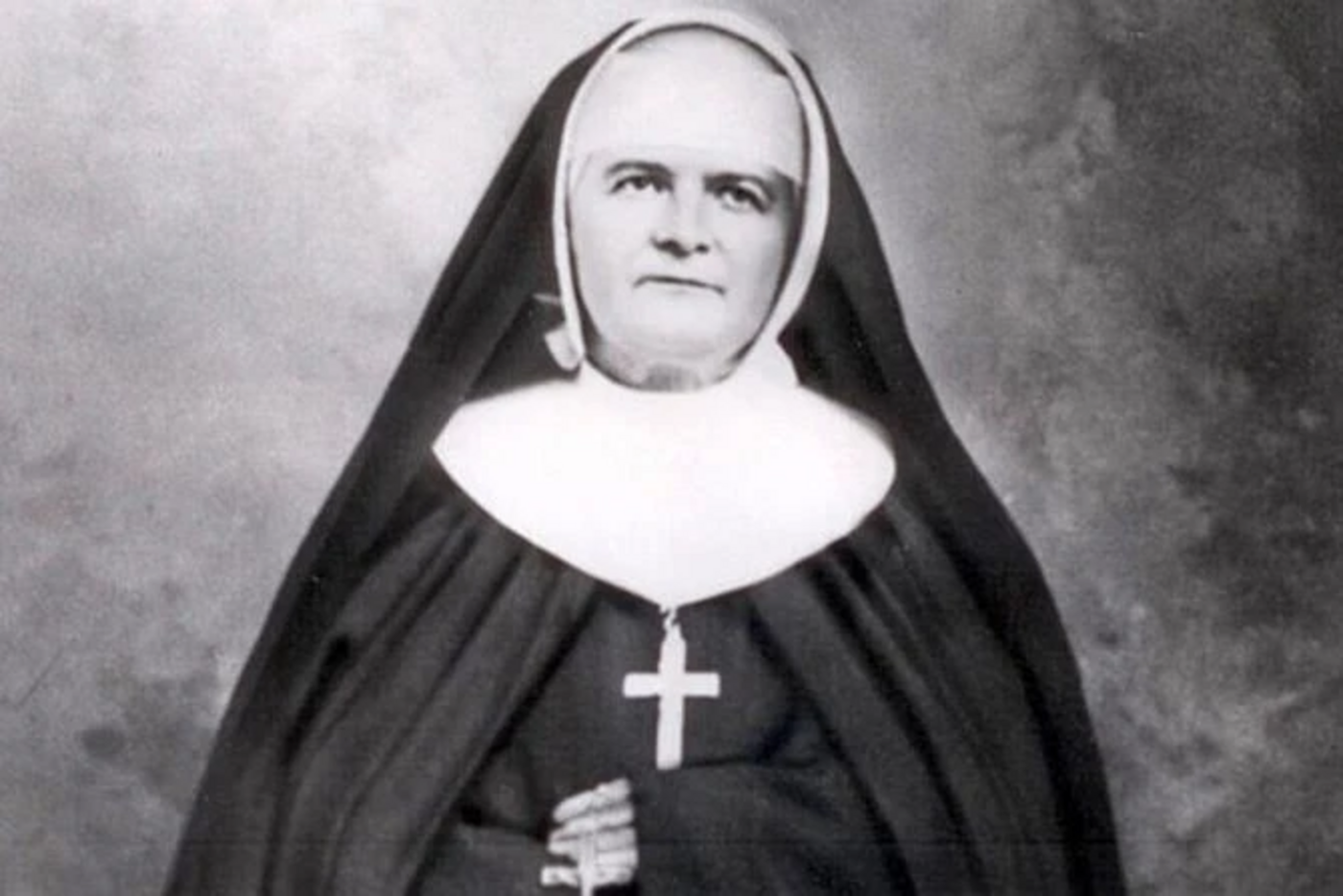
Canadian St. Marie-Leonie Paradis canonized in Rome
Pope Francis has canonized 14 new saints, including St. Marie-Leonie Paradis, a nun from Montreal known for founding an order dedicated to the service of priests.
In a Mass in St. Peter’s Square on Oct. 20, the Pope declared three 19th-century founders of religious orders and the 11 “Martyrs of Damascus” as saints to be venerated by the global Catholic Church, commending their lives of sacrifice, missionary zeal, and service to the Church.
“These new saints lived Jesus’ way: service,” Pope Francis said. “They made themselves servants of their brothers and sisters, creative in doing good, steadfast in difficulties, and generous to the end.”
The newly canonized include St. Giuseppe Allamano, a diocesan priest from Italy who founded the Consolata missionary orders, and Francis Massabki, a father of eight children and one of the Martyrs of Damascus, a group of 11 men killed in 1860 for refusing to renounce their Christian faith and convert to Islam.
Also among the saints are St. Elena Guerra, hailed as an “apostle of the Holy Spirit,” and St. Manuel Ruiz Lopez and his seven Franciscan companions, all martyred in Damascus in 1860 for refusing to renounce their Christian faith.
The final three canonized are siblings, Sts. Francis, Mooti, and Raphael Massabki, lay Maronite Catholics martyred in Syria along with the Franciscans.
Thousands of pilgrims prayed the Litany of the Saints together in St. Peter’s Square before Pope Francis declared the 14 as enrolled among the saints “for the honor of the Blessed Trinity, the exaltation of the Catholic faith, and the increase of the Christian life, by the authority of Our Lord Jesus Christ, and of the holy apostles Peter and Paul.”
“We confidently ask for their intercession so that we too can follow Christ, follow him in service, and become witnesses of hope for the world,” the Pope said.
In his homily, Pope Francis highlighted how service embodied the lives of each of the new saints. “When we learn to serve,” he said, “our every gesture of attention and care, every expression of tenderness, every work of mercy becomes a reflection of God’s love. And so we continue Jesus’ work in the world.”
St. Marie-Leonie Paradis: ‘humble among the humble’
St. Marie-Leonie Paradis (1840–1912), a Canadian religious sister, also took her place among the new saints. She founded the Little Sisters of the Holy Family, an order whose spirituality and charism is the support of priests through both prayer and by taking care of the cooking, cleaning, and laundry in rectories in “humble and joyful service” in imitation of “Christ the Servant.”
Letters: Dance coverage was slightly out of step
I appreciate your recent coverage of our event at Our Lady of the Assumption (“Starry-eyed young Catholics dance the night away”), but there were several inaccuracies that need to be addressed.
The event was organized solely by Our Lady of the Assumption, not in collaboration with the Catholic Young Adults of Surrey as stated.
The article implied the dance suffered from poor weather conditions; however, we experienced sunny and warm weather, which was ideal for the event. God graciously blessed us with a clear night sky. The original plan included a bonfire and sparklers, so everything went as intended.
While our previous event drew inspiration from NASA’s James Webb Space Telescope, this year’s inspiration was on fostering community among young adults in the archdiocese.
The article also inaccurately reported attendance as over 150 people, whereas we had over 200 participants at the dance.
Jose Lopez
Coquitlam
(We regret the errors, some of which were made because we accidentally referred to information from last year’s event—Editor)
I note that in Dr. Gerry Turcotte’s Oct. 21 column “Every day is Thanksgiving Day,” Pope John Paul XXIII is referenced.
I suspect that Dr. Turcotte isn’t intentionally foreshadowing the future but, in fact, means Pope John XXIII.
Mark Nikkel
Abbotsford
I would like to thank The B.C. Catholic for the comprehensive B.C. Election Catholic Voters Guide in Oct. 14 issue. It covered a wide breadth of issues that should be of concern to Catholics, helping us be better informed in deciding whom to vote for in the provincial elections.
Mark Norbury
Port Moody
(The lion’s share of the work, and credit, belongs to Catholic Conscience, which is now producing Catholic voter guides for elections all over North America. Check them out at catholiconscience.org—Editor)
I just want to thank Father Hawkswell for his clear and concise homily in the Oct. 21 issue, “Jesus didn’t leave behind a movement, but his Church.”
Ron Beaulieu
Powell River
Your voice matters! Join the conversation by submitting a Letter to the Editor here.
The synod might plug the hole in the ship
It was Christmas time when Joe came out to me as an atheist.
His text was unprompted and depressing: “My grandmother told me I was possessed by the devil when I told her I don’t believe in God anymore,” he wrote.
“I’m sorry, I just don’t feel anything anymore.”
Ultimately, this collision of his grandmother’s reference to the transcendent – albeit demonic – with his cynical millennial materialism was the final straw, and he embraced the creed of Dawkins and Hitchens shortly after.
His explanation was time spent on Reddit atheist forums and books about evolution; but I don’t think any of that is true. The real reason was right there in his message: “I just don’t feel…”
Around that same time, another Catholic school friend, again unprompted, confided in me that when we were kids he had wanted to be a priest. It clearly haunted him, but he managed to shrug it off.
“That was just brainwashing,” he said.
In spite of a gnawing sense of loss, he chose the same path most of us had at the time. Waiting at home was all the alcohol, video games, and porn anyone could ever hope would fill the void.
Somewhere in between the old-world faith of Joe’s grandmother and the early 2000s-era Catholicism that raised us, something went wrong for Joe and the rest of my cohort.
The faith had been offered, but for whatever reason, be it self-obsession or the influence of secular culture, he had found it wanting. Most, if not all, of my Catholic school friends – some far more sobre and faithful than Joe – took that same path towards the spiritual periphery that he did, and they wandered off into the spiritual wasteland.
A lot has been said about this phenomenon, about the rise of the so-called “nones,” those unchurched and unaffiliated wanderers. Various answers have been proposed, but one of the most interesting and explanatory has probably come from Bishop Robert Barron, who decries the impact of what he terms “beige Catholicism,” the bland cultural whitewash of the post-Vatican II era that eroded our sense of religious mystery and majesty, replacing them with kumbaya niceties and liberal affectations.
No redemptive suffering. No challenge. No adventure. Just comfort. The violence of the Crucifixion and the regal visage of Christ have no place in “beige Catholicism.” Only a bland and colourless gospel, bereft of all challenge and weight, can remain.
Perhaps this is a tad overwrought. After all, we all know good and faithful Catholics who made it through the beige haze – there would be no young people in the Church at all if they hadn’t – and Vatican II is hardly the sole cause of many of the most pressing crisis of the twentieth century Church.
Every day is Thanksgiving, so Happy Thanksgiving
I don’t often have fast food but on a whim I recently popped into an A&W near my campus. Waiting for my order, I noticed a wall decoration with the familiar company logo. Beneath the large letters, were the names Allen & Wright. There’s a phenomenon that was popular on social media recently that begins a discovery of something obvious with the phrase: “I was today year’s old when I discovered…” that A & W stood for the names of its founders.
Other “discoveries” people have made late in life include realizing the division sign (÷) is just a fraction sign with both the denominator and the numerator left blank. Or that a turtle isn’t inside its shell — it actually is its shell. As a specialist in the gothic, I was stunned to discover Grant Wood’s famous American Gothic painting Wood features a father and daughter, not a husband and wife. The story may be even more complex. Rumour has it the model, embarrassed at being mistaken for the wife of a man twice her age, went overboard reassuring everyone it was a father and daughter. The painter never corrected her nor confirmed her version.
Other discoveries: There’s a bear in the mountain face of a Toblerone chocolate bar. The hole in a pasta serving spoon represents the recommended single serving size. The word “footage” comes from film being measured in feet. The first episode of a television show is a “pilot” because it’s the first time it’s “on air.” You say “break a leg” to an auditioning actor in hope they end up in a cast. Hold your horses is a pun telling you to be stable. We are surrounded by things that are as plain as the nose on our faces but we never see, or perversely misapprehend, them.
I was easily in my late teens before I realized Canadian and American Thanksgiving are on different dates. Researching the origins of the event, I was stunned to read Martin Frobisher first celebrated Thanksgiving in 1578 on Baffin Island. It was not a celebration of a successful harvest, but sheer relief for successfully crossing the Atlantic into what would become Canada. Thanksgiving is also more popularly understood as the celebration of American Pilgrims in 1621, which has often been presented as a romanticized celebration of community between Indigenous people and settlers.
Thanksgiving isn’t a holy day of obligation but was always a part of parish life. Then I moved to Australia and a bunch of holidays shifted. Father’s Day was in September not June. Christmas was celebrated in July, a tradition that arose so Aussies could have a hot roast dinner in the cooler winter months.