
Epiphany: Finding ourselves changed at the manger
“When Jesus was born in Bethlehem of Judea, in the days of King Herod, behold, magi from the east arrived in Jerusalem, saying, ‘Where is the newborn king of the Jews? We saw his star at its rising and have come to do him homage.’” (Mt 2:1–2).
The Epiphany has always been a favourite feast of mine. I love hearing how the magi knew they needed to search for a king and how they found him in the humblest of circumstances. During Advent, I benefitted from daily reflections reminding me of the magi and their importance in the story of our salvation. In this article, I will share a collection of the words of wisdom I have recently acquired.
The magi brought their earthly gifts to the Christ-Child and then returned home a different way due to the threat of King Herod. Not unlike today, Christianity from the beginning was humbling, uncomfortable, and even dangerous. Emily Stimpson Chapman reflects on the fact that being Christian is worth the risks:
“Look at the babe in the manger and the man on the cross and bow down before him in wonder, gratitude, and awe. Let the holy fire of his love wash over you. Trust it. Risk everything for it. Risk everything to share it, too. Because in the end, it’s the only love worth having. It is not safe. But it is real. It is glorious. And it does save.”
Author Danielle Bean reflected, “The regal splendor of the magi contrasts with the simplicity of the manger, reminding us of Mary’s song in the Magnificat: ‘He has cast down the mighty from their thrones and has lifted up the lowly’ (Lk 1:52). In Baby Jesus, we see the perfect union of humility and exaltation. God humbles himself, taking on human flesh, so that we may be lifted into his divine life. Where is God inviting us to be humbled and where does he desire to lift us up? When we lay down our pride and earthly treasures at his feet, we open ourselves to joy.”
In examining Botticelli’s painting, Adoration of the Magi, Bean also writes, “This scene weaves together majesty and humility. Kings bow before the infant Jesus, beautifully reflecting Jesus’ words: ‘The first will be last, and the last will be first’ (Mt 20:16). Though the magi were esteemed in the eyes of the world, they laid their treasures at the feet of a child born in poverty, acknowledging him as the King of Kings. God calls us to reorder our priorities. Are we putting Christ first in our hearts, or are we clinging to worldly distractions? By humbling themselves, the magi found their true treasure in Jesus.”
At creation, God had baptism in mind
Baptism of the Lord, Year C
First Reading: Is 40:1–5, 9–11
Second Reading: Ti 2:11–14; 3:4–7
Gospel Reading: Lk 3:15–16, 21–22
In 1955, Pope Pius XII separated the Feast of the Lord’s baptism from the Epiphany (then Jan. 6) and moved it to Jan. 13. In 1969, Pope St. Paul VI transferred it to the Sunday after Jan. 6. In 1996, Pope St. John Paul II made Christ’s baptism one of the Luminous Mysteries of the Rosary.
Why is it so important? John proclaimed “a baptism of repentance for the forgiveness of sins,” but Jesus was sinless; why did he need baptism?
Jesus first took on the sin of the human race at his Incarnation, when he became man. With his baptism, at the beginning of his public life, he accepted and inaugurated “his mission as God’s suffering Servant,” allowing “himself to be numbered among sinners,” says the Catechism of the Catholic Church. As John realized, he was already “the Lamb of God, who takes away the sins of the world.”
Jesus told Nicodemus that to enter God’s Kingdom, he must be “begotten from above” of “water and Spirit.” Just before his Ascension, he told his apostles that anyone who believes in the good news and “accepts baptism will be saved,” while he who “refuses to believe in it will be condemned.”
Baptism is “the basis of the whole Christian life,” the Catechism says: the “gateway” to supernatural life and “the door which gives access” to the other sacraments, all of which “are efficacious signs of grace, instituted by Christ and entrusted to the Church, by which divine life is dispensed to us.”
The ordinary minister of baptism is a bishop, priest, or deacon, but “in case of necessity such as danger of death, anyone may baptize”—and anyone should know how to.
Some years ago, a young man who had intended to become Catholic but had to relinquish his studies twice due to cancer returned to China to die. There, in an ICU where only his father, a Buddhist monk, was admitted, he asked to be baptized. His father phoned a woman who had taken my course The Catholic Faith in Plain English, and she, reading from my material, told him what to do: pour water three times over his son’s head, saying, at the same time, “I baptize you in the name of the Father, and of the Son, and of the Holy Spirit.”
By the power of the Holy Spirit, that water and those words actually accomplished what they signified: namely death to sin and rebirth into the life of the Holy Trinity.
Indeed, water—which drowns us, cleanses us, refreshes us, and keeps us alive—symbolizes baptism very clearly.
Canadian group that led push to MAiD warns of abuse of system
An activist group that led the push to legalize medical aid in dying (MAiD) in Canada is now warning that additional government safeguards are needed to combat reports of abuse of the program.
Liz Hughes, executive director of the British Columbia Civil Liberties Association (BCCLA), told the National Post that the organization has become “aware of concerning reports of people being offered MAID in circumstances that may not legally qualify as well as people accessing MAID as a result of intolerable social circumstances.”
The BCCLA was a key figure in Canada’s legalization of euthanasia, having filed the suit Carter v. Canada that led to the Supreme Court of Canada’s striking down the government ban on the procedure.
In the roughly nine years since euthanasia became legal in Canada in 2016, the practice has become increasingly popular. The latest government figures, released this month, showed another double-digit year-over-year increase in the procedure, with 15,343 Canadian citizens euthanized by medical officials in 2023, accounting for 1 in 20 deaths there.
Yet a bombshell report in November revealed that out of hundreds of violations of the country’s controversial euthanasia law over the course of several years, none of them have been reported to law enforcement, with whistleblowers warning of numerous “issues with compliance” in reportage.
Hughes told the National Post that the country’s federal and provincial governments “must put in place, actively review, and enforce appropriate safeguards to ensure that people are making this decision freely.”
The civil rights organization “will continue to hold the government accountable” for its policing of the euthanasia program, she said.
At its launch, the country’s euthanasia regime was billed as a last-resort choice for terminally ill adults undergoing terrible suffering. In the years since, however, activists have called for its expansion to include much broader categories of applicants.
An activist group sued the federal government earlier this month, calling for an immediate expansion of the country’s euthanasia program to allow physician-assisted suicide for those suffering from mental illness.
The federal government had earlier been set to expand the program to those with mental illnesses; that measure was delayed early this year and is now projected to take effect in 2027.
The Quebec government last month began allowing assisted suicide for individuals who cannot consent at the time of the procedure, permitting “advance requests” by those who have “been diagnosed with a serious and incurable illness leading to incapacity” such as Alzheimer’s disease.
The federal government, meanwhile, is actively soliciting citizen input for a proposal to legalize “advance requests” at the national level.
Your voice matters! Join the conversation by submitting a Letter to the Editor here.
Mary a sign of ‘certain hope’ in the Jubilee Year
On Wednesday, Jan. 1, we celebrate the Solemnity of Mary, the Mother of God, a holy day of obligation for Catholics.
The Gospels usually call Mary “the mother of Jesus,” but when Mary greeted her cousin Elizabeth after conceiving Jesus, Elizabeth cried out: “Who am I that the mother of my Lord should come to me?”
This was the first use of the title “mother of the Lord” or its equivalent, “mother of God.” (Out of respect, the Jews always substituted God’s title, “Lord,” for his name.) However, it continued to be used.

It went unchallenged until the fifth century, when Bishop Nestorius of Constantinople began to argue that Mary had given birth to Christ’s human nature, but not his divine nature. However, St. Cyril of Alexandria noted that a mother gives birth to a person, not a nature, and that Christ is one person, although he has two natures.
Finally, at the Council of Ephesus in 431, under Pope Celestine I, the Church declared Mary to be “the mother of God because God the Word took flesh and became man and from his very conception united to himself the body he took from her.”
Mary did not originate God, but she “mothered” him in the sense that a man “fathers” a child.
Thus God began the events that led up to our redemption – the only secure grounds we have for hope even today.
On Ascension Sunday, May 9, 2024, Pope Francis issued a “Bull of Indiction” entitled Spes Non Confundit (Hope Does Not Disappoint), proclaiming 2025 a Jubilee or Holy Year, starting throughout the world on Dec. 29, 2024, and ending on Dec. 28, 2025.
By ancient tradition, the Pope proclaims a jubilee year every 25 years. This one will lead up to the extraordinary jubilee of 2033, the 2,000th anniversary of our redemption.
“We need to recognize the immense goodness present in our world, lest we be tempted to think ourselves overwhelmed by evil and violence,” Pope Francis said. “The signs of the times, which include the yearning of human hearts in need of God’s saving presence, ought to become signs of hope.”
He cited the widespread desire for peace and the enthusiasm for life – the “joy of living” – that leads married couples to have children.
He called on Catholics to become “tangible signs of hope” to prisoners, migrants, the sick, the disabled, the young, the elderly, and the poor. In the spirit of Old Testament jubilees, he implored “the more affluent nations” to “acknowledge the gravity of so many of their past decisions and determine to forgive the debts of countries that will never be able to repay them.”
‘Recognize the Child Jesus in faces of the world’s children,’ Archbishop Miller says in Christmas message
Dear brothers and sisters:
“To you is born this day in the city of David a Saviour, who is Christ the Lord” (Lk 2:11). Those words spoken by the Angel in the heavens above Bethlehem so long ago are just as clearly addressed to us today. That the Lord has been born for us fills us with hope and trust because the Son of God has made his home among us. This is the good news that has changed the course of history and the life of each one of us.
As we look towards the upcoming Jubilee Year of Hope, we recall that the reason for our hope is this: God is with us; he accompanies us; he is always by our side.
I encourage you in these special days to kneel before the Nativity scene to experience the joy that comes from the nearness of Jesus, the tenderness of God himself. With haste and enthusiasm, let us set out to see the Saviour lying in the poverty of the manger and adored by Mary, Joseph, the Angels, and the shepherds.
This Christmas I invite you to recognize the Child Jesus in the faces of the world’s children. From the manger, this Child directs our gaze to all children who are suffering and abused: to children killed in their mother’s womb; to children brutalized in their homes by terrorists; to children hiding underground to escape bombardment; to children at the bottom of a boat overladen with immigrants; to children who go to school hungry in our own City; to children without the blessing of a happy family home; to children who are victims of human trafficking, the pornography industry and every kind of appalling exploitation in our own Downtown Eastside.
Born of the Virgin Mary, God became man in the Child Jesus, the Saviour of the world. May he who is “the light of the world” (Jn 8:12), enter your hearts, brighten your homes, bring hope to our City, and grant peace and bring joy to the whole world.
With the assurance of my prayers for you and your families, I wish you all a blessed Christmas season.
Your voice matters! Join the conversation by submitting a Letter to the Editor here.
‘Promise of salvation is ours’: Canadian bishops’ Christmas message
Below is the Christmas message from the Canadian Conference of Catholic Bishops.
Dear brothers and sisters in Christ,
A Saviour has been born for us; a Son has been given to us.
Christ, who in his birth and in becoming human has allowed us to share in the glory of his immortal nature. He has freed us from death, and the power of sin and darkness. This promise of salvation is ours and thus we rejoice in the knowledge that God is with us.
In our world overshadowed by war, injustice, oppression, division and selfish concerns the Good News proclaimed by Christ continues to offer us a message of salvation and hope. His words speak to us today, they reassure us, and fill us with hope:
Peace I leave with you, my peace I give to you.
Do not let your hearts be troubled, and do not let them be afraid.
I am the way, and the truth and the life.
I am the good shepherd.
I am the bread of life.
On 29 December 2024 the solemn opening of the Jubilee Year of Hope will take place in the cathedrals across Canada. In announcing the Jubilee year Pope Francis wrote: “The Holy Spirit illumines all believers with the light of hope. He keeps that light burning, like an ever-burning lamp, to sustain and invigorate our lives. Christian hope does not deceive or disappoint because it is grounded in the certainty that nothing and no one may ever separate us from God’s love.”
May the light of hope illuminated by the Holy Spirit burn within our hearts this Christmas. May the light of God’s love shine through us, and may our witness of faith be an invitation for others to believe in the gift of salvation that Christ offers to all, and most especially in this upcoming Jubilee year.
Wishing you a Merry Christmas and a blessed New Year 2025!
The Most Rev. William McGrattan
Bishop of Calgary
President of the Canadian Conference of Catholic Bishops
Your voice matters! Join the conversation by submitting a Letter to the Editor here.
Bible translation brings Word to Mohawks
Since being named co-chair of the Roman Catholic Evangelical Dialogue Group in 2018, Bishop Joseph Dabrowski has done extensive work promoting unity and understanding among Christian traditions.
Bishop Dabrowski and others within the group have also been involved in educating themselves on issues of reconciliation and establishing healthy relations with Indigenous communities across the country.
Through this work, the Bishop of Charlottetown discovered a poignant testament to a lifetime of reconciliation in practice, which lay in the story of Harvey Satewas Gabriel.
The Indigenous elder from the Mohawk community of Kanesatake, south of Montreal, met with Bishop Dabrowski as part of the dialogue group’s visit in June. Following conversations on the importance of reconciliation and harmonious relationships between the two parties, Gabriel presented Bishop Dabrowski with the culmination of nearly two decades of his life’s work — a Bible translated into Mohawk.

“It was a profoundly inspiring experience, and what initially struck me was that despite his age, he spoke with eloquence, passion, and humility about his remarkable dedication to translating the Bible into Mohawk,” Bishop Dabrowski said. “We asked him to pray with us, and hearing him recite the Lord’s Prayer in his native Mohawk was moving. It brought the language to life in such a meaningful way.”
Now 83, Gabriel told the group the translation has taken nearly 17 years to complete. To the elder, the Mohawk Bible is not a translation for leisure but rather a testament to preserving his culture while making the word of God accessible to his people, the Mohawk Nation, which is part of the Haudenosaunee or Iroquois Confederacy in the St. Lawrence region of Canada and upper New York State.
The story goes that upon hearing his church minister translate Scripture into Mohawk in the late 1950s, Gabriel began wondering why there wasn’t a Bible in Mohawk. This sparked a lifelong journey that culminated in August 2023 when the Bible was completed.

To Bishop Dabrowski, the Mohawk Bible is more than a physical collection of books crafted with materials; it is a tangible sign that reconciliation and mutual respect between Christians and their Indigenous brothers and sisters is indeed a two-way street.
“Gabriel’s story demonstrates how Indigenous communities are not just recipients in the reconciliation process but active contributors as well. I was pleased to hear that he continues to encourage young people not to lose their language and to do so by reading the Bible,” he said. “I was also stunned to hear that a passage from his translation of the Book of Revelation was read aloud at Queen Elizabeth II’s funeral in Toronto, so it is already being shared in the country.”
Toronto Cardinal Leo finds strength in prayer, Mary, supporters
Describing the Papal Consistory that welcomed him and 20 other leaders of the Catholic Church into the College of Cardinals as “very profound” and “beautiful,” Cardinal Francis Leo of the Archdiocese of Toronto has deeply contemplated the prayers recited during the Dec. 7 ceremony in the Vatican.
“What does it mean,” pondered Leo during a joint interview with The Catholic Register and Salt + Light TV at the Canadian Pontifical College on Dec. 9. “It’s a ritual, a liturgy, but what’s its significance? The deep significance in the life of the Church and the witnessing of the Church in the world today. All of these thoughts came together, and interiorly renewing my own faith and my commitment to Christ and the Holy Mother Church to serve faithfully.”
The inspiration of Mother Mary was knitted close to the 53-year-old Montreal native’s heart during this weekend of both elevation and humility. A devout Marian with a degree in Mariology from the University of Dayton — he also co-founded the Canadian Mariological Society — Leo treasured the gift of his first Mass as cardinal-archbishop occurring on the Dec. 8 Solemnity of the Immaculate Conception.
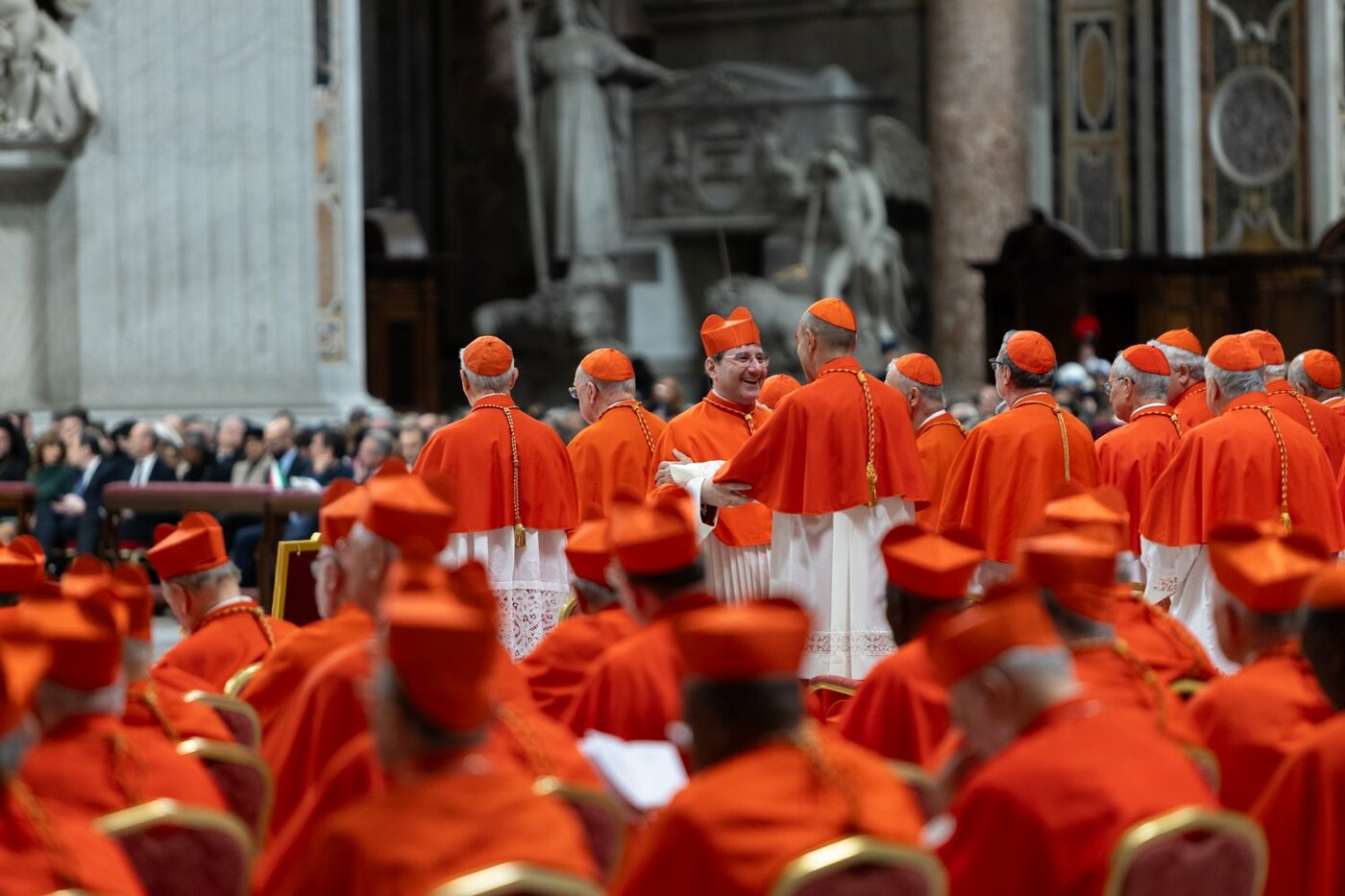
“It’s God saying, ‘I’m here and I’m here for you, I love you and I’m guiding you,’ ” said Leo. “I see her presence very strongly this week. Indications here and there of the gift that she is and her maternal care for me and the Church.”
Leo said he also felt the prayers of both the hundreds of pilgrims who accompanied him to Rome and his supporters back home in Canada. He also drew strength from being in Rome.
“We’re sharing the same faith with the apostles of Christ,” said Leo. “That is very touching. In the continuity of 2,000 years of the Church, of the Holy Spirit who is the soul of the Church enacted in the Church.”
Looking forward, Leo’s advancement into the cardinalate will be celebrated in Toronto, commencing with a special invite-only Mass at St. Michael’s Cathedral Basilica on Jan. 15. In late January and throughout February, liturgies and receptions will be held in the western, northern, central and eastern regions of the archdiocese.
The new Cardinal will also spiritually guide his flock throughout the 2025 Jubilee declared by Pope Francis. He anticipates that “the Lord wants to pour out generously into our hearts many graces — graces of conversion, graces that will deepen our faith, and graces of prayer, healing and liberation.”
Leo will inaugurate the year-long celebrations with a 5 p.m. Mass at St. Michael’s on Dec. 29. Many archdiocesan committees are planning a series of activities and celebrations at designated parishes.
Letters: grateful for Simbang Gabi
Every time I hear Simbang Gabi songs in the church, I cannot help but tear up. My heart swells with gratitude that Christianity was introduced to the Philippines by the Spaniards.
We have overcome many difficulties to arrive where we are now. No cross was ever wasted, and no achievement forgotten. The Filipino people in Canada invite other cultures to experience the Simbang Gabi tradition: a loving remembrance and thanksgiving to the Lord for being one of us except sin; expressing kindness and generosity to one another and sharing whatever we have, big or small, out of the kindness of our hearts.
Maligayang Pasko (Merry Christmas)
Rita Castillo
Vancouver
Thank you for reporting some of the falsehoods in the stories that have come out about the so-called genocide of Native People in Canada. I hope you will continue to correct this and help prevent a new law criminalizing denial of this.
There was much good done to help the Natives. Yes, there were abuses, but nothing like what has been reported. In the Fifties and Sixties in the public school system there were many problems also. It should not be a past that we are forbidden to investigate or comment on.
John Turner
Kelowna
Your voice matters! Join the conversation by submitting a Letter to the Editor here.
The fairways have withered: remembering Bishop Fred Henry
Whoever aspires to the office of bishop desires a noble task. (1 Tim 3:1)
Driving to work one cold January day in 2016, I heard an announcement on the radio that the Bishop of the Diocese of Calgary, Frederick B. Henry, was officially announcing his retirement after 19 years as a bishop.
I can’t say I was surprised, but I certainly felt a tug of sadness. Bishop Henry was the first bishop I served under as president of St. Mary’s University in Calgary. He was chancellor of the university, and as such, we worked side by side on many projects for almost six years.
Our projects included convocations, opening and closing term liturgies, five Bishop’s Dinners, fundraising events, and more. In all of these, the diminutive giant, as I called him, towered good-naturedly over his community.
He was, as many know, a fearless advocate for the faith, sometimes adopting a take-no-prisoners position, at others humbly tending to parishioners in their time of need. Through it all, his sense of humour knew no bounds.
One of my first exchanges with Bishop Henry was not what some might expect. I recall, at the very start of my presidency, sitting at my kitchen table with my children when the phone rang.
The conversation went something like this:
“Gerry?”
“Yes?”
“This is Bishop Henry. You’re golfing with me at the charity tournament next week.”
I hung up the phone and looked at my kids: “I have to learn to play golf.”
That tournament was one of the most stressful public events I have ever attended. To suggest that my golf game was execrable is to be charitable, and not in a fundraising way.
In fact, as I moved towards the cart for the first time on that fateful day, someone leaned towards me pityingly. “He got two holes-in-one last year.”
As we approached the first hole, I gamely suggested: “You’ll need to be a bit patient. This is the first time I’ve ever golfed.”
Bishop Henry stared at me with those piercing eyes of his. “Charity is for the Church! This is golf. You’re on your own.”
But as he prepared to tee off for the first time, he looked back at me: “You know, I got two holes-in-one last year.”
Later, during the speeches, he singled me out for special mention. Hopeful for words of encouragement about the heroic effort I’d made on the golf course, he said to the crowd: “There’s only one person who can help Gerry’s golf game. St. Jude.”
The saint for hopeless causes.
On all other matters, Bishop Henry was unbelievably supportive.
He loved students and encouraged them in their faith life, applauded their commitment to community service, and looked for ways to be present despite the crippling workload that all bishops carry.