
About St. Anthony
by Lyndon Little
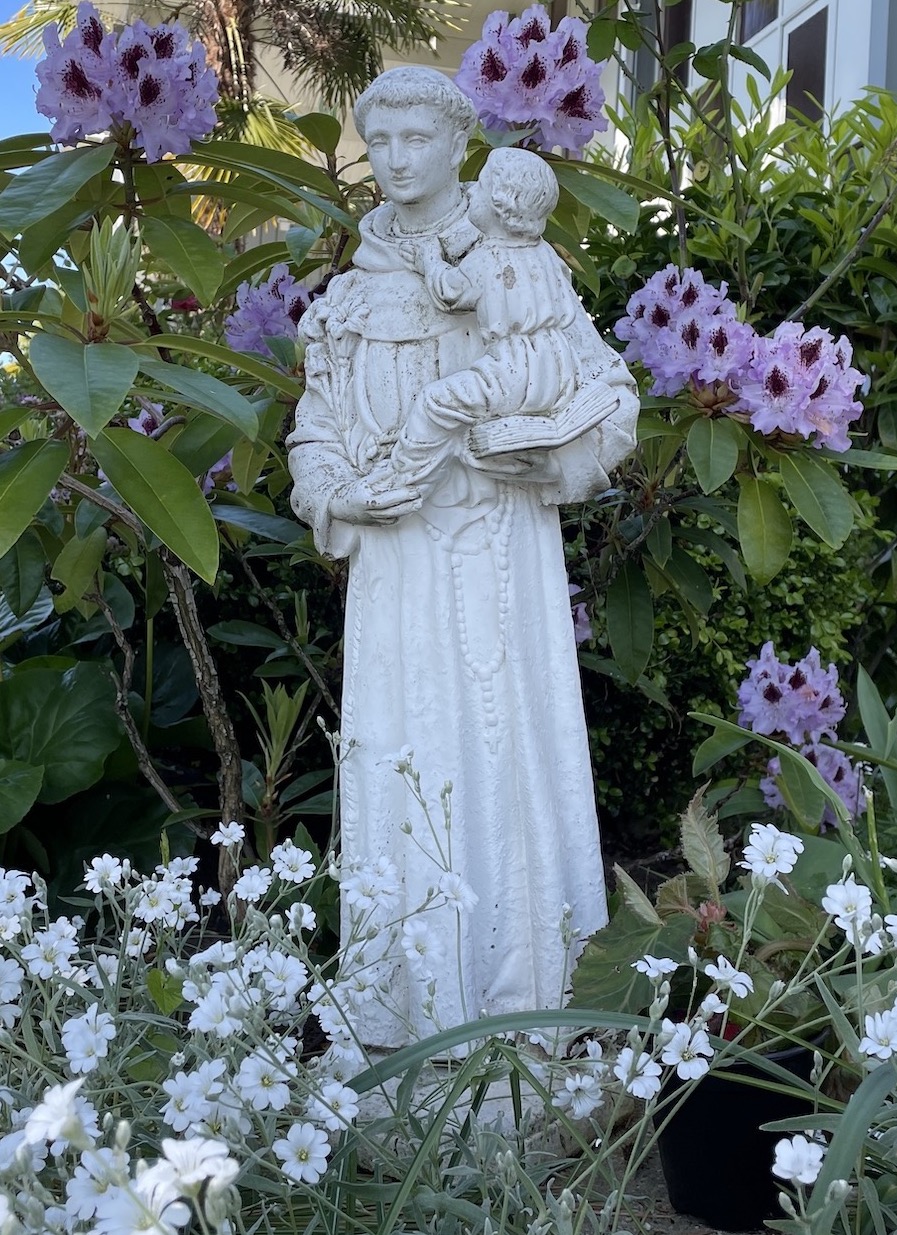 St. Anthony of Padua — a Franciscan friar and the patron saint after whom our parish is named — is a man worthy of serving as an inspiration to all of us for his selfless devotion to our Lord in his preaching of the gospel and service to the poor.
There is actually another famous St. Anthony celebrated by the Catholic Church — St. Anthony of Egypt, who lived about nine centuries before the one who has lent his name to our parish. When St. Anthony’s, West Vancouver, was first established as a mission in 1921 a wealthy patron from Eastern Canada requested our church be named after his favourite saint.
St. Anthony of Padua is known as one of the most celebrated followers of St. Francis of Assisi, founder of the Order of St. Francis.
Our St. Anthony was born in 1195 in Lisbon into a rich and powerful Portuguese family. His life, which lasted only 36 years, can be divided into three distinct phases. He lived 15 years with his parents, 10 years as a Canon Regular of St. Augustine — primarily at Coimbra, Portugal — and 11 as a member of the Order of St. Francis.
During his time in Coimbra, Anthony was so impressed by some of the Franciscan monks who visited there before being martyred in Morocco that soon after in 1220 he asked to be allowed to join the Friars Order, taking the name by which we know him today (he had been baptized at birth as Ferdinand).
After joining the Franciscan Order, Anthony sailed for Morocco in hopes of continuing his mission with his new order. Unfortunately, he was soon struck by illness and was forced to return to Portugal. During the intended voyage home, his ship was driven by a storm onto the coast of Sicily where he remained for some time until he recovered his health.
St. Anthony eventually made his way to Assisi in Italy where his knowledge and contemplative nature attracted the attention of St. Francis himself, who chose him to teach theology to the friars in Bologna and Padua. Whether St. Anthony and St. Francis actually met face-to-face is a matter of debate among religious scholars. However, what is known is that St. Anthony was sent to France a few years later where he began preaching and teaching. It was during this period of his life that his reputation as a charismatic orator began to spread. His fame was such, it is said he drew crowds so large he often spoke in market places rather than in churches.
He was especially noted for attacking the vices of luxury, avarice and heresy.… Read more “About St. Anthony”
History of St. Anthony’s Roman Catholic Parish
By Patrick Raynard
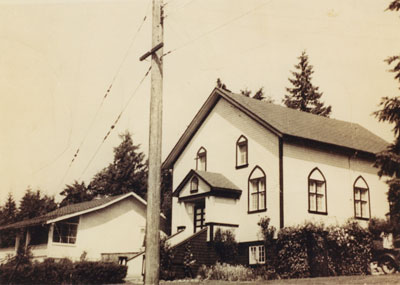 The Roman Catholic presence on the North Shore began almost 160 years ago when the Oblate Missionaries and Chief Snatt of the Squamish First Nation built a mission chapel in what is now North Vancouver. The 1866 building was renovated in 1909 and renamed St. Paul’s in honour of Vancouver Bishop Paul Durieu.
West Vancouver was born from a cluster of summer cabins that were built at Ambleside Beach in the 1880s, following the building of the first lighthouse at Point Atkinson in 1875. The population grew after a ferry connected Vancouver to the foot of Lonsdale in 1890 and Ambleside in 1910. West Vancouver became a municipality in 1912, with a population of 1,500, but Catholic residents had to travel to North Vancouver until one of the Oblates started celebrating Mass in the Ambleside cabins in 1915. Around this time building lots in West Vancouver sold for $450.
As West Vancouver’s Catholics grew in number, their need for larger Mass locations took them from Ambleside Hall to a Dundarave building later known as Sager’s Maple Shop and from there to the Clachan Hotel at the foot of 25th Street (which became Peppi’s Restaurant and is now the Beach House.) Catholic children took the Pacific Great Eastern (PGE) train to North Vancouver and walked up to St. Edmund’s parish where the Sisters of the Child Jesus taught them Catechism and prepared them for the Sacraments.
In 1920, West Vancouver’s 20 Catholic families petitioned Bishop Timothy Casey for a church of their own. He responded by sending an Oblate from St. Paul’s, Father W. Brabender, to establish a mission parish and to start plans for a building at the confluence of Inglewood and Haywood Avenues (where the present church stands); the far-sighted Archdiocese had purchased a property there in 1912. An anonymous wealthy donor from Eastern Canada asked that the parish be named after St. Anthony of Padua.
Father Brabender celebrated the first Mass in the incomplete new church in the early 1920s. The building held 150 people; the Squamish First Nation donated most of the furniture, the sacred vessels, and the bell. In 1924 Bishop Timothy Casey elevated the mission to the status of a full parish, thanked the Oblates for their services, and appointed Father Alex McDonald as the first official pastor. There being no rectory, Father McDonald roomed in the Clachan Hotel.
The next pastor was Father John Kelley, on loan from a diocese in New Mexico, who operated from his sister’s home on Haywood Avenue. His greatest challenge was heating the entire church from one wood-burning stove; he never succeeded and delivered his winter homilies wrapped in a woollen blanket.… Read more “History of St. Anthony’s Roman Catholic Parish”
Our Beliefs
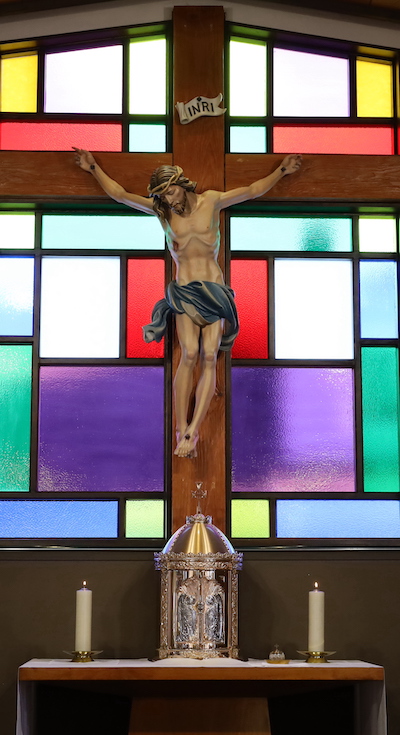 We believe in Jesus Christ.
Jesus Christ is the Son of God, sent to mankind by the Father, so that we may all have everlasting life. We believe that Jesus walked here on earth, just like you and me. He was conceived by the Holy Spirit and was born of the Virgin Mary in a humble manger in Bethlehem. We believe in the Incarnation – that God was made man without ceasing to be God. Thus He is true God and true man. This man is Jesus Christ. Through Him we are called to be heirs of the Kingdom of Heaven. Jesus is the second person of the Holy Trinity: God the Father, God the Son, and God the Holy Spirit.
We have Good News.
God created the heavens and the earth, and all who live in it. As His sons and daughters, we were created to be in relationship with Him forever in paradise. However, through the fault of our first parents, Adam and Eve, sin entered and broke our relationship with God. This created a great divide between us, a barrier that we can never fix on our own. Because of this, God sent His only begotten Son, Jesus Christ, to reconcile us to Him. Jesus was condemned to suffer for our sake — leading to His death on the cross. His death bore our sin and shame and through this one act of love He fixed the broken relationship between us and the Father. We believe that Jesus died and went to the grave, and that in three days He rose again in glory. Through His death and resurrection, He conquered sin. His victory over death is our hope and our salvation. Through Christ we can rise again and through Him we are invited into the heavenly inheritance that awaits us. This is the Gospel or the Good News as we call it. However, it does not end there. The Good News is about hope and the invitation that follows it. It is an invitation to get to know the person of Jesus Christ, in whom we place our trust. It is an invitation to say yes to Him and to encounter the Church.
We belong to a very big family.
During His time on earth, Jesus moved the hearts of many followers. He especially transformed 12 Apostles that He called by name and gave them authority to take care of the Church that He started on Earth. Jesus promised His believers that when He returns to Heaven, He will send for us an advocate. On Pentecost, the Holy Spirit came down to the early Church giving courage to the apostles to become fearless and courageous witnesses to Christ.… Read more “Our Beliefs”