
‘Recognize the Child Jesus in faces of the world’s children,’ Archbishop Miller says in Christmas message
Dear brothers and sisters:
“To you is born this day in the city of David a Saviour, who is Christ the Lord” (Lk 2:11). Those words spoken by the Angel in the heavens above Bethlehem so long ago are just as clearly addressed to us today. That the Lord has been born for us fills us with hope and trust because the Son of God has made his home among us. This is the good news that has changed the course of history and the life of each one of us.
As we look towards the upcoming Jubilee Year of Hope, we recall that the reason for our hope is this: God is with us; he accompanies us; he is always by our side.
I encourage you in these special days to kneel before the Nativity scene to experience the joy that comes from the nearness of Jesus, the tenderness of God himself. With haste and enthusiasm, let us set out to see the Saviour lying in the poverty of the manger and adored by Mary, Joseph, the Angels, and the shepherds.
This Christmas I invite you to recognize the Child Jesus in the faces of the world’s children. From the manger, this Child directs our gaze to all children who are suffering and abused: to children killed in their mother’s womb; to children brutalized in their homes by terrorists; to children hiding underground to escape bombardment; to children at the bottom of a boat overladen with immigrants; to children who go to school hungry in our own City; to children without the blessing of a happy family home; to children who are victims of human trafficking, the pornography industry and every kind of appalling exploitation in our own Downtown Eastside.
Born of the Virgin Mary, God became man in the Child Jesus, the Saviour of the world. May he who is “the light of the world” (Jn 8:12), enter your hearts, brighten your homes, bring hope to our City, and grant peace and bring joy to the whole world.
With the assurance of my prayers for you and your families, I wish you all a blessed Christmas season.
Your voice matters! Join the conversation by submitting a Letter to the Editor here.
‘Promise of salvation is ours’: Canadian bishops’ Christmas message
Below is the Christmas message from the Canadian Conference of Catholic Bishops.
Dear brothers and sisters in Christ,
A Saviour has been born for us; a Son has been given to us.
Christ, who in his birth and in becoming human has allowed us to share in the glory of his immortal nature. He has freed us from death, and the power of sin and darkness. This promise of salvation is ours and thus we rejoice in the knowledge that God is with us.
In our world overshadowed by war, injustice, oppression, division and selfish concerns the Good News proclaimed by Christ continues to offer us a message of salvation and hope. His words speak to us today, they reassure us, and fill us with hope:
Peace I leave with you, my peace I give to you.
Do not let your hearts be troubled, and do not let them be afraid.
I am the way, and the truth and the life.
I am the good shepherd.
I am the bread of life.
On 29 December 2024 the solemn opening of the Jubilee Year of Hope will take place in the cathedrals across Canada. In announcing the Jubilee year Pope Francis wrote: “The Holy Spirit illumines all believers with the light of hope. He keeps that light burning, like an ever-burning lamp, to sustain and invigorate our lives. Christian hope does not deceive or disappoint because it is grounded in the certainty that nothing and no one may ever separate us from God’s love.”
May the light of hope illuminated by the Holy Spirit burn within our hearts this Christmas. May the light of God’s love shine through us, and may our witness of faith be an invitation for others to believe in the gift of salvation that Christ offers to all, and most especially in this upcoming Jubilee year.
Wishing you a Merry Christmas and a blessed New Year 2025!
The Most Rev. William McGrattan
Bishop of Calgary
President of the Canadian Conference of Catholic Bishops
Your voice matters! Join the conversation by submitting a Letter to the Editor here.
Bible translation brings Word to Mohawks
Since being named co-chair of the Roman Catholic Evangelical Dialogue Group in 2018, Bishop Joseph Dabrowski has done extensive work promoting unity and understanding among Christian traditions.
Bishop Dabrowski and others within the group have also been involved in educating themselves on issues of reconciliation and establishing healthy relations with Indigenous communities across the country.
Through this work, the Bishop of Charlottetown discovered a poignant testament to a lifetime of reconciliation in practice, which lay in the story of Harvey Satewas Gabriel.
The Indigenous elder from the Mohawk community of Kanesatake, south of Montreal, met with Bishop Dabrowski as part of the dialogue group’s visit in June. Following conversations on the importance of reconciliation and harmonious relationships between the two parties, Gabriel presented Bishop Dabrowski with the culmination of nearly two decades of his life’s work — a Bible translated into Mohawk.

“It was a profoundly inspiring experience, and what initially struck me was that despite his age, he spoke with eloquence, passion, and humility about his remarkable dedication to translating the Bible into Mohawk,” Bishop Dabrowski said. “We asked him to pray with us, and hearing him recite the Lord’s Prayer in his native Mohawk was moving. It brought the language to life in such a meaningful way.”
Now 83, Gabriel told the group the translation has taken nearly 17 years to complete. To the elder, the Mohawk Bible is not a translation for leisure but rather a testament to preserving his culture while making the word of God accessible to his people, the Mohawk Nation, which is part of the Haudenosaunee or Iroquois Confederacy in the St. Lawrence region of Canada and upper New York State.
The story goes that upon hearing his church minister translate Scripture into Mohawk in the late 1950s, Gabriel began wondering why there wasn’t a Bible in Mohawk. This sparked a lifelong journey that culminated in August 2023 when the Bible was completed.

To Bishop Dabrowski, the Mohawk Bible is more than a physical collection of books crafted with materials; it is a tangible sign that reconciliation and mutual respect between Christians and their Indigenous brothers and sisters is indeed a two-way street.
“Gabriel’s story demonstrates how Indigenous communities are not just recipients in the reconciliation process but active contributors as well. I was pleased to hear that he continues to encourage young people not to lose their language and to do so by reading the Bible,” he said. “I was also stunned to hear that a passage from his translation of the Book of Revelation was read aloud at Queen Elizabeth II’s funeral in Toronto, so it is already being shared in the country.”
Toronto Cardinal Leo finds strength in prayer, Mary, supporters
Describing the Papal Consistory that welcomed him and 20 other leaders of the Catholic Church into the College of Cardinals as “very profound” and “beautiful,” Cardinal Francis Leo of the Archdiocese of Toronto has deeply contemplated the prayers recited during the Dec. 7 ceremony in the Vatican.
“What does it mean,” pondered Leo during a joint interview with The Catholic Register and Salt + Light TV at the Canadian Pontifical College on Dec. 9. “It’s a ritual, a liturgy, but what’s its significance? The deep significance in the life of the Church and the witnessing of the Church in the world today. All of these thoughts came together, and interiorly renewing my own faith and my commitment to Christ and the Holy Mother Church to serve faithfully.”
The inspiration of Mother Mary was knitted close to the 53-year-old Montreal native’s heart during this weekend of both elevation and humility. A devout Marian with a degree in Mariology from the University of Dayton — he also co-founded the Canadian Mariological Society — Leo treasured the gift of his first Mass as cardinal-archbishop occurring on the Dec. 8 Solemnity of the Immaculate Conception.
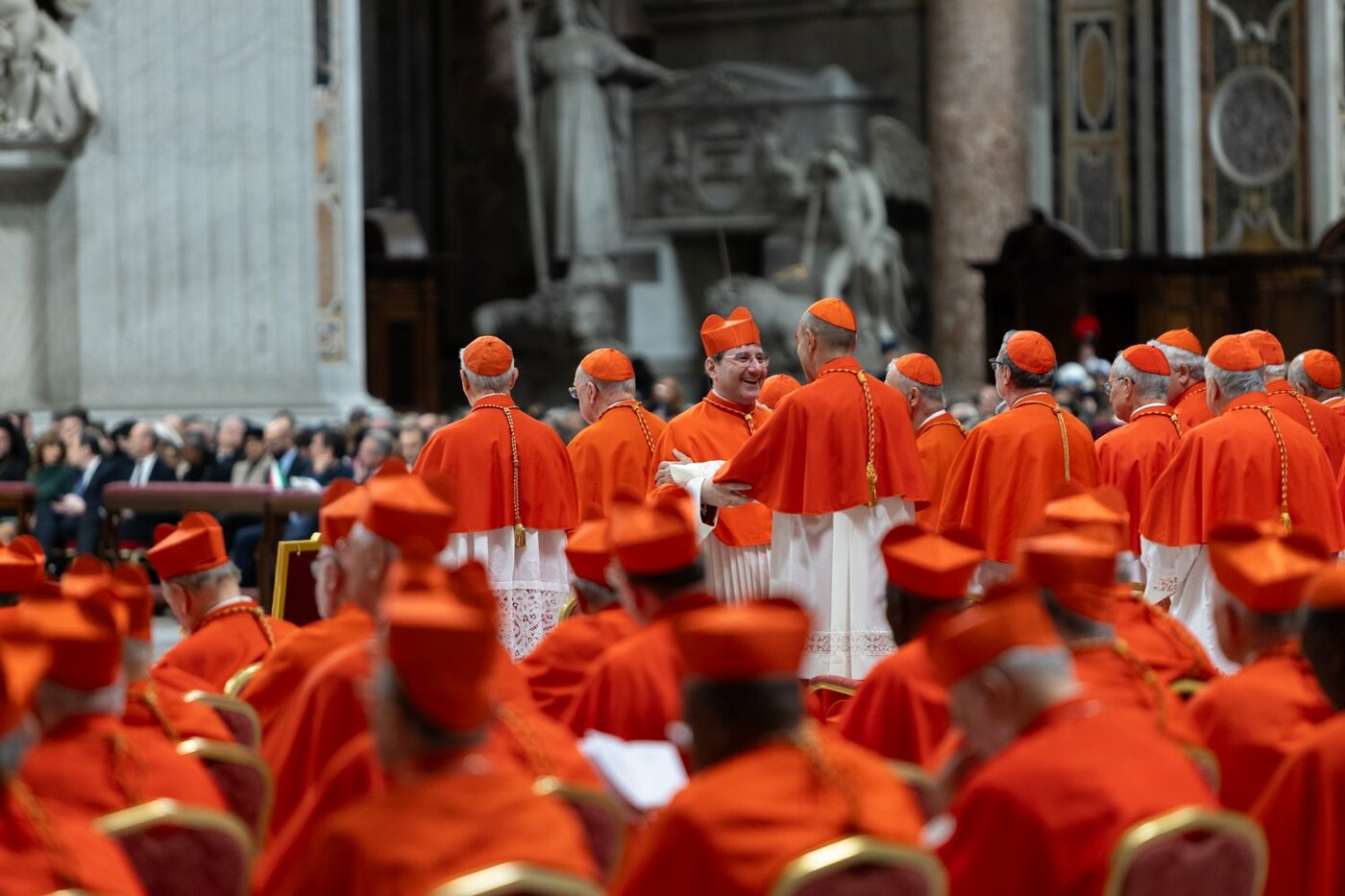
“It’s God saying, ‘I’m here and I’m here for you, I love you and I’m guiding you,’ ” said Leo. “I see her presence very strongly this week. Indications here and there of the gift that she is and her maternal care for me and the Church.”
Leo said he also felt the prayers of both the hundreds of pilgrims who accompanied him to Rome and his supporters back home in Canada. He also drew strength from being in Rome.
“We’re sharing the same faith with the apostles of Christ,” said Leo. “That is very touching. In the continuity of 2,000 years of the Church, of the Holy Spirit who is the soul of the Church enacted in the Church.”
Looking forward, Leo’s advancement into the cardinalate will be celebrated in Toronto, commencing with a special invite-only Mass at St. Michael’s Cathedral Basilica on Jan. 15. In late January and throughout February, liturgies and receptions will be held in the western, northern, central and eastern regions of the archdiocese.
The new Cardinal will also spiritually guide his flock throughout the 2025 Jubilee declared by Pope Francis. He anticipates that “the Lord wants to pour out generously into our hearts many graces — graces of conversion, graces that will deepen our faith, and graces of prayer, healing and liberation.”
Leo will inaugurate the year-long celebrations with a 5 p.m. Mass at St. Michael’s on Dec. 29. Many archdiocesan committees are planning a series of activities and celebrations at designated parishes.
Letters: grateful for Simbang Gabi
Every time I hear Simbang Gabi songs in the church, I cannot help but tear up. My heart swells with gratitude that Christianity was introduced to the Philippines by the Spaniards.
We have overcome many difficulties to arrive where we are now. No cross was ever wasted, and no achievement forgotten. The Filipino people in Canada invite other cultures to experience the Simbang Gabi tradition: a loving remembrance and thanksgiving to the Lord for being one of us except sin; expressing kindness and generosity to one another and sharing whatever we have, big or small, out of the kindness of our hearts.
Maligayang Pasko (Merry Christmas)
Rita Castillo
Vancouver
Thank you for reporting some of the falsehoods in the stories that have come out about the so-called genocide of Native People in Canada. I hope you will continue to correct this and help prevent a new law criminalizing denial of this.
There was much good done to help the Natives. Yes, there were abuses, but nothing like what has been reported. In the Fifties and Sixties in the public school system there were many problems also. It should not be a past that we are forbidden to investigate or comment on.
John Turner
Kelowna
Your voice matters! Join the conversation by submitting a Letter to the Editor here.
The fairways have withered: remembering Bishop Fred Henry
Whoever aspires to the office of bishop desires a noble task. (1 Tim 3:1)
Driving to work one cold January day in 2016, I heard an announcement on the radio that the Bishop of the Diocese of Calgary, Frederick B. Henry, was officially announcing his retirement after 19 years as a bishop.
I can’t say I was surprised, but I certainly felt a tug of sadness. Bishop Henry was the first bishop I served under as president of St. Mary’s University in Calgary. He was chancellor of the university, and as such, we worked side by side on many projects for almost six years.
Our projects included convocations, opening and closing term liturgies, five Bishop’s Dinners, fundraising events, and more. In all of these, the diminutive giant, as I called him, towered good-naturedly over his community.
He was, as many know, a fearless advocate for the faith, sometimes adopting a take-no-prisoners position, at others humbly tending to parishioners in their time of need. Through it all, his sense of humour knew no bounds.
One of my first exchanges with Bishop Henry was not what some might expect. I recall, at the very start of my presidency, sitting at my kitchen table with my children when the phone rang.
The conversation went something like this:
“Gerry?”
“Yes?”
“This is Bishop Henry. You’re golfing with me at the charity tournament next week.”
I hung up the phone and looked at my kids: “I have to learn to play golf.”
That tournament was one of the most stressful public events I have ever attended. To suggest that my golf game was execrable is to be charitable, and not in a fundraising way.
In fact, as I moved towards the cart for the first time on that fateful day, someone leaned towards me pityingly. “He got two holes-in-one last year.”
As we approached the first hole, I gamely suggested: “You’ll need to be a bit patient. This is the first time I’ve ever golfed.”
Bishop Henry stared at me with those piercing eyes of his. “Charity is for the Church! This is golf. You’re on your own.”
But as he prepared to tee off for the first time, he looked back at me: “You know, I got two holes-in-one last year.”
Later, during the speeches, he singled me out for special mention. Hopeful for words of encouragement about the heroic effort I’d made on the golf course, he said to the crowd: “There’s only one person who can help Gerry’s golf game. St. Jude.”
The saint for hopeless causes.
On all other matters, Bishop Henry was unbelievably supportive.
He loved students and encouraged them in their faith life, applauded their commitment to community service, and looked for ways to be present despite the crippling workload that all bishops carry.
Pondering before the manger with the pregnant mother
I notice them most when I’m not moving: the squirms, kicks, and hiccoughs of two tiny people in my womb. Already they have different personalities.
Baby A’s movements are obvious and distinct; like a Looney Tunes cartoon character travelling underground, I can clearly see a foot or elbow on the move just below my skin. Baby B is more subtle, only felt when I place my hand on my belly in just the right place and find someone dancing to an unknown tune or massaging my organs.
I must sit and relax to notice. I must quiet my mind to let the joy and anticipation sink in. Sometimes, we can only notice the most profound moments and miracles in our lives in silence and stillness.
It’s a special thing to be pregnant before Christmas. Advent – the season of waiting – feels very real and personal when you are waiting for your own miracle. It makes it easier to unite your waiting with Mary and ponder it all in your heart, as she did.
How many of us spend the few weeks of Advent careening toward Christmas instead of approaching it in thoughtful anticipation? We get stressed out shopping for decorations, gifts, and special foods, exhausted by standing in lines, and burdened by the number of family gatherings and events in our schedules.
This Advent, I’m finding myself drawn toward quiet places and slower paces. I’d rather sit in a cozy chair re-reading favourite books and imagining myself as a mother bird sitting on a pair of eggs – being productive by simply existing in the right place – than go shopping or take my 3-year-old to photo ops with Santa.
For pregnant women, the instinct of “nesting” is joked about as a sudden burst of energy that makes moms scrub baseboards and purge kitchen cabinets. But, looking with anticipation toward the joy of new life in this season, I’m realizing nesting is more like prayer.
Minnesota midwife Jana Studelska wrote: “To give birth … a woman must go to the place between this world and the next, to that thin membrane between here and there. To the place where life comes from, to the mystery, in order to reach over to bring forth the child that is hers… We need time and space to prepare for that journey. And somewhere, deep inside us, at a primal level, our cells and hormones and mind and soul know this.”
During Advent and Christmas, the “membrane” between heaven and earth feels thin. The air is pregnant with the excitement that something big is coming. We can hustle toward it with piles of gift bags, dishes, and to-do lists, or we can see it in the distance and amid the chaos create space for the anticipation to wash over us, in awe of what it means.
God has become our salvation
4th Sunday of Advent, Year C
First Reading: Mi 5:2-5a
Second Reading: Heb 10:5-10
Gospel Reading: Lk 1:39-45
“Rejoice in the Lord always; again I say, rejoice! Indeed, the Lord is near.”
The first word of that Entrance Antiphon, in Latin, gives this Sunday its name: Gaudete Sunday.
The First Reading echoes it: “Sing aloud, O daughter Zion; shout, O Israel! Rejoice and exult with all your heart, O daughter of Jerusalem!” The response to the Psalm repeats it, and so does the Second Reading.
Why should we rejoice?
The answer is that “the Lord has taken away the judgments against” us. Indeed, he has become our “salvation.”
Right after Adam and Eve’s fall, God said to the serpent — Satan, who had deceived them — “I will put enmity between you and the woman, and between your offspring and hers; he will strike at your head, while you strike at his heel.”
In these words — called the Protoevangelium, Latin for “Proto-Gospel” or “First Good News” — God promised victory over evil and the restoration of what humans had lost. It was the first hint of a Saviour, a Redeemer, who would make amends for Adam and Eve’s disobedience and lack of trust.
“Saviour,” “salvation,” and “Redeemer” are words we hear often in church, but their meaning can be overlooked.
To “redeem” is to “free” by “buying back” or “paying a ransom.” We needed to be freed from the three things that have enslaved us since the Fall: the pleasures of the senses, covetousness for earthly goods, and the desire for self-assertion. We had to be ransomed, or bought back, from Satan, who, through his success with Adam and Eve, gained a certain domination over us, including the power of death.
Finally, someone had to mend — to make amends for — the relationship with God that Adam and Eve had broken. If a small child breaks a window, he may repent, and his father may forgive him, but the window remains broken. The child cannot repair or pay for it himself. Similarly, we needed someone to take on the consequences of Adam and Eve’s rebellion, especially death, to make reparation (from the verb “to repair”) or restitution (from the verb “to restore”).
God solved these problems by becoming our Redeemer: he became a man and, as a man, did for us all that needed to be done, something only he could do. His love for humanity was “so great that it turned God against himself, his love against his justice,” said Pope Benedict XVI. It was so great “that by becoming Man he followed him even into death, and so reconciled justice and love.”
Vancouver priest assigned to Vatican’s Secretariat of State
Father Paul Goo, pastor of Christ the Redeemer Parish in West Vancouver, has been called to Rome to serve in the English-language section of the Vatican’s Secretariat of State, starting in January 2025.
Vancouver Archbishop J. Michael Miller, CSB, who recommended Father Goo for the role, made the announcement in a Nov. 30 letter sent to archdiocesan clergy.
“As you all know, loyalty to the Holy Father and the Apostolic See is a defining characteristic of our Archdiocese, notably in the joyful gift of Vancouver priests called to serve the Church as Bishops,” he wrote.
“We have now been honoured with a different kind of request from Rome; namely, that one of our pastors be released for service in the English-Language section of the Secretariat of State, the Vatican dicastery which works most closely with Pope Francis in the exercise of his universal ministry.”
The Archbishop said Papal Nuncio Archbishop Ivan Jurkovic had asked him to suggest a priest suited to the responsibility, and Father Goo was his choice. “I responded knowing that we would lose – for a time – a dedicated and zealous pastor, but with confidence that this sacrifice would bring blessings to the Archdiocese.
The appointment is for five years.
In a Nov. 30 letter to his parishioners, Father Goo expressed his mixed emotions about the “surprising” news.

“While I am both happy and excited about this new chapter in my priesthood, I will miss all of you. Serving as your pastor has been a tremendous blessing and joy. From the moment I arrived, I have said that this parish does not belong to me but to the Holy Spirit. It is the Lord who has brought us together, and it is the Lord who will carry us through this change.”
Ordained to the priesthood in 2015, Father Goo was appointed as assistant pastor at Christ the Redeemer and named pastor in July 2023. He was vocations director for the Archdiocese of Vancouver from 2019 to 2013.
In his letter, Father Goo said he will be “supporting the coordination of the Holy Father’s communication in English-speaking parts of the world.”
Archbishop Miller will appoint a temporary parish administrator to work with Father Goo in December and assume responsibility for the parish in January until next year’s pastoral appointments are named.
Father Goo reflected on the unexpected move, saying “I know this news may come as a shock to many, just as it was to me. Transitions like these are always a challenge, but they also remind us of the mysterious and providential ways of the Holy Spirit.”
A divided Canada: two cities, two stances on Christianity
A tale of two cities has just presented itself a few days before Advent, offering contrasting approaches to the coming Christmas season.
- In Canada’s largest city, Toronto City Council voted to commemorate the final month of the year as Christian Heritage Month.
- In B.C.’s largest city, a member of the Vancouver Police Board was pressured to resign for expressing her views on such topics as Christianity, immigration, culture, and transgenderism.
Canada is clearly trying to sort out where it stands on issues like freedom of expression and religious rights. The Toronto example makes a case for confronting restrictions and woke culture.
Molly Banerjei, co-founder of the Christian Music Festival in Toronto, says she faced more resistance than ever this year trying to find a venue for the festival. So she launched a campaign to promote Christian Heritage Month in cities across the country.
More than 30 municipalities, including Prince George and Whistler in B.C., have declared December Christian Heritage Month, and organizers are now appealing to federal and provincial governments to do the same.
In the words of The Catholic Register in reporting the story, “the script was officially flipped, and this grassroots effort attained its most seismic victory to date”
Contrast that with Vancouver, where Comfort Sakoma-Fadugba was forced off the Vancouver Police Board for “expressing concerns shared by millions” of Canadians, says the Church for Vancouver blog.

Church for Vancouver Publisher Flyn Ritchie describes what happened.
“Did she jump, or was she pushed? Comfort Sakoma-Fadugba left her position as Vice Chair of the Vancouver Police Board November 22, following an outraged response to a statement she posted on Instagram.”
Ritchie notes that CKNW radio host (and former BC Liberal MLA) Jas Johal tweeted her comment, saying, “When you sit on the Vancouver Police Board you are representing a multi-ethnic police force which serves and protects a diverse city. I hope Vice Chair Comfort Salome-Fadugba [sic] can clarify her comments to taxpayers.”
Sakoma-Fadugba, who immigrated to Canada from Nigeria as a child, introduced her comment by saying, “I’m going to get very vocal about things happening in Canada, and it’s OK if it upsets some people.”
Ritchie recounts how she “reflected was:
“Years ago I warned that people were losing the ability to define what it truly means to be Canadian. Take 10 random people off the street, and we can’t identify a common food, sport or pastime that unites us. The implications of an immigration system that allowed for mass immigration without considering cultural integration, combined with a growing aversion to assimilation, are slowly transforming Canada into a place where a shared identity is disappearing.”