
Serving up a little Raspberry Pi
If I use the term Raspberry Pi, many of you will think I’m making a spelling error, or possibly an attempt at being clever with the famous mathematical constant.
In this case it is neither. Raspberry Pi is the brand name of a class of ultra small computers, initially aimed at hobbyists but which have gained so much traction over the past decade that they are now being produced at around a million units a month.
Raspberry Pi units vary in size from credit card dimensions up to about the size of a small paperback book. They are also relatively inexpensive, from a few tens of dollars up to about a hundred dollars.
First introduced in February 2012 by the Raspberry Pi Foundation in the U.K., the small single-board computers were intended to introduce students to computer science. Their use quickly branched beyond education into fields such as robotics, weather monitoring, and earthquake detection. Within three years the Raspberry Pi was outselling the original U.K. domestic market record holder, the ZX Spectrum.
Just a dozen years after that initial launch, some 60 million Raspberry Pi units had been sold. Some of the heaviest demand came during the pandemic years, not just from work-at-home types having more time for hobbies, but also for industrial uses such as ventilators in hospitals.
In their initial decade the little computers became ubiquitous. Industrial demands, coupled with supply chain issues and chip production problems meant fewer of the small computers were available for hobbyist users. The net result is that reseller prices skyrocketed. Official sellers maintained their price points but had no stock for a couple of years.
Reseller operations such as Facebook Marketplace showed sellers setting Pi unit prices at double or in some cases at quadruple the nominal official prices. However, by May 2023 came the first word that the Pi Foundation expected to ramp up production by summer. Indeed, by July last year new Pi units were appearing at local outlets. Those who didn’t get their outlandish asking prices by then had to begin slashing, and by September the market was basically back to normal, although not necessarily with all models in the Pi lineup.
I’ve been a user of Raspberry Pi hardware for a number of years. Presently there are half a dozen Pi units (mostly model 3B+ and 4) running various radio-related applications at my house: two for weather satellite signals decoding and processing, one for aircraft tracking, one for marine vessel tracking, and two for a big-screen application displaying current space weather and radio signal propagation conditions.
Recently I decided to test the educational waters with a Raspberry Pi and a six-year-old grandson.
Letters: when killing becomes health care
Re MAiD in Canada Crisis, B.C. Catholic, June 10:
As a serious pro-life person, I am grateful that we have the Christian Heritage Party – CHP Canada and Christian Heritage Party of BC. As a Catholic, I have enough problems with my taxes being used to kill people as part of health care, so donating to a political party that supports killing as health care and a right is too much for my conscience.
We need to pray and act to get Christian values back in our government.
Nancy Peirce
Surrey
As long as the cost of euthanasia is a fraction of that for treatment or palliative care, there is danger, and the vulnerable and seniors must be on their guard.
How can one fully trust a system that considers homicide to be a medical treatment?
Gerry Hunter
Burnaby
It was timely to see an update on the situation with St. Paul’s Hospital and MAID access. Apparently, St. Paul’s is waiting for an update from Vancouver Coastal Health as to access and connection, as well as from the Ministry of Health on the land acquired to build a euthanasia facility.
The waiting and questioning of these government bodies would not be relevant if our Catholic moral stand had been taken seriously from the onset. We do not accommodate or accompany MAID. Providence would not be in a position of “attempting to make the best of a bad situation or facing “a conundrum.” Mary Wagner has been well quoted twice now in The B.C. Catholic as to maintaining the Catholic position.
What is the purpose of clearly stating this position many times in The B.C. Catholic but not carrying through to refuse MAID entry or connecting.
Cecilia von Dehn
Vancouver
Bravo to the Roy family for writing these books. Why are they not available at the Catholic bookstore or in the little shop in the cathedral?
Many people like me do not order online. We would like to see the book first before we purchase it. I am sure it would make a great gift, especially for grandparents to give to their children and grandchildren.
Marianne Werner
Vancouver
Your voice matters! Join the conversation by submitting a Letter to the Editor here.
Overcoming Envy
On which sin are we reflecting today? Envy. A young married woman gave me permission to share how she’s struggling so much with not being able to have children yet. Every time a friend gets pregnant, or someone talks about the beauty of children, her heart sinks. Why can’t she have children of her own? Why won’t God the Father give her something good, that we’re made to have? When some friends try to console her by saying, “God’s calling you to be a spiritual mother,” that does nothing for her whatsoever.
Her pain is real and normal. Let’s acknowledge the pain that many of us feel when we want something good and don’t receive it: wanting to get married, be healthy, have financial security. But then there’s the sin of envy we feel when we see others have what we desire and we’re not happy for them.
We can understand the experience of the older brother in the Gospel. He’s in the field working, and, while approaching the house, hears the celebration. A slave tells him that his younger brother, who is depicted in the parable as truly an awful person, is receiving the celebration. The older brother then tells his father, “Listen! For all these years I have been working like a slave for you, and I have never disobeyed your command; yet you have never given me even a young goat so that I might celebrate with my friends. But when this son of yours came back, who has devoured your property with prostitutes, you killed the fatted calf for him!” (Lk 15:29-30).
The experience of perceived injustice is painful. It would be one thing if the younger brother had received the same treatment as he did, but the younger brother receives more!
Here’s the first step in overcoming envy: Speak your pain. Never insult God, but do say exactly how you feel. The Father expects us to speak and listens to it.
The second step is to ask Him questions: “Father, why do You give good things to those who don’t deserve them? Why don’t You give basic good things to me? Why can’t I receive them?” Once we get it all out, then we’re ready to hear what He says.
The Gospel says that “his father came out and began to plead with him” (15:28). This father is actually not unfair; he cares about both his children equally. That’s why he humbles himself as a father and goes out to meet his elder son. And his words reveal his heart: “Son, you are always with me, and all that is mine is yours” (15:31). The word ‘Son,’ and of course, ‘daughter,’ reveals God’s love for us.
Digital Minimalism: How to Live Better with Technology
One of the defining struggles of our generation is to balance the way technology occupies our attention and desire with our calling to live intentionally and boldly. Digital technology certainly enriches our lives, but we all know that restless, distracted feeling it can leave us with, too.
Cal Newport’s most recent book, Digital Minimalism: Choosing a Focused Life in a Noisy World, offers a practical and convincing solution to those of us who feel enslaved by the dizzying swarm of our technological “conveniences.” Newport, a professor at Georgetown and a New York Times best-selling author, understands that what’s needed is not merely a list of helpful tips or theorized critiques regarding our relationship with digital technology, but an entirely new approach to living.
Such an approach, according to Newport, is summed up by the phrase “digital minimalism,” which he describes as a “philosophy of technology use in which you focus your online time on a small number of carefully selected and optimized activities that strongly support things you value, and then happily miss out on everything else.”
The key word here is “happily” — Newport isn’t proposing a way of life concerned with superficial outcomes like efficiency or utility, but rather one with greater happiness and fruitful relationships.
What I appreciate most about Newport’s insights (besides the fact that they are well-researched) is that he takes very seriously the issue of our addiction to technology. To be clear, Newport is no Luddite — he’s a computer science professor, after all — so he doesn’t fault the latest technologies in and of themselves, but rather their unintentional and aimless use. For Newport, a haphazard and unreflective relationship with the latest technologies ultimately hinders a well-lived life.
Here’s his main thesis: Our lives are cluttered with technologies that offer us little benefit in exchange for their cost. For example, it’s easy to justify maintaining platforms like LinkedIn or Twitter because of the benefit of possibly connecting to others who can introduce us to new opportunities. And while that can indeed be a benefit, if it comes at the cost of spending 20 hours a week on those platforms, then we need to reconsider the actual value of that benefit.
In other words, we need to be doing a cost-benefit analysis of the technologies we use and not overlook the hidden value of our time — something that we all have in limited supply. Such costs can come in the form of weakened relationships with loved ones, feelings of restlessness, and countless hours of lost time.
Newport also highlights that we tend not to think about how we use a given technology — only whether we should use it or not.
How Do We Avoid Tech Interfering With Our Humanity?
Throughout history, people have asked the question, what makes us human? Philosophers, scientists, and theologians have all tackled this question in different ways, and I won’t claim to have a new answer. But I have found that looking at humanity through the lens of technology — and the future we’re building towards with it — offers me new insights into the answer to that question.
In its simplest form, a human is a person as distinguished from an animal or (in science fiction) an alien. However, being human is much more complicated than that. We are rational beings capable of understanding and making decisions, we have curiosity about the world around us and we have a wide variety of emotions that affect both of the former. In a spiritual sense, we are beings that live for one another when fully cooperating with the Lord through our free will. He did not want to make slaves or clones but instead, those who are in His likeness. Due to this, we are meant to be creators and not solely consumers of the things around us.
The rise of technology
In the last two decades, technology has been a significant part of people’s lives. From the increase in household use of the World Wide Web to the unveiling of the iPhone in 2007, the world has been increasing its use of technology in daily life. Facebook changed the way we share information with friends and family, initiating the start of social media.
Today, AI tools are capable of writing papers, creating realistic images, imitating people’s voices, and much more. Robot vacuums clean our houses for us. “Alexa” turns on our lights, sets reminders for us, and changes the temperature in the room with a simple voice command. We have increased people’s ability to talk with those on the other side of the world as well as enabled clearer communication for those who are nonverbal through keyboard or eye-scanning communication devices.
Along with these benefits of advanced technology, there have also been drawbacks. Technology has pushed society towards more consumerism. Not only do we consume media through our phones and televisions, but we are also bombarded by advertisements in our social media feeds, encouraging us to buy more using an algorithm that pushes ads individually suited to our tastes and habits.
Technology shapes our lives
Since the rise of social media and the widespread use of the internet, scientists have been interested in the effect of technology on the brains of both young and old individuals. One study found that most adults use the internet daily, and nearly one out of four report being online most of the time.
Serrans share their vocation stories
Serra International is an organization created by Catholic laity whose objective is to foster and promote vocations to the priesthood and all religious vocations in the Catholic Church, as well as encouraging the laity to fulfill their Christian vocation to service. Serra is named after St. Junipero Serra, a Spanish Franciscan missionary who played a leading role in early missionary work in Mexico and the United States. Below, local Serrans share their experiences.
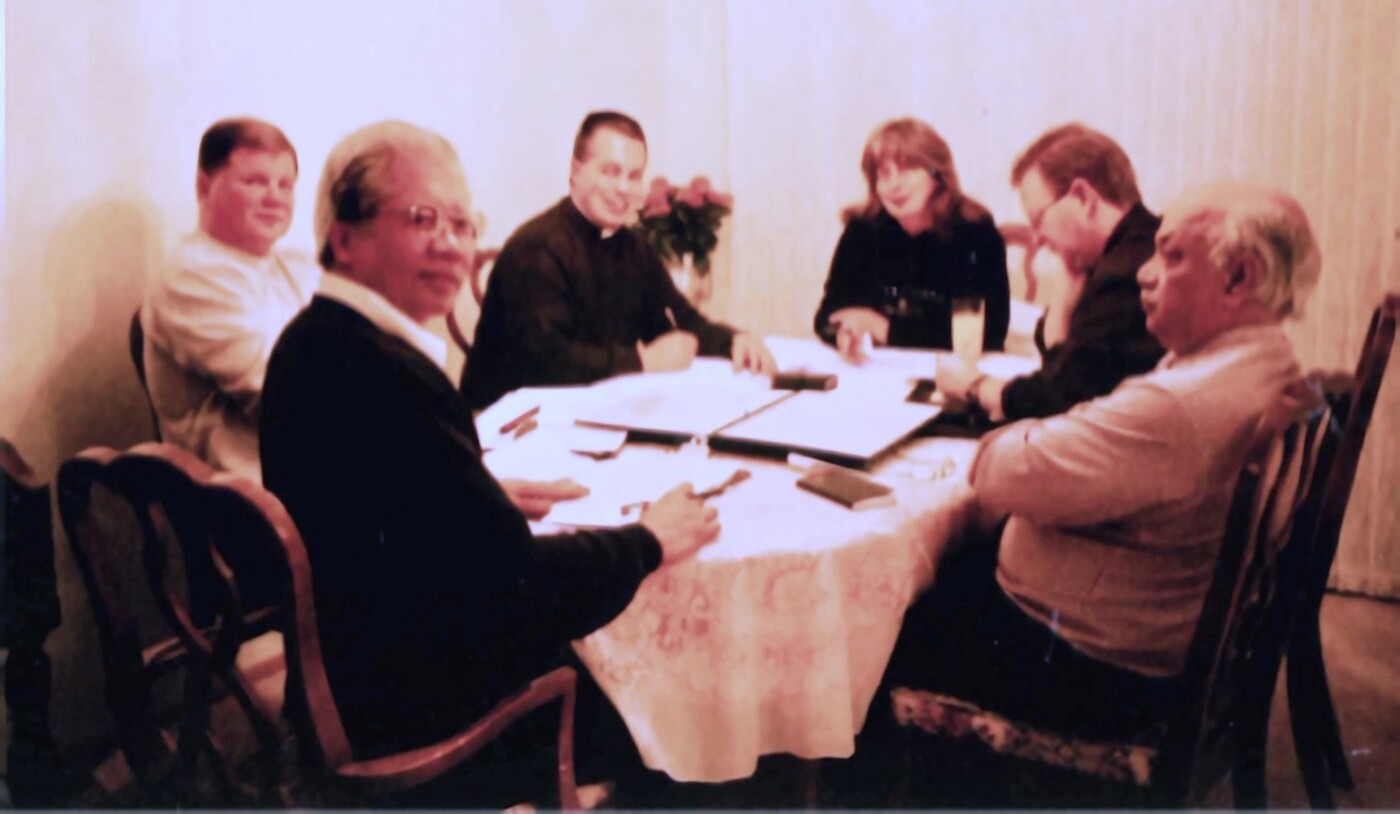
“I joined Serra over 20 years ago, wishing to be a part of those eager to promote vocations. The outcome is the opportunity to know seminarians in their place at the abbey, the several times we can convene at Holy Rosary Cathedral to support our faith, and in our activities to be together for the greater glory of God.” — Mike
“I joined Serra shortly after I was baptized and confirmed in the Church. The organization was instrumental in helping me to build my faith over the last 20+ years. The fellowship and purpose of Serra kept me engaged with the Church.” — Ben
“Just as a number of Catholic mothers pray, I too prayed that my son would have a vocation to the priesthood. When I realized the priesthood was not his vocation, I joined Serra so that I would have Spiritual Sons who would become priests – thereby making me a Spiritual Mother of priests.” — Ethelyn
“After many years of struggling with my two sons, they decided not to pursue the priesthood and my heart was broken. I lost all my desires in my life until I joined Serra Club where I encountered seminarians. Therefore, I am not only a mother of two sons but also a mother of all the seminarians, to whom I share my heart, and pray for their vocations.” — Cathy
My passion now is to promote vocations, particularly to the priesthood, so when my time comes I may have a priest to celebrate my funeral Mass.
What I have been doing with the Serrans: Since 1981, I’ve been instrumental in starting the club in the Fraser Valley West, started the Serrans in Kelowna, established a Kamloops chapter, organized Stations of the Cross in the Fraser Valley West every Friday of Lent for the FVW deanery (Surrey), and got the traveling Chalice for Vocations that goes to homes promoting vocations to the priesthood, diaconate, and consecrated religious life.
As a result of the above experiences, I am at St. Ann’s Abbotsford re-establishing a parish vocations committee/ministry. — Leo
“I know that the celebration of the Eucharist can only be done through a priest, and as the Holy Eucharist leads us to eternal salvation, praying for priests is a priority.
The hands of a priest
“Let me see your hands,” I said to my three-year-old son after he had finished a large piece of orange chiffon birthday cake.
I took his chubby little fingers in my hands and with a warm cloth wiped away the sticky mess between each finger. When I was close to completing my task, he impatiently squirmed and before I was satisfied that all the icing had been wiped away he was on the escape and rushing to play ball with his older cousins and younger brothers. It was just a fleeting moment in time, but a moment that I cherished and held onto. I knew how quickly time would fly by and just as he had escaped my motherly gestures in that moment he would soon be escaping into the world to find his own way in school, in work, in life.
“Hold your hands tighter on the bat,” the baseball coach yelled to my now 12-year-old son. Sitting beside my husband in the small stands, we, along with all the other parents, called out encouragement to our young, energetic ball players. I watched my almost-teenage boy grip the bat as he swung and connected with the ball that had been pitched to him. The stands erupted into cheers as he slid safely into first base. Just like baseball’s first base, he would soon be sliding into high school.
“Wake up, they’re not home yet,” I would sometimes say to my husband, nudging him awake. During the busy years of four teenagers, we had a hard and fast rule in our home; it didn’t matter what time of the night each of the kids came home, but they had to come into our bedroom and let us know they were okay. My husband is a deep sleeper, and my side of the bed was closest to the door, so the kids would always come and talk to me, sometimes just to say they were home before slipping down to their bedroom and other times sitting on the side of the bed talking for hours about things happening in their lives. On one of these nights, our now 19-year-old son stared down at his trembling hands and shared with me his desire to enter into the seminary and, if God willing, become a priest.
This had not been on my radar at all. Our son was in his first year of business administration at university, and I knew he had been thinking of applying to larger universities in Vancouver. This meant he would soon be moving away. But this news sucked all the breath out of my lungs. I never thought about any of our children going into religious life, it had never really been a topic of conversation in our home.
Parents of priests also said ‘yes’ to God
“Faith is God’s gift, received in baptism, and not our own work, yet parents are the means that God uses for it to grow and develop,” writes Pope Francis in his book Amoris Laetitia (The Joy of Love). To get a sense of the vocational journey that parents witness in their child’s formation of faith, we spoke with the parents of priests in the Archdiocese of Vancouver.
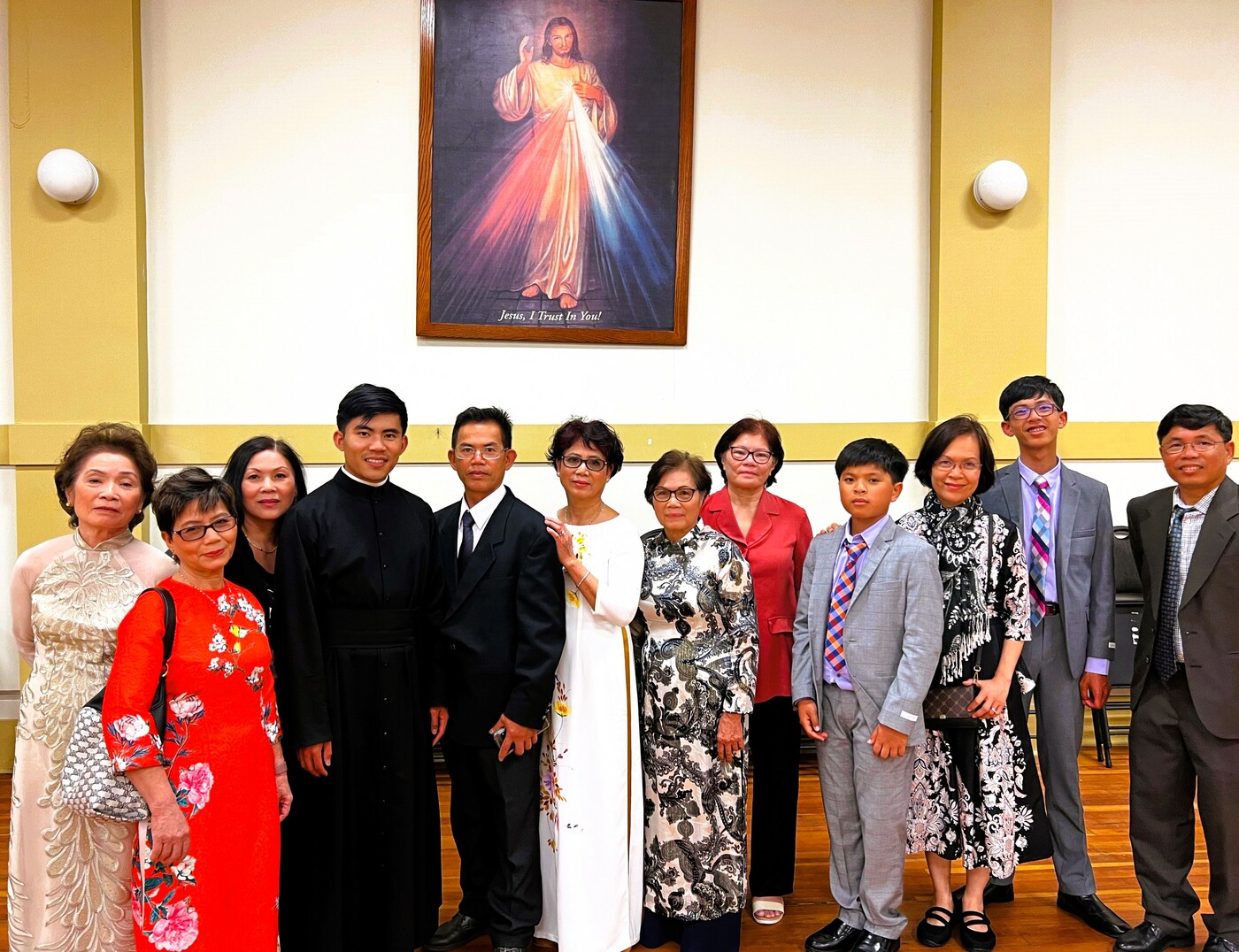
Mr. Tong Lê and Mrs. Mai Nguyễn (Le) are the parents of recently ordained Father Patrick Le, who is now an assistant pastor at St. Matthew’s Parish in Surrey. They are also long-time parishioners of St. Patrick’s Parish in Maple Ridge, their home church. Both Mr. and Mrs. Le credit St. Patrick’s Parish and Father Richard Au for playing a crucial role in their son’s discerning to join the seminary and become a priest.
Can you describe Father Patrick at a young age?
Mr: Le: Before the seminary, he was really picky. He wanted to do things his way. Even from the way he’s eating, he asked his Mom to cook a different meal every day.
Mrs. Le: I’m a hairstylist and when Patrick was 4, I would bring him to work. He always brought his notebook and a pen. One day I asked him, “What are you writing in the book?” And he said, “I’m writing the Bible.” He showed me the book and there were drawings of different shapes, a square or a dot, things like that, then a heart and a cross. I asked him, “What is this for?” He said, “It’s a heart for the mother. Mother Maria. And the cross is Jesus.” In my mind, I thought that this boy is going to become a priest. But I kept it to myself. I just kept praying.
How did you react to him going to the seminary?
Mrs. Le: It was a big reaction. He was in Grade 6 and we said, “No, no.” We thought he was too young to think that way.
Mr. Le: Then one of my wife’s customers, a former seminarian, came to us for a haircut. He just asked one question: “If your child wants to play soccer, would you tell him to wait until he’s 25 years old to start playing? Or would you let him play right now?” Only a simple question like that caught our hearts. I said, “Okay, we should let him go.”
What have you learned as parents witnessing him become the person he is today?
Mr. Le: Do simple things. Pray. A little bit of reading the Bible at night.
Why I’m Catholic: It’s a Force for Good
Maura’s Story
Around a dozen girls, sporting the reliable Catholic school plaid, sat in a classroom tucked away in a side hallway on the third floor of an all-girls high school. During the fall of 2006 and into 2007, the room was filled with raucous, back-and-forth conversations every time the class met. We talked about the genocide in Darfur, homelessness in our city of Boston, and the death penalty. Tough topics, but this was senior year theology at my high school: a yearlong class in social justice.
We read the work of Catholics who dedicate their lives to social justice work, watched Frontline documentaries, and studied the seven themes of Catholic Social Teaching until they were basically second nature. When we weren’t in our classroom chairs, there was a community service requirement to fulfill, because the mission of the sisters who founded our school, the Sisters of St. Joseph, is to “love the dear neighbor without distinction.”
We didn’t always have the same ideas about how to help or even who to help. One classmate sold T-shirts and donated the proceeds to a nonprofit. Another volunteered at a local food pantry. I helped out at a theatre camp focused on building self-esteem in preteen girls. But whatever we did, it all came back to the idea that every life has inherent value and potential.
I’ve been Catholic since my baptism in November 1988, but attempting to live out what I learned during senior year high school theology is why I’m Catholic today.
For me, the heart of the Catholic Church and Jesus’ message, is reaching out and helping others. Different messages and priorities might seem louder or more prominent, depending on who is talking, but my lived experience of being Catholic is one that aligns with the image of a welcoming Jesus — a man who sought out people who were different from him, who helped people who were otherwise overlooked.
There have been times when I’ve been embarrassed to be Catholic, especially with all that continues to come to light with the clergy abuse crisis. Sometimes, it feels like my experience of Catholicism might not exist anymore, and it definitely isn’t the one that gets attention. I’ve worried that people might assume the worst of me when they hear the worst of my Church. But then I remember those conversations in that third-floor classroom, and the group of women who went out into the world to bring justice to others, each in their own way. So I resolve to be that vision of Catholicism, to be representative of the Church at its best, not its worst.
One of my favorite church songs is called “The Servant Song,” and it includes these lyrics: “We are pilgrims on the journey, we are travellers on the road.
How to Navigate Some of Today’s Most Pressing Issues
Research suggests that, on average, we make well more than 200 decisions every day about what we eat and drink. And yet, most people are aware of making only 15 to 20 daily nutrition-related decisions. These findings could easily be extrapolated to other areas of decision-making throughout a typical day. Not only do many of our choices lack intentionality, but often we aren’t even aware we’re making decisions at all.
We humans are an adaptive bunch. Arguably, there are thousands of micro-decisions to be made each day, and it would be overwhelming to deliberate over each one. (Chidi from The Good Place, anyone?) Part of the problem is that our commercialized culture presents us with a dizzying array of choices about things that don’t really matter, as author Thomas Merton famously diagnosed one day while shopping for toothpaste after spending the previous months “off the grid.”
The trick is to identify which decisions are worth weighing carefully and which aren’t. It might help to relearn the art of asking what might be termed “foundational questions.” Foundational questions come packaged in the rawest, most basic language and demand an answer not just from the information in our heads but from the very fabric of how we understand the mysteries of life.
Asking foundational questions is built into the very DNA of toddlers and college students, but somewhere along the way we mistakenly “outgrow” the habit. During our young professional years, many of us are busy developing the expertise and specialization necessary to analyze profit margins, decipher CT scans, or diffuse temper tantrums. Incidentally, the young professional years — when there is the least amount of mental and emotional space for asking foundational questions — are when many of us begin making for ourselves what might equally be called foundational decisions that shape the course of our lives and the type of people we’re becoming: deciding what neighborhood we live in, what kind of work we will do, and what and how much we consume.
For more than two millennia, folks in the Church have been asking foundational questions about life in this beautiful, broken, and messy world in light of three beliefs central to the Catholic Christian faith: 1) God lovingly created a good world; 2) the goodness of creation has been damaged by sin; and 3) God became human and invites us to participate in His saving work here and now toward our final good in the life to come.
Guided by these three tenets, people of faith and goodwill throughout the Church’s history have accumulated questions, time-tested good ideas, and real-life examples in building up what is known as the Catholic social tradition, or CST.