
Questions to Ask Elderly Loved Ones
Your grandparents, aunts and uncles, and older loved ones have a lifetime of wisdom to share. Why not carve out some time to sit down and ask them about it?
We’ve put together this list of questions that you can print out and jot down their answers about their childhood, favourite things, and life lessons. And don’t feel like you need to stick to the handout — the questions can serve as conversation starters. Your loved ones will likely have more to share than we could even think up!
Download the worksheet by clicking the link below:
©2024 Grotto Network
About St. Anthony
by Lyndon Little
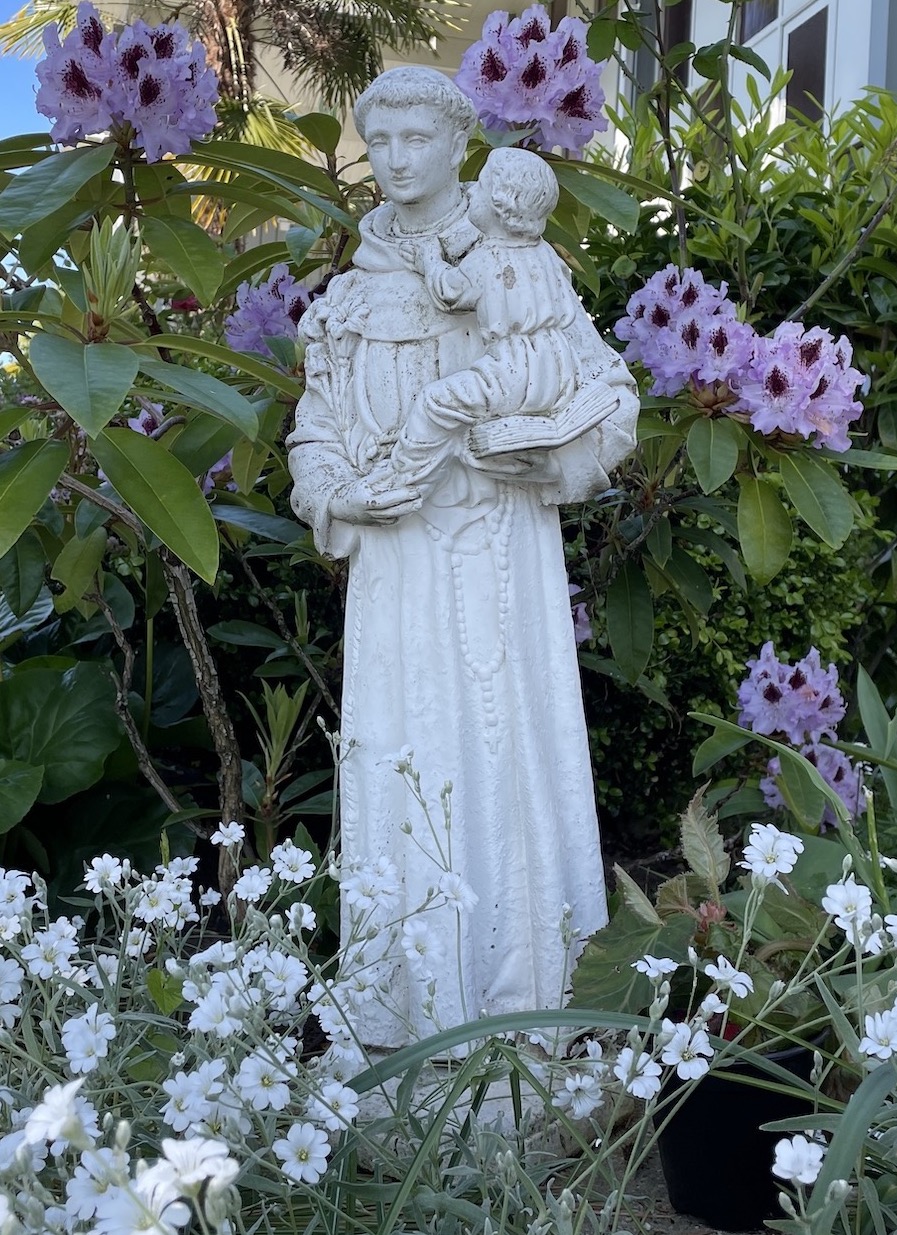 St. Anthony of Padua — a Franciscan friar and the patron saint after whom our parish is named — is a man worthy of serving as an inspiration to all of us for his selfless devotion to our Lord in his preaching of the gospel and service to the poor.
There is actually another famous St. Anthony celebrated by the Catholic Church — St. Anthony of Egypt, who lived about nine centuries before the one who has lent his name to our parish. When St. Anthony’s, West Vancouver, was first established as a mission in 1921 a wealthy patron from Eastern Canada requested our church be named after his favourite saint.
St. Anthony of Padua is known as one of the most celebrated followers of St. Francis of Assisi, founder of the Order of St. Francis.
Our St. Anthony was born in 1195 in Lisbon into a rich and powerful Portuguese family. His life, which lasted only 36 years, can be divided into three distinct phases. He lived 15 years with his parents, 10 years as a Canon Regular of St. Augustine — primarily at Coimbra, Portugal — and 11 as a member of the Order of St. Francis.
During his time in Coimbra, Anthony was so impressed by some of the Franciscan monks who visited there before being martyred in Morocco that soon after in 1220 he asked to be allowed to join the Friars Order, taking the name by which we know him today (he had been baptized at birth as Ferdinand).
After joining the Franciscan Order, Anthony sailed for Morocco in hopes of continuing his mission with his new order. Unfortunately, he was soon struck by illness and was forced to return to Portugal. During the intended voyage home, his ship was driven by a storm onto the coast of Sicily where he remained for some time until he recovered his health.
St. Anthony eventually made his way to Assisi in Italy where his knowledge and contemplative nature attracted the attention of St. Francis himself, who chose him to teach theology to the friars in Bologna and Padua. Whether St. Anthony and St. Francis actually met face-to-face is a matter of debate among religious scholars. However, what is known is that St. Anthony was sent to France a few years later where he began preaching and teaching. It was during this period of his life that his reputation as a charismatic orator began to spread. His fame was such, it is said he drew crowds so large he often spoke in market places rather than in churches.
He was especially noted for attacking the vices of luxury, avarice and heresy.… Read more “About St. Anthony”
Don’t be possessed by possessions
Greed is a sickness of the heart. Pope Francis called greed “that form of attachment to money that keeps a person from generosity.”
He continued, saying, “to heal from this sickness, the monks proposed a drastic, though highly effective method: meditation on death. As much as one can accumulate goods in this world, we can be absolutely sure of one thing: they will not enter the coffin with us. We cannot take property with us! Here, the senselessness of this vice is revealed. The bond of possession we create with objects is only apparent, because we are not the masters of the world: this earth that we love is in truth not ours, and we move about it like strangers and pilgrims.”
Life is a journey, and it is very important to set our hearts on our eternal destination. St. Gregory the Great put it this way: “whatever you possess must not possess you; whatever you own must be under the power of your soul; for if your soul is overpowered by the love of this world’s goods, it will be totally at the mercy of its possessions. In other words, we make use of temporal things, but our hearts are set on what is eternal. Temporal goods help us on our way, but our desire must be for those eternal realities which are our goal.”
He also said, “be not anxious about what you have, but about what you are.”
Greed is frequently mentioned in the Scripture. Of Christ’s 38 parables in the Gospels, 16 are concerned with the handling of money and possessions. St. Paul wrote, “For the love of money is a root of all kinds of evils.” (1 Tim. 6:10)
Wealth can create a false sense of security; we can only find true security in our faith in Christ. Pope Francis called greed “an attempt to exorcise fear of death: it seeks securities that, in reality, crumble the very moment we hold them in our hand.”
We are created for God and material wealth can never satisfy us. St. Bernard used a very vivid image to describe this. “Suppose you saw a starving man inhaling great deep breaths, filling his cheeks with wind to stay his hunger; would you not call him mad? And it is just as mad to think that blowing yourself out with earthly goods can satisfy your hunger.”
Wealth can’t satisfy our hearts. St. Isidore of Seville observed: “Cupidity never knows how to be satisfied. The greedy man is always in need; the more he acquires, the more he seeks, and he is tortured not only by the desire of gaining, but by the fear of losing.”
Archdiocese and First Nation pledge ‘meaningful steps towards healing’ through Sacred Covenant
Looking to the future with hope was the clear message presented by the Archdiocese of Vancouver and the Kamloops First Nation (Tk’emlúps te Secwépemc) as the two signatories of the Easter Sunday Sacred Covenant held a press conference Wednesday.
The full document was released in English and Chinook for National Indigenous Peoples Day, June 21, with a promise to answer questions at Wednesday’s press conference.
Archbishop J. Michael Miller and Kamloops Chief Rosanne Casimir addressed the release of the covenant, saying they are committed to focusing on the future and moving forward together.
The covenant “affirms that all the signatories seek to build on official Catholic teaching support” for the rights and the freedoms of Indigenous people, said Casimir.
“It’s about relationships,” she said. “It’s about making some meaningful steps towards healing. We can’t do that alone, we have to do it in partnership.”
Answering a reporter’s question about whether the covenant has set a precedent for future engagement between the Catholic Church and Indigenous communities, Casimir said she believes “that it sets a lot of precedents.”
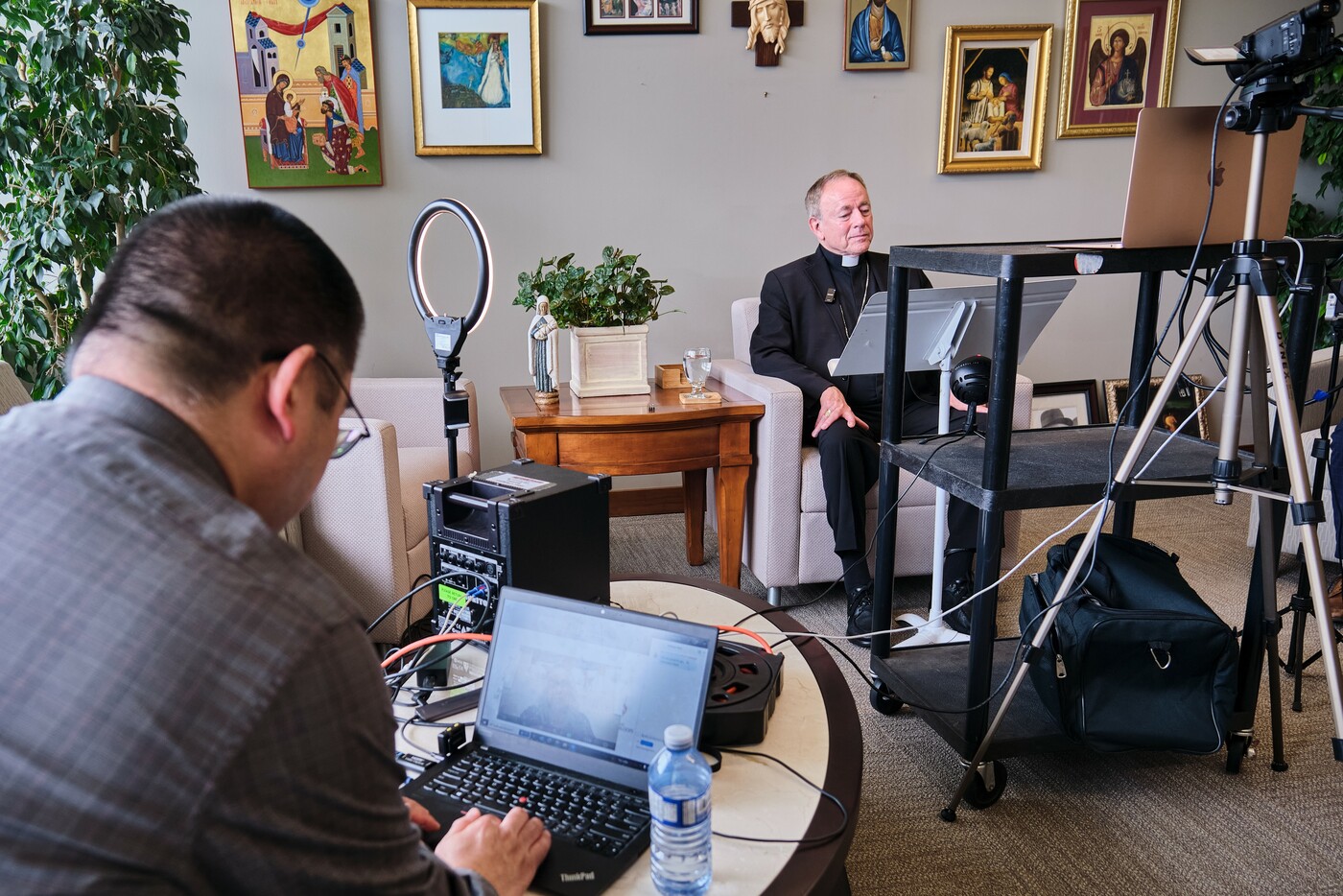
“We also need to take those meaningful steps to provide opportunity for those to find justice, but also to find healing. It takes everybody at every level to be walking that path and journey together,” she said.
“I would encourage others to build and establish those relationships to take those meaningful steps,” said Casimir.
Archbishop Miller agreed, saying Canada’s bishops are looking for ways to make the covenant a possible template to help the Church “enter into healing relationships with the First Nations communities of which they form a part. We have a lot to do.”
He reiterated the acknowledgement of harm to the First Nation from the Indian Residential School system. “The Church was wrong in how it complied in implementing a government colonialist policy that resulted in the separation of children from their parents and their families. Even the most ardent skeptics must know that a system requiring or pressuring the separation of families would have tragic consequences.”
In answer to a question about making possible financial reparations, the Archbishop said that while the covenant is meant to help heal the spiritual and communal rift between the church and First Nations, monetary support is ongoing across the country through truth and reconciliation grants, with nearly 20 approved in the Archdiocese of Vancouver.
Interfaith call for greater protection for religious institutions is timely, says Vancouver rabbi
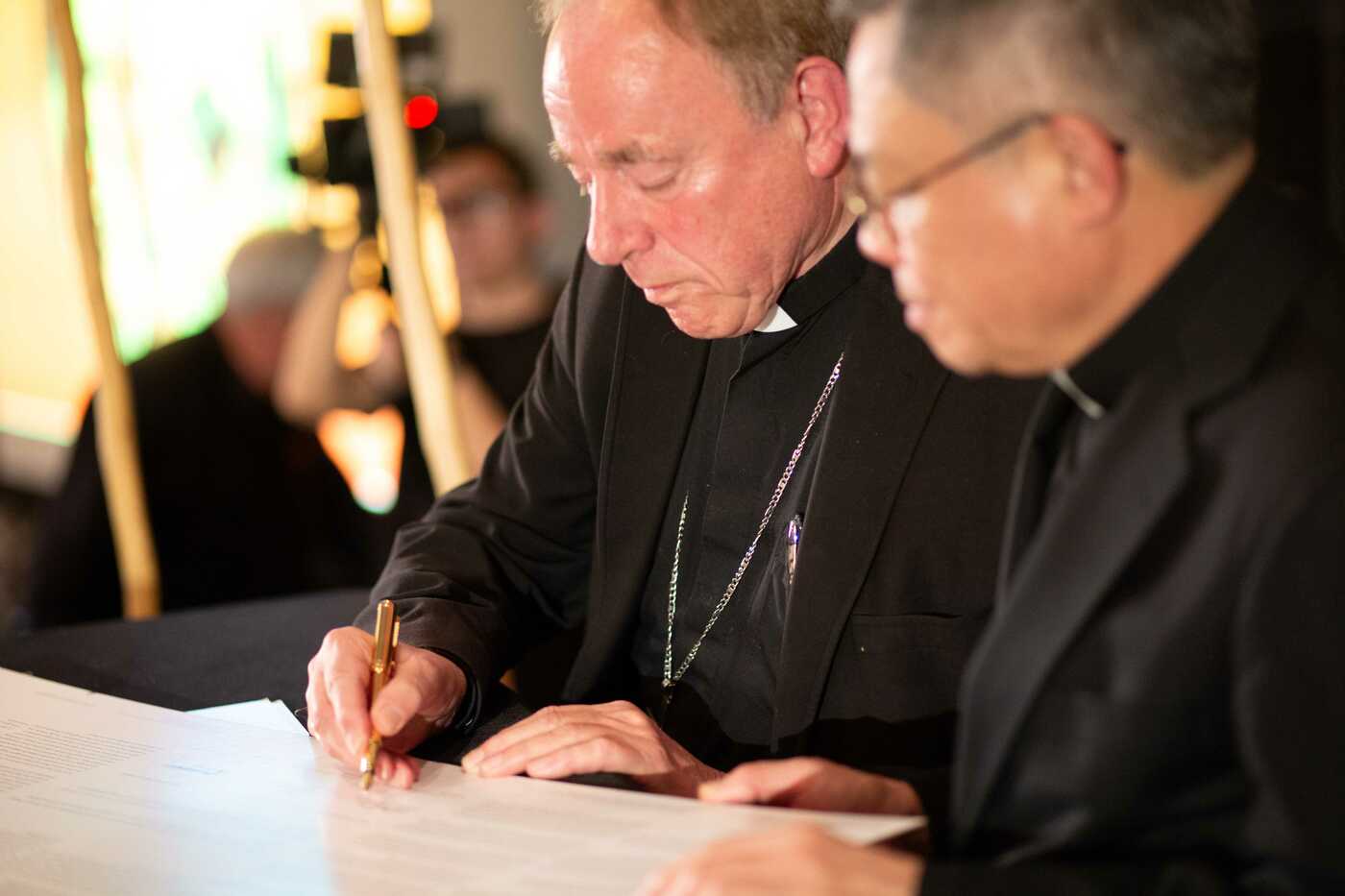
Vancouver Archbishop J. Miller and a Vancouver rabbi are welcoming the call by an alliance of faith communities for more robust protection of religious institutions.
At a June 18 news conference on Parliament Hill, the Canadian Interfaith Conversation (CIC), an alliance of faith communities working to combat hate based on religious identity, issued an urgent call to action for the protection of all faith groups from such attacks.
Archbishop Michael J Miller told The B.C. Catholic “the CIC statement takes a strong stand in its recommendations to the Canadian government. At bottom is the need for citizens and governments at every level to ensure the safety and security of adherents to every faith tradition as well as recognized the positive role that religion plays in the public life of our nation.”
A Vancouver rabbi says the interfaith declaration is timely.
“I think that in a time period in which the Jewish community and synagogues have been under attack physically in Canada, it is important that the entire interfaith community comes together to call for the protection of all houses of worship,” Rabbi Infeld of Vancouver’s Synagogue Beth Israel told The B.C. Catholic.
Highlighting the role of religious communities in building bridges, Aakash Maharaj, ambassador-at-large of the Ottawa-based Global Organization of Parliamentarians Against Corruption and member of the executive council of CIC, said: “Faith communities share a deep reverence for and commitment to the dignity of every human being and for the sacredness of humanity and creation. Hate ignores and undermines that dignity and sacredness, and has no place in Canada.”

Attacks against religious communities are “only a Jewish community problem,” said Richard Marceau of the Centre for Jewish and Israeli Affairs. “All other faith institutions deserve as much protection.”
Shaila Carter, co-chair of CIC and interfaith specialist at Islamic Relief Canada, said Canada should be a safe environment for people to practice their faith freely and happily.
“As the daughter of (Bangladeshi) immigrants I am here to build bridges between people, to combat hate in solidarity with other faiths and to promote love. As women, we should be able to wear our head scarves if we choose to.”
The CIC statement, signed by 60 representatives of Christian, Jewish, Muslim and Baha’i communities, outlined four recommendations for the government of Canada. In addition to stepping up security measures for all religious institutions including houses of worship, schools, daycare centres, community centres and cemeteries, it called on the government to:
- support Canadian interfaith efforts to provide non-sectarian medical and humanitarian aid to victims, especially child victims, of international conflicts through reputable and trustworthy organizations as a means of advancing peace-building efforts abroad and social solidarity in Canada;
- introduce a comprehensive strategy to foster understanding about online hate based on religious identity; and
- ensure, in collaboration with other levels of government, that hate crime units are informed about hate based on religious identity in every law enforcement service, so that targeted groups can feel safe, heard and respected.
Archdiocese and Kamloops First Nation release Sacred Covenant on Indigenous Peoples Day
The Sacred Covenant signed on Easter Sunday by the Archdiocese of Vancouver and Kamloops First Nation was made public on Friday, National Indigenous Peoples Day.
In a statement, the Archdiocese and the Tk’emlups te Secwepemc said the date was chosen to share the document in English and Chinook, “an important common language among First Peoples and settlers arriving from many countries.”
Chinook was a trade language promoted by Father Jean-Marie Raphael Le Jeune, OMI, and Tk’emlups and other elders, according to the statement.
Father Le Jeune was an Oblate missionary priest who supported BC First Nations in the 19th century and is referenced in the covenant. Kamloops Chief Rosanne Casimir said the nation had the goal of “fostering healing and reconciliation and countering targeted skepticism and denial” when it chose to work with Catholics and allow Church leaders to publicly acknowledge past wrongs, especially those from the Catholic Church’s role in administering many of the residential schools. She said the Tk’emlups te Secwepemc remain “steadfast in their sacred duty as guardians to and advocates for the children who died and were harmed while they were students at the Kamloops Indian Residential School.”
With staff working on a “multidisciplinary investigation” and on construction of a Healing House for Survivors, she said she is “committed to ensuring Survivors and Intergenerational Survivors are supported on their healing path.”
An online press conference has been called for Wednesday, June 26, where representatives of the Archdiocese and the First Nation will be answering questions.
The text of the document follows.
SACRED COVENANT
between
TK’EMLÚPS TE SECWÉPEMC NATION
ROMAN CATHOLIC ARCHDIOCESE OF VANCOUVER
ROMAN CATHOLIC DIOCESE OF KAMLOOPS
ON THE 31ST DAY OF MARCH
2024
WHEREAS the people of the Tk’emlúps te Secwépemc Nation desire that the historical truths regarding the Kamloops Residential School be shared and that a path to healing be set out clearly in this sacred Covenant.
WHEREAS the Archdiocese of Vancouver and the Diocese of Kamloops acknowledge the deep flaws in the Residential School system, their part in the resulting tragedies and the desire to journey with the people of the Tk’emlúps te Secwépemc Nation on a path to healing and understanding.
WHEREAS all Parties seek to build on official Catholic teaching supporting the rights and freedoms of Indigenous people and the promising historical relationship held between Fr. Jean-Marie-Raphael Le Jeune, Chief Louis Clexlixqen (Xlexléxken) and Chief Johnny Chiliheetza (Ts̓ elcíts̓ e7).
WHEREAS the purpose of this sacred Covenant is to establish our shared path to reconciliation and to reflect our mutual belief that honour, truth, justice, and healing are necessary to guide our future.
Therefore, the Parties agree as follows:
HISTORICAL PRECEDENT FOR A SACRED ACCORD
1.
Decluttering adds sparkle and shine, and calms the brain
Reading cleaning and decluttering blogs I’ve been inspired to go through my clothes and knick-knacks to get rid of anything I don’t need. Marie Kondo, a professional organizer and tidying expert, has a whole philosophy, “Keep only those things that speak to the heart, and discard items that no longer spark joy. Thank them for their service – then let them go.”
I have donated two bags of clothing, a box of books, and little items that no longer serve me. It has been an experience of letting go and embracing what I have. I know that the Lord provides for me. When I am buried in things, I can’t live freely. The books, clothes, and things are supposed to help me live in simplicity and freedom. My mental health improves when I clean, tidy, and declutter our house.
It starts to feel like I have more space in my mind to think and be creative. St. Josemaria Escriva, the founder of Opus Dei, spoke about forming a bright and cheerful home and in doing so God would help couples to be generous.
When I go to bed at night and the kitchen counters sparkle and shine, I feel more relaxed when I wake up to a beautifully clean room. Our environment has a role in maintaining good mental health. With lots of “stuff,” we can feel weighed down with all the decisions of what to do with it. It was my goal to remove what I no longer used or needed so I could be happier and healthier.
Taking the time to clean, tidy, and declutter gives me clarity of mind and spirit. I feel as if laundry and cleaning never end; it’s a constant movement of doing one thing at a time. This is just like the spiritual life. Prayer is meant to be a daily conversation with Jesus. Receiving the sacraments of confession and holy Eucharist is frequent nourishment for the soul in order to be holy. It is a good routine to clean house and soul to be one with the Lord who gives us every resource to do so.
When we reach for the goodness of a warm and organized home, it helps us grow in virtue and service for our family and any guests who come visit.
I love keeping checklists to show what tasks I have completed and what I still need to do. My list is always growing. With a home, a garden, and an adorable dog to care for, my little growing family is a busy ground for housekeeping and saint making.
Hard work is worth the effort in maintaining the home.
The Desires of Our Hearts
What does God mean by this promise?
Years ago, when I first became a Christian, there was a young couple at our church who took me under their wing. I was grateful for their friendship, encouragement and efforts to answer my many questions.
One day, the topic of unfulfilled hopes and dreams came up, to which the wife responded by quoting Psalm 37:4, “He will give you the desires of your heart.” The strong implication was that as a Christian, I could expect God to give me anything I wanted, if I would only ask.
At this point, most of the Scriptures were still terra incognita to me. But I did recall a verse, 1 John 5:14 as it turned out, which qualified that promise by insisting we ask according to God’s will. To my surprise, my friend waved this off by stating that most of the time, we don’t know God’s will, anyway.
Both of us would have greatly benefitted, I think, if we’d known the first rule for reading the Bible (or any text, for that matter): Context is king.
The promise in context
Sometimes it’s as simple as reading the complete sentence, rather than cherry-picking a single phrase for a theological sound bite. In its entirety, Psalm 37:4 reads, “Delight yourself in the Lord, and he will give you the desires of your heart.”
Taken as a whole, the meaning of the verse comes into sharper focus. It’s not a carte blanche, whereby God binds himself to provide whatever pops into the reader’s imagination: more money, better job, nicer home, exciting vacations. This isn’t the gospel according to Janis Joplin, who sang back in 1970, “Oh Lord, won’t you buy me a Mercedes Benz? My friends all drive Porsches, I must make amends.”
Nor is it the philosophy enshrined in Disney movies, which says, “Follow your heart. It will never lead you wrong.” In point of fact, Jeremiah 17:9 paints a starkly different picture: “The heart is deceitful above all things, and desperately sick; who can understand it?”
Delight yourself in the Lord
The key to Psalm 37:4 is found in the opening phrase: Delight yourself in the Lord. In essence, God is promising that for those who make him the object of their desire, he will fulfill that desire.
That’s not a tautology or an empty truism. It’s one of the most vital truths of Scripture, reflected in the broader context of the book of Psalms and beyond.
Psalm 16, in particular, addresses the theme of delighting in God more fully. Like Psalm 37, it too contains a verse that often gets yanked from its setting and made to stand on its own: “The lines have fallen for me in pleasant places.”
True love gives itself; lust aims to possess
Pope Francis shared a beautiful defence of true love at a general audience this year.
“We have to defend love, the love of the heart, of the mind, of the body, pure love in the giving of oneself to the other… that beauty that makes us believe that building a story together is better than going in search of adventures… that cultivating tenderness is better than bowing to the demon of possession,” he said in January.
“True love does not possess, it gives itself. That serving is better than conquering. Because if there is no love, life is sad, it is sad loneliness.”
This makes the vice of lust particularly odious, for at least two reasons.
“First, because it destroys relationships between people… chastity is more than sexual abstinence – but rather, to be connected with the will never to possess the other,” he explained.
“But there is a second reason why lust is a dangerous vice. Among all human pleasures, sexuality has a powerful voice. It involves all the senses; it dwells both in the body and in the psyche, and this is very beautiful; but if it is not disciplined with patience, if it is not inscribed in a relationship and in a story where two individuals transform it into a loving dance, it turns into a chain that deprives human beings of freedom. Sexual pleasure, which is a gift from God, is undermined by pornography: satisfaction without relationship that can generate forms of addiction.”
Many saints have offered insights about chastity, purity, and lust. Father Joseph M. Esper, author of Saintly Solutions to Life’s Common Problems, wrote, “how, then, are we to cultivate, preserve, or reacquire the virtue of purity? First, we must specifically and regularly pray for this grace; without God’s help, we’ll almost certainly fall, for it’s almost impossible to avoid sexual temptations in our highly immoral society.”
Then, relying on insight from St. Teresa of Avila, he said, “it isn’t possible for a person who prays regularly to remain in serious sin; because the two are incompatible, one or the other will have to be given up. Thus, if we remain faithful to prayer, God’s grace will one day be victorious in us, even if we have many setbacks along the way.”
Next, wrote Father Esper, we must form good habits. “We must form the habit of immediately resisting lustful thoughts and temptations. St. Francis de Sales advises us: ‘be extremely prompt in turning away from all that leads and lures to impurity, for this evil works insensibly and, by small beginnings, progresses to great mischief. It is always easier to avoid than to cure this.’”
Eat to live, don’t live to eat
Gluttony is one of the capital sins. Father John Hardon defined gluttony as “inordinate desire for the pleasure connected with food or drink.”
This desire may become sinful in various ways, he wrote:
“By eating or drinking far more than a person needs to maintain bodily strength; by glutting one’s taste for certain kinds of food with known detriment to health; by indulging the appetite for exquisite food or drink, especially when it is beyond one’s ability to afford a luxurious diet; by eating or drinking too avidly, i.e., ravenously; by consuming alcoholic beverages to the point of losing full control of one’s reasoning powers. Intoxication that ends in complete loss of reason is a mortal sin if brought on without justification, e.g., for medical reasons.”
The Baltimore Catechism states: “The Church commands us to fast and to abstain in order that we may control the desires of the flesh, raise our minds more freely to God, and make satisfaction for sin.” According to Sacred Scripture, “healthy sleep depends on moderate eating; he rises early and feels fit. The distress of sleeplessness and of nausea and colic are with the glutton.” (Sir 31:20)
Blessed Antony Grassi called abstinence “the mother of health.” He said, “a few ounces of privation is an excellent remedy for any ailment.”
Let’s never forget the proverb: “Eat to live, don’t live to eat.”
In the Gospel, Jesus declared all food clean (Mk 7:19) and thus eliminated the distinction between pure and impure foods. “Jesus clearly says that what makes something good or bad, let’s say about food, is not food in itself but the relationship we have with it,” said Pope Francis.
“We see this when a person has a disordered relationship with food; we see how they eat, they eat hastily, as though with the urge to be full but without ever being sated. They do not have a good relationship with food; they are slaves to food. This serene relationship that Jesus established with food should be rediscovered and valued, especially in so-called affluent societies, where many imbalances and many pathologies manifest themselves. One eats too much, or too little. Often one eats in solitude. Eating disorders – anorexia, bulimia, obesity – are spreading. And medicine and psychology are trying to tackle our poor relationship with food. A poor relationship with food produces all these illnesses.”
The Holy Father added: “Tell me how you eat, and I will tell you what kind of soul you have. In the way we eat, we reveal our inner selves, our habits, our psychological attitudes.”
Father Adolphe Tanqueray proposed three means to foster a serene relationship with food.