
How I Find God in Everyday Life
At Mass one Sunday morning, as I was kneeling after receiving Communion, I glanced up to see a man pushing his wife’s wheelchair over to the Eucharistic minister. I watched the husband patiently stand by his wife and coax her to open her mouth to receive the host. I found out later that the woman had early onset Alzheimer’s. The tragedy of this disease was eclipsed by the unconditional love I saw in this husband living out his marriage vows. It was an example of pure and beautiful love, a true display of a Godly marriage and faith lived out loud.
During my spiritual journey, I have struggled to feel close to God during Mass, despite knowing He is physically present. I yearn for this closeness, and I feel jealous when I hear others talking about their profound experiences with the Eucharist. This intimacy has always felt unattainable to me, and while I don’t know why I haven’t experienced it, I keep going back. I hope for this one day, but in meantime, God has found other ways to draw me closer to His heart.
God speaks to me through small, day-to-day miracles — through interactions with strangers or in the beauty I find in art or nature. It can be as simple as a funny conversation, witnessing an act of humanity, or observing from afar how people treat one another. When I find a piece of art that is profoundly beautiful, I am always awestruck by how our talents are God-given, and the act of using them is a way of saying “yes” to God. Catholics sometimes have the impression that we must reject all things “worldly,” but my faith experience has led me to embrace the world and to not be afraid of what it has to offer. My mom always describes this approach by saying that we are meant “to be in the world, but not of it.” This doesn’t mean unconditional acceptance of everything, but rather only of the pure, beautiful, and true. It’s so easy to get caught up in the despair, sadness, and unsightly things we come across on a day-to-day basis. The goodness that presents itself in the simple minutiae of life can lead us to God’s presence.
The saints were my first examples of what it means to live a holy and faith-filled life that puts God first. The saints are amazing role models, and their example can teach us how to find God in the everyday. Many found holiness removed from the world, however. The lives of some of these holy men and women seem distant and unattainable — we are not all called to a monastic religious life or to spend hours each day in prayer.
What’s My Vocation?
“What should I do with my life?” It’s a question on many hearts, maybe even our own.
In this video, Father Mike Schmitz gives some direction that can lead to an answer for ourselves or someone we know. He shares how a vocation is more than just figuring out whether we’re called to married life or religious life, and it’s about more than just finding out what we like to do.
As he breaks down three different types of vocation we all have, he draws a practical path we can follow to pursue holiness.
Letters: Luke 15 House and the ‘gift of networking’
Thank you so much for the beautiful picture of Luke 15 Recovery House, which was painted through the words of the residents, in the July 15 issue.
I’ve been a part of Luke 15 House since 2005, first as a volunteer coming twice a week to help with groceries, menu planning, and cooking. I became assistant to the executive director and then returned as a volunteer, helping with food and facilitating a group session each week.
This environment is not something I had ever given thought to until I assisted at RCIA and met founder Alan Ammerlaan, who was sponsoring two Luke 15 House residents. He invited me to volunteer at the house.
Luke 15 House is one of the greatest gifts God has given me. He fills me with more grace than I could ever ask for. My husband Larry has joined me for several years for groups, often bringing his guitar and getting the guys going. I tell them, “God doesn’t ask you to make a beautiful noise, He asks for a joyful noise!” So, yes, enthusiastic joyful “noise” is what they give!
Larry and I know very well each of the men who were interviewed. We love them deeply and thank God for the love we receive in return. I am so inspired by each of these men and others, and so privileged to witness their transformation. I’m reminded of hearts of stone to hearts of flesh in Ezekiel 36 and of endurance and proven character in Romans 5: 3-4.
A word I never used before this year when referring to the men is “gentlemen,” and that’s what they are today. The Holy Spirit has broken down all barriers between us and our time spent, whether with a group of 25 or one on one, is so natural.
With the gifts God has given Nigel and the great team (some of whom were former residents), we’ve never seen so much fruit from the dedication and love given to each prodigal son, whom God brings to “His” House. To love and to be loved, I would say, is the greatest gift. So much of natural conversation, spoken and heard, includes “the Love of Jesus, the Holy Spirit, and God’s will be done.”
Thanks to the gift of networking, by Nigel and others, the community of support that Luke 15 House receives is truly by God’s grace. If you wonder if God is calling you to share your gifts (no matter what they are) with the Luke 15 community, please seriously pray for the Holy Spirit to guide you. God will not be outdone. You will be blessed beyond imagining.
The middle way in responding to The Last Supper outrage
I am a woke Catholic, I’m sorry to say, and likely so are you.
We are woke because we take personal offence from attacks on Christianity, such as the recent opening ceremonies of the Paris Olympics.
We are woke when we look at this mockery from an all-too-human point of view: It offended me. It’s them against us again. What are we going to do to stop it or to get even? What is our next move? How can we make them see they have offended us?
But this woke-Catholic view is a woke-Marxist view that sees life as a struggle between the victim (us, of course) and the perpetrators (them). This is not a Christian outlook. It is a Catholic version of the Marxian power dynamic.
This idea has been revealed to us by public figures such as Bishop Robert Barron and Father Chris Alar, MIC, of the National Shrine of the Divine Mercy. While they did not actually put it in those terms, they did very vigorously and seriously speak about the Olympics incident as being, primarily, a blasphemy against Our Lord.
The International Olympic Committee has indeed admitted to re-imagining the Last Supper as a gathering of drag queens. It issued a quasi-apology that says in trying to “celebrate tolerance,” it “never intended to show disrespect to any religious group.”
The 2.6 billion Christians in the world seemed to have slipped its mind.
Bishop Barron called the apology a “masterpiece of woke duplicity,” saying it amounts to: “If you are so simple-minded as to be offended, we are sorry.”
Again, it is not about us, but about a direct attack on Jesus himself. Father Alar pointed out it is blasphemy, the very worst of sins. As St. Thomas Aquinas said, every sin is slight compared to this one.
Bishop Barron sees the opening ceremonies as proof that our “deeply secularist post-modern society knows who their enemy is and they are naming it.”
Then again, maybe we aren’t woke-Catholics at all, and we don’t see the point of wasting our time worrying about an opening ceremony that really won’t affect our lives. So we don’t get angry. We don’t bother thinking about it and are not offended.
Yet, there is a middle way between personal outrage and a nonchalant attitude. It is righteous anger.
Father Alar quoted St. Thomas Aquinas, who taught that anger can be justifiable and, in fact, it might be a sin not to get angry in a right-ordered way.
Then Father Alar asks, “What are we going to do?” Burning and rioting are not the Christian way, he says, yet we are called to defend God and our faith.
Olympic organizers ‘abused’ their position in Last Supper mockery, Catholic Civil Rights League says
Canada’s Catholic Civil Rights League rejected the apology offered by Paris Olympic organizers for the controversial depiction of the Last Supper during the Olympic opening ceremonies.
“The worldwide reaction to the mock Last Supper from the opening ceremonies on July 26 makes clear that the Paris Olympics organizers have abused their position,” the league said in a statement.
Organizers’ “weak efforts at a mock apology (if offence was taken, we are genuinely sorry…) further exposes their duplicity,” the CCRL said.
The controversial show, part of the 1.5-billion-euro (about $1.62 billion) spectacle to kick off the Olympic Games, featured drag queens portraying the apostles and an overweight DJ as Jesus in what appeared to be part of a fashion show apparently mocking Leonardo da Vinci’s famous painting of the Last Supper.
The CCRL contrasted the opening ceremonies display with “the efforts of the Catholic Church, which organized prayers and a mass to observe a Peace Truce” during the Olympic Games.
“The Church sought a worldwide cessation of war and violence, while the Olympics organizers sought to mock a core tenet of the Christian, and in particular, the Catholic faith, at the expense of over one billion adherents.”
Anne Descamps, spokesperson for the Paris Olympics, defended the opening ceremonies, saying, “There was never an intention to show disrespect to any religious group.”
She said the goal of the opening ceremony was to “celebrate community tolerance.”
“We believe this ambition was achieved. If people have taken any offence we are really sorry,” Descamps added.
The CCRL responded that “No confusion over the intent was possible,” adding that Barbara Butch, a lesbian who parodied Jesus from Da Vinci’s Last Supper with a silver aureole halo crown, admitted in a now-deleted Instagram post “Oh yes! Oh yes! The new gay testament!”
The league said, “Is there much doubt that the leading edge of the aggressive secular culture seeks to aim its fire on Catholics and Catholic doctrine? May God have mercy.”
Christian as well as other leaders worldwide have spoken out against the opening ceremonies. Bishop Robert Barron panned Descamps’ statement as “anything but an apology.” The world’s wealthiest individual, Elon Musk, called the scene “extremely disrespectful to Christians.”
Top government officials in Iran and Turkey, along with other Muslim religious figures, are speaking out against the drag-queen-led parody of the Last Supper at the Paris Olympics opening ceremony that shocked Christians and others across the world.
The supreme leader of Iran, Ayatollah Ali Khamenei, condemned the “insults” against Jesus Christ, noting that Jesus is a respected figure in Islam.
“Respect for #JesusChrist … is an indisputable, definite matter for Muslims,” Khamenei said in a post on X.
Edmonton Archbishop assures Jasper of prayers as wildfire devastates community
With Parks Canada reporting “significant damage” in Jasper, Alta., from wildfires sweeping through the national park, Edmonton Archbishop Richard Smith offered prayers on behalf of the Catholic community.
“Today is indeed a very sad day and I wish to convey my sorrow, solidarity and support to the people of Jasper and the parish community of Our Lady of Lourdes,” the Archbishop said in a July 25 statement.
Alberta Premier Danielle Smith said the fast-moving fire had damaged or destroyed up to half the local structures. The status of the Jasper Catholic church is unknown as residents evacuated the community and emergency crews worked to save as much of the town as possible. St. Mary and St. George Anglican Church was destroyed by the flames.
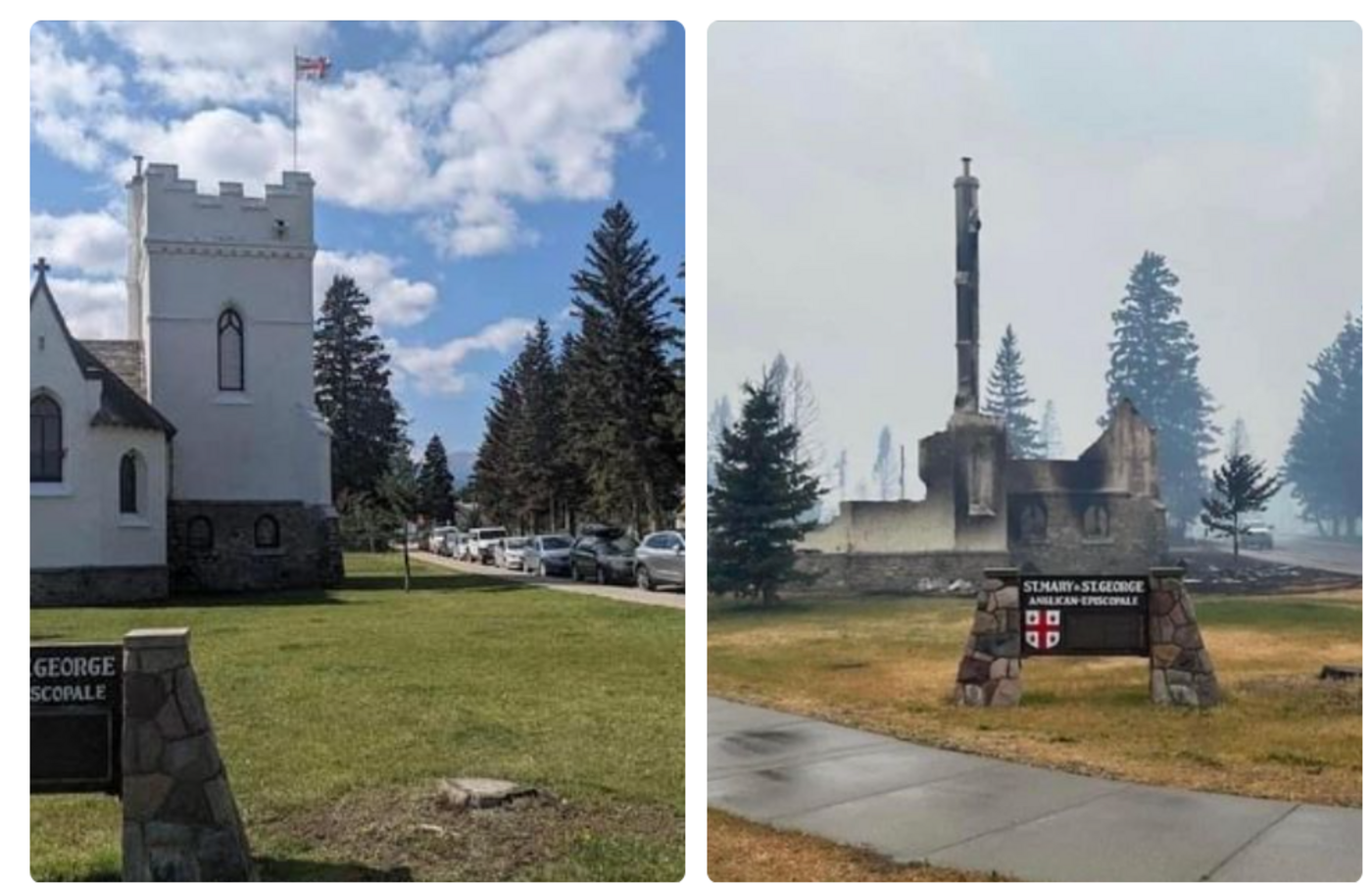
Archbishop Smith noted the far-reaching effects of the devastation on residents as well as visitors.
“Also greatly impacted by this horrific fire are the thousands of people who call Jasper home as permanent and seasonal residents, as well as the surrounding communities. The loss of property is devastating, but even greater is the heartbreak for this world heritage site.”
He reached out to the parish community of Our Lady of Lourdes, including pastor Father Anthony Narisetty and associate pastor Father Marreddy Udumala, saying, “Please be assured of my prayers at this difficult time.”
He said the parish has been a place “where Catholics have gathered for more than five decades to worship and adore Jesus Christ. It is a place of sanctity not only for the close-knit parish community, but for people from around the world who come to visit Jasper and marvel at God’s creation.”
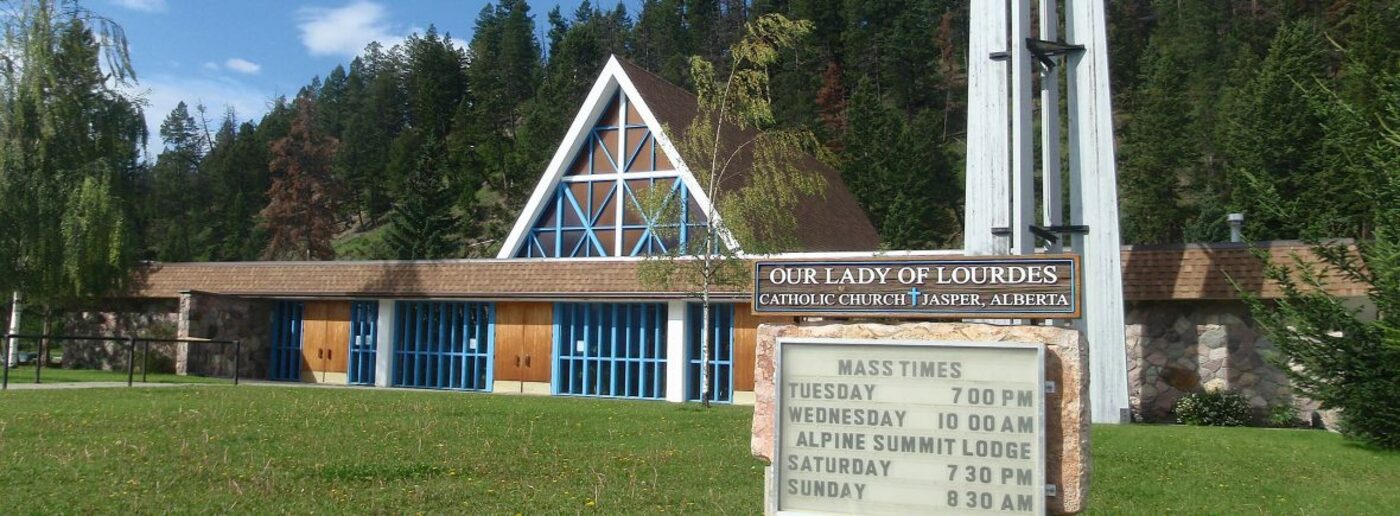
The Archbishop said all those affected by the fire, including first responders and everyone helping the community “will remain in the prayers of the faithful members of the Catholic community throughout the Archdiocese of Edmonton in the days and weeks ahead.”
The Archbishop encouraged the faithful to attend Mass in the community closest to them for the foreseeable future and to watch for updates.
Your voice matters! Join the conversation by submitting a Letter to the Editor here.
Eucharistic Congress is a contrast to polarized culture: Canadian sculptor
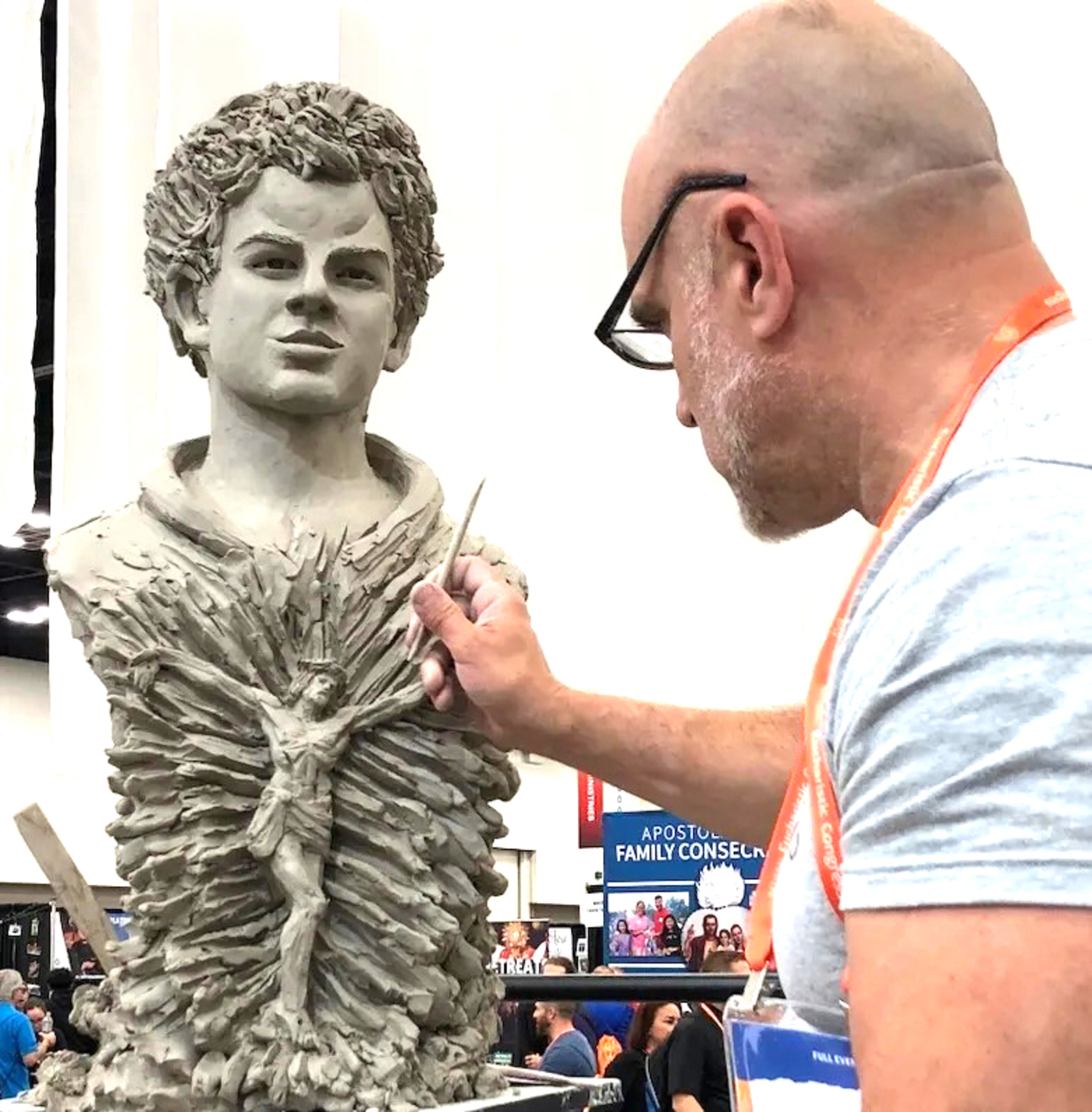
Although he was deeply immersed in fashioning a life-sized bronze tribute to future saint Blessed Carlo Acutis, Canadian Catholic sculptor Timothy Schmalz keenly kept abreast of the discourse at the 10th U.S. National Eucharistic Congress in Indianapolis.
In a nation, indeed a world, that has become so polarized, the congress was a breath of fresh air, bringing thousands together over five days — and several pilgrimages in the weeks before leading to Indianapolis — from every corner of the U.S. and elsewhere, including Canadians, to foster a devotion to the Eucharist.
“People who I talked to acknowledged the significance of our culture becoming chaotic with violence and hate,” said Schmalz, of St. Jacob’s, Ont., who was working on his sculpture in one of the Indiana Convention Center’s expo halls. “This gathering is the opposite of that, and I think this did not go unnoticed among anyone there about the violence that happened just a couple of days beforehand.”
Schmalz alluded to the attempted assassination of Donald Trump at a Pennsylvania campaign rally July 13. While the Republican nominee survived, firefighter Corey Comperatore died while shielding his family, and two others were hospitalized.
The presence of Jesus Christ in the Eucharist was on the mind of 60,000 Catholics in Indianapolis. Believers descended upon Lucas Oil Stadium to be inspired by keynote speakers and tasked with a “great commissioning.”
Prominent speakers included Bishop Robert Barron of Word on Fire ministry, Father Mike Schmitz, who launched the popular Bible in a Year podcast, and Mother Adela Galindo, the foundress of Servants of the Pierced Hearts of Jesus and Mary convent in Miami, Fla.
-
- Timothy Schmalz works on his homage to Blessed Carlo Acutis at the National Eucharistic Congress in Indianapolis. (Photo courtesy Timothy Schmalz)
Cardinal Luis Antonio Tagle, the pro-prefect of the Vatican Dicastery for Evangelization, told the crowd at the closing Mass, “the presence of Jesus in the Eucharist is a gift and the fulfillment of his mission. Those who choose to stay with Jesus will be sent by Jesus. Let us go to proclaim Jesus zealously and joyfully for the life of the world.”
Dennis Girard, an Ottawa resident who co-founded the Marian Devotional Movement (MDM) alongside his wife Angelina, hailed the Eucharistic Congress as “transformative.”
“It reminds one of the experience we often see at World Youth Day,” said Girard. “We are all one in Christ, and that affirmation pierces through the darkness of the world and eclipses what we are living through in society now. That feeling was shared by most if not all. There was a real sense of the presence of the Lord in a very efficacious way.”
On 2nd anniversary of Pope’s visit, Canada’s bishops recommit to reconciliation
Canadian Conference of Catholic Bishops (CCCB) President Bishop William McGrattan has reaffirmed the Catholic Church’s commitment to reconciliation with Canada’s Indigenous peoples to mark the second anniversary of Pope Francis embarking upon his penitential pilgrimage to Canada.
In a July 24 CCCB communique titled a “Letter to the People of God,” the bishops outlined the financial support, record-sharing, dialogue events and other initiatives launched to address the Pontiff’s call for justice, healing and understanding. The message also reprised the call for Catholics nationwide to engage in these efforts.
Bishop McGrattan reflected upon the impact of Pope Francis’ visit, especially the historic apology in Maskwacis, Alta., before elders and residential school survivors, and the importance of accompanying Indigenous peoples shoulder to shoulder.
“After years of listening, learning, prayer and dialogue, the Bishops of Canada were deeply grateful for the Holy Father’s apology and to the many Indigenous partners who shared their experiences and desires for a brighter future,” said Bishop McGrattan, the Bishop of Calgary. “We believe this was a meaningful step in the reconciliation journey — but the effects of the residential school system persist to this day. As we look back on the words of Pope Francis, we must continue to confront this painful legacy and to walk alongside the Indigenous peoples in the spirit of solidarity and hope.”
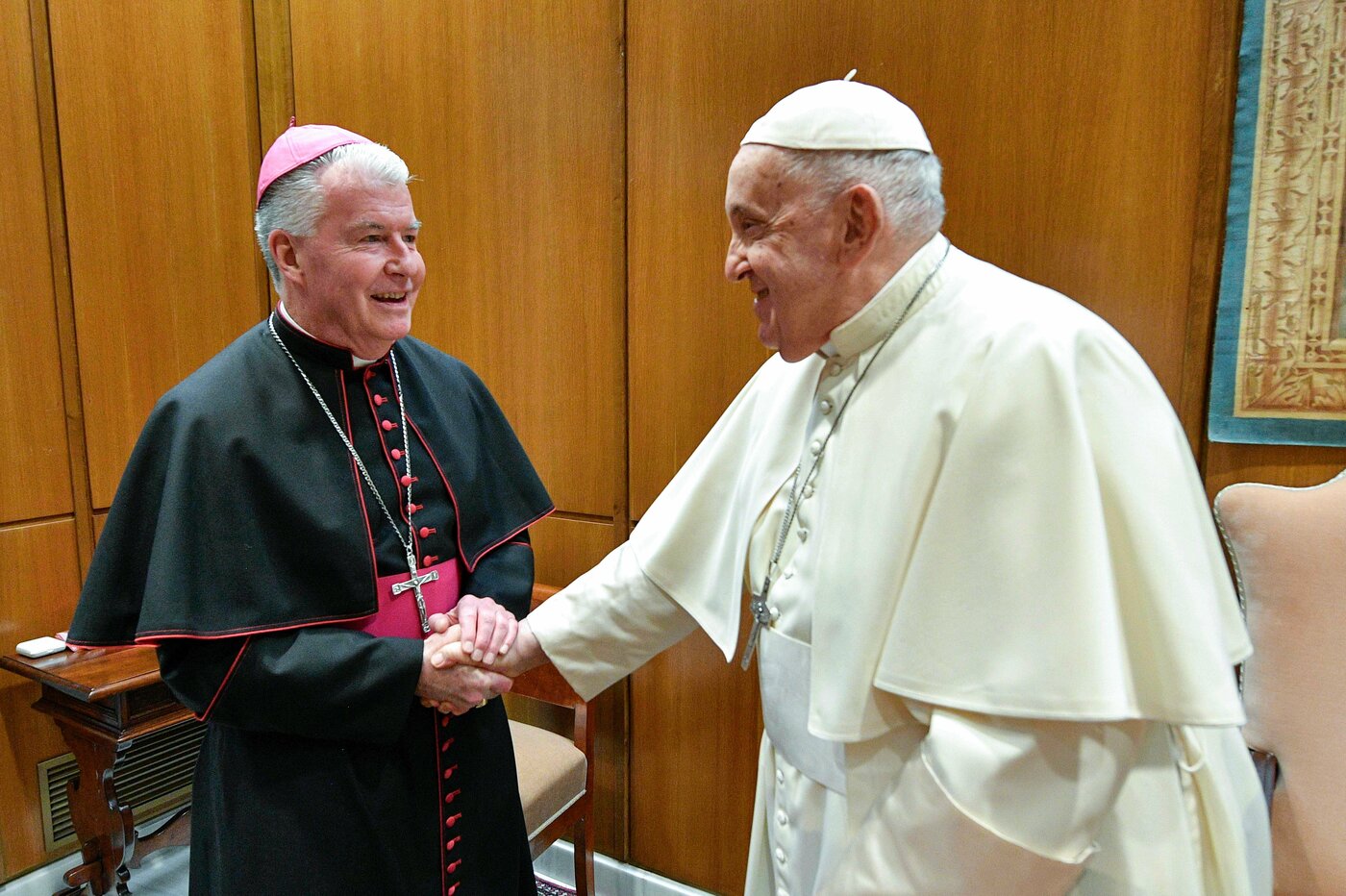
Pope Francis meets with Bishop William McGrattan, president of the Canadian Conference of Catholic Bishops, at the Vatican in November 2023. In a July 24 CCCB communique, Bishop McGrattan reflected on the impact of the Pope’s 2022 visit to Canada. (CNS photo/Vatican Media)
The letter called for the Catholic community to embrace “the path of unity and hope” at a time when there are “many difficult conversations taking place around the country regarding our painful legacy.”
The correspondence expressly refers to a building chorus for “more rigorous investigations into reports of unmarked burial sites.” Skeptics of the unmarked graves narrative point to how several previous high-profile excavations have not uncovered any bodies.
“Let us keep in mind that this deep desire for truth and transparency resides first with Indigenous communities and residential school survivors,” asserted the CCCB. “Decisions to study this history are best made locally by Indigenous leaders, who have the most direct understanding of the needs of their respective communities.”
The bishops also shared how dioceses and archdioceses have raised $15 million for the Indigenous Reconciliation Fund (IRF) to date, which puts the Canadian Catholic Church on pace to achieve the $30-million target ahead of the five-year deadline. The IRF backs projects that stimulate the revitalization of Indigenous culture and languages, foster communities and empower educational pursuits.
Feeling lazy? Think of Jesus, the apostles, and hard-working saints
Sloth or laziness is one of the capital sins. The root of sloth is often acedia which means “lack of care,” or, as the Catechism defines it: “a form of depression stemming from lax ascetical practice that leads to discouragement.”
Pope Francis said, “it is as though those who fall victim to it are crushed by a desire for death: they feel disgust at everything. Their relationship with God becomes boring to them, and even the holiest acts, those that used to warm their hearts in the past, now appear entirely useless to them. A person begins to regret the passing of time, and the youth that is irretrievably behind them.”
Pope Francis proposed “the patience of faith” as the most important remedy against acedia. He said, “although in the clutches of acedia, man’s desire is to be ‘elsewhere’, to escape from reality, one must instead have the courage to remain and to welcome God’s presence in the ‘here and now’, in my situation as it is.”
He called the fight against acedia a decisive battle that must be won.
“How many people, in the grip of acedia, stirred by a faceless restlessness, have stupidly abandoned the good life they had embarked upon!… [The saints] recommended, under the oppression of acedia, to maintain a smaller measure of commitment, to set goals more within reach, but at the same time to endure and persevere by leaning on Jesus, who never abandons us in temptation.”
St. Ignatius of Loyola said, “idleness begets a life of discontent. It develops self-love, which is the cause of all our miseries and renders us unworthy to receive the favours of divine love.”
St. Jane Frances de Chantal advised: “Perform faithfully what God requires of you each moment, and leave the thought of everything else to him. I assure you that to live in this way will bring you great peace.”
Father Adolphe Tanqueray defined sloth as “an inclination to idleness or at least to aimlessness, to apathy in action.”
He suggested three degrees of sloth. The first is a man taking up his task “reluctantly and indifferently” and completing it poorly. The second is a “sluggard” that does not refuse to work, but delays and postpones the task indefinitely. The third is a “truly lazy man” who “wants to do nothing that proves irksome and shows a distinct aversion to all real work, whether physical or mental.”
He also warned against spiritual sloth. “This consists in a species of dislike for things spiritual, which tends to make us negligent in the performance of our exercises of piety, causes us to shorten them, or to omit them altogether for vain excuses.
Jesus’ miracles prove he is one with God the Creator
17th Sunday in Ordinary Time, Year B
First Reading: 2 Kg 4:42-44
Second Reading: Eph 4:1-6
Gospel Reading: Jn 6:1-15
No one can miss the connection between the First Reading and the Gospel Reading this Sunday: both relate how a crowd is fed with a little food. Bible scholars would say that the first account is a type of the second.
A “type” is a person, thing, action, or event—usually in the Old Testament—that “prefigures” or “foreshadows” a new and greater truth, action, or event—usually in the New Testament.
For example, the event in the First Reading is a “type” of the event in the Gospel Reading, and both are “types” of what happens at Mass, when Christ feeds the whole world with his body and blood under the appearances of bread and wine (as we will see in coming weeks).
By “typology,” the Church learns “the full significance of what the writers are saying,” apparent only when she looks back at it in the light of Christ.
Now we all know how unreliable hindsight can be. Speaking as an author with experience, C.S. Lewis said that “almost anything can be read into any book if you are determined enough.”
However, the Bible prompts us to see types. The apostles and evangelists often cited Old Testament events as types of what they were reporting. Matthew and John repeatedly pointed out that events of Christ’s life “fulfilled” Old Testament prophecies.
Moreover, Jesus himself appealed to typology when he called his miracles his Father’s works.
We are so accustomed to the wholesale activity of God displayed always and everywhere throughout creation that we often fail to recognize it, Lewis explains, quoting St. Athanasius. For example, God heals us by creating human bodies able to heal themselves; he changes water into wine by creating vines that draw up water and, with sap, eventually produce wine; he creates plants and animals that can reproduce their kind, thus continuously multiplying grain and fish.
The miracles performed by Jesus, “God incarnate, living as a man in Palestine, take place at a different speed and on a smaller scale,” Lewis notes, but otherwise they reproduce God’s wholesale activity, thus proving to the people that Jesus is one with God the Creator.
“I solemnly assure you: the Son cannot do anything by himself—he can do only what he sees the Father doing,” Jesus said. “Whatever the Father does, the Son does likewise. For the Father loves the Son, and everything the Father does he shows him.”
St. Thomas Aquinas defines a “miracle” (from the Latin mirus, “inspiring wonder”) as something “wrought by divine power,” but “apart from the order usually observed in nature.”