
Archbishop Miller calls for prayer after deadly attack claims 11 at Filipino community festival
Archbishop J. Michael Miller reacted with shock and grief to what Vancouver police called “the darkest day in Vancouver’s history after a man drove into a crowd of people at a Filipino street festival, killing 11 people and injuring numerous others.
The Archbishop said he mourned “the tragic and senseless loss of life” that took place last night at Vancouver’s Lapu Lapu Festival.
“We grieve the deaths of 11 people and the suffering of so many others. We hold especially close our beloved Filipino community, who are a treasure to our parishes and to our city.”
The attack took place on the eve of Divine Mercy Sunday, he said, when “we are reminded that the Risen Christ is near to the wounded, the suffering, and the brokenhearted. We entrust the souls of the departed to his mercy and pray for comfort and healing for all those affected.”
Social media was filled with expressions of prayer and solidarity from around the world and across Canada, with messages of support coming from Catholic school boards in Fort McMurray and Ottawa.

Poignantly, as Vancouver’s Filipino community was reeling from the violence, the Philippines became the first nation in the world to consecrate itself entirely to Jesus through divine mercy.
The Permanent Council of the Catholic Bishops’ Conference of the Philippines (CBCP) had given its official approval for a national consecration to divine mercy to take place during all Masses on April 27 as part of the 2025 Jubilee Year celebrations.

Police officers at the scene of the Lapu Lapu Day block party, where a man drove an SUV into the crowd at the Filipino heritage festival hours, killing at least 11 people and injuring multiple others .(OSV News photo/Chris Helgren, Reuters)
In the Archdiocese of Vancouver, condolences were sent to the Filipino community, who were included in memorial Masses Sunday at Gardens of Gethsemani Catholic Cemetery in Surrey, said Filipino ministry coordinator Deacon Raul Abella. He said he planned to meet with B.C. MLA Mable Elmore, who was a festival organizer.
Expressions of sorrow also came from the president of Providence Living, a Catholic health care organization in Vancouver with many Filipino staff members.
“There are no words to express the deep heartbreak brought on by the senseless tragedy last night at the Lapu-Lapu Festival in Vancouver,” said Mark Blandford, president and CEO. He noted that many staff likely had family and friends “deeply affected by this event.”
“I want you to know that myself, the board, and all of the Providence family stand with you today.”
Noting the “great pride in the strong Filipino representation among our staff,” Blandford said, “Everyone is devastated by this senseless tragedy and we know that the Filipino community is grieving deeply.”
Assessing Pope Francis: A legacy in motion
Assessing a Pope—his life, his legacy—is fraught with risk, especially within days of his passing.
The obvious has already been said by those who were prepared well in advance. But some of us need time to assess him in the light of the void—the interregnum—that now confronts us. The Holy Spirit often works in silence, so this time before the conclave can offer a rich opportunity for reflection and discernment.
This raises a deeper question: Should we even assess? Rushing to evaluate, we risk getting caught in the swirl of instant analysis—in the currents of the day. But getting into those currents might not always be a bad thing. Pope Francis was often caught in them. And what’s the difference between being caught in a current and reading the signs of the times? G.K. Chesterton said that only a living thing can swim against a current. Francis often seemed to get into these cultural eddies, and then come out with something generated by the Holy Spirit. It was in those eddies that he was defined by many, by how he was perceived—by both his critics and his supporters.
Eddies form when the main flow hits resistance—rocks, riverbanks, sudden turns—and the water circles back on itself. They can look like traps, places where momentum is lost. But they can also be pockets of stillness in an otherwise relentless current. In many ways, Francis’s eddies were often just that—resting places where something deeper could form.
Name 10 things Francis is most known for, and I’d suggest many were produced in eddies, not currents: “Who am I to judge?”, the residential school genocide comments in Canada, and the Pachamama statues controversy. Each of these became opportunities for him to be assessed, while something was being forged in the struggle of eddies.
Francis pushed me out of my comfort zone more than once. As a communications director, it was a constant challenge trying to keep up with his latest unscripted moments and then explain what he was actually trying to say. More often than not, a quick source check revealed there was far less controversy than people assumed.
Over time, I had to surrender my Benedictine left brain and make room for the Francis right brain—drawn less to argument and more to listening. It’s still a work in progress. I even had to step back from engaging in social media, which has little room for listening. I began asking myself: “Would Pope Francis post this?” And more often than not, the answer was no—he would simply listen.
And maybe that’s the most honest assessment I can offer right now. He’s been called many things: the People’s Pope, the speak-off-the-cuff-and-let-the-world-sort-it-out Pope, the Messy Pope, the Field Hospital Pope.
How to receive Jubilee Indulgence
Clarification on Holy Doors during the Jubilee of Hope
The Archdiocese of Vancouver has received many inquiries regarding Holy Doors during the Jubilee Year of Hope. This Jubilee Year, Pope Francis has designated Holy Doors exclusively at the four major papal basilicas in Rome to highlight the unity of the universal Church and to invite Catholics worldwide to make the traditional pilgrimage to Rome. There are no Holy Doors in Vancouver, though Catholics can still obtain the Jubilee Indulgence by following the instructions below.
How to receive Jubilee Indulgence
During the Jubilee Year 2025, you can receive a plenary indulgence in the Archdiocese of Vancouver (the complete remission of the temporal punishment of sin), by completing the following:
- Detachment from sin (even venial)
- Visit a Jubilee Pilgrimage site:
• Holy Rosary Cathedral, Downtown Vancouver
• St. Jude’s Parish and Shrine, East Vancouver
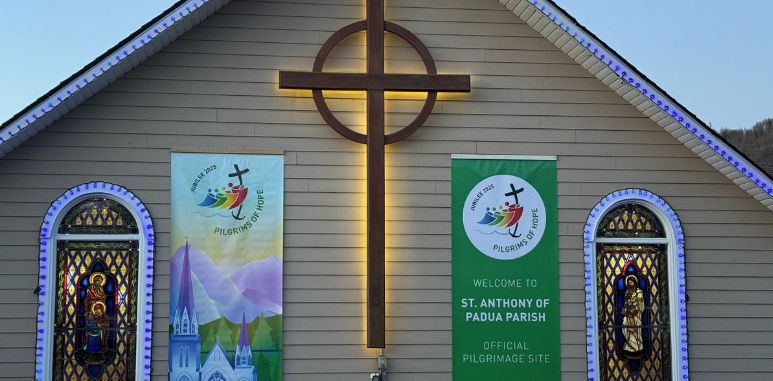
• St. Anthony of Padua Parish and Shrine of Santo Niño de Cebu, Agassiz
• Or another site dedicated by Pope Francis or the local Bishop - Attend Holy Mass or any of the following, ideally at the pilgrimage site:
• Celebration of the Word of God
• Liturgy of the Hours
• Way of the Cross
• Rosary
• Penitential Celebration with individual confession - Confession on the same day or within about 20 days of visiting a pilgrimage site
- Pray for the Pope
• Our Father, Hail Mary etc.
The plenary indulgence is available until December 28, 2025.
For more details, including Mass schedules, confession times, and visiting hours, please visit rcav.org/jubilee… Read more “How to receive Jubilee Indulgence”
Why I became Catholic at a time like this
A cradle Anglican, Kasey Kimball grew up in Newburyport, Mass., moving to Vancouver in 2014 to attend Regent College. In 2018, she graduated with her MA in doctrinal theology and was received into the Catholic Church this Easter. She shared her story of conversion at St. Mark’s College April 7 with the talk “The Body of Christ Suffers Together: Reflections from a Convert to a Church in Crisis.” This is a shortened version of that testimony.
Trying to tell one’s own conversion story is a bit like trying to express the ineffable. Yes, there are important moments, important revelations, and important books to mention, but the work of grace is also inherently mysterious. Every time I tell this story, I get more insight into that work of grace, and am newly amazed by it.
Last August, I attended Mass at a small outdoor chapel in Lake Tahoe, Calif. At that time, I was deep in ecclesiastical no-man’s land. I’d flunked out of RCIA a few months earlier (by that, I mean I attended all the classes and went through all the rites but could not in good conscience become a Catholic at Easter).
I wanted to be a Catholic and was certainly living as one (using the Magnificat missal religiously, getting comfortable with the Rosary, speaking about Protestants as if I wasn’t one), but I simply wasn’t ready theologically. I was missing that deep conviction that the Church is who she says she is – a conviction without which there could be no moving forward.
At the same time, I knew I couldn’t go back to Protestantism. I’d tried, but after spending a year attending Mass, Protestant liturgies seemed so full of arbitrary human words (some of which, as an occasional preacher, I’d written myself). It seemed we were reinventing the wheel Sunday by Sunday, even though the riches of tradition were there, ready to be used.
There was also the question of authority that lurked in the back of my mind. While Protestants claimed the Bible as their final authority, in reality we all appealed to someone – to Luther or Calvin or Cranmer or Barth or a blog we liked or our local pastor – when it came to interpreting what the Bible said and meant. My own Anglican church was struggling to remain viable after a major theological split. Who had the final say? Without a clear authority, it seemed we always fell back on ourselves.
I also found Protestant churches lacked the definitive presence of Christ I’d sensed at Mass. This is not to say that Christ was absent in Protestantism, but there was a palpable difference in intensity.
Christ is risen, but has anything really changed for us?
In the heart of Eastertide, we can ask ourselves: Has Easter changed us? What are the consequences of truly accepting the reality of the Resurrection?
The other day it struck me that we were in the heart of the Easter season and I had to ask myself: Has anything really changed for us – or is life pretty much going on as always?
I sometimes wonder if many of us aren’t a little bit like the two disciples on the road to Emmaus. They had heard about the empty tomb; in fact, it was the subject of their conversation. Maybe they wanted to believe that Jesus had risen, but they couldn’t help but feel skeptical – so much so that they didn’t even recognize Jesus when he started walking along beside them. In Luke’s gospel it says that “their eyes prevented them from recognizing him.”
We too often have eyes that prevent us from seeing. We keep hurrying along as if Easter never happened and nothing has really changed. In place of faith, we live with a sense of desperate urgency because the clock is ticking, and time is running out. Life is short. We don’t want to miss out on experiences or live in regret about the dreams we left unfulfilled.
But the truth of Easter is meant to penetrate and alter the course of our lives.
Freed from anxiety
Accepting the reality of the Resurrection means that death and decay have no power over us. We have been truly set free – and that means we should be freed from the anxieties that so often dominate our lives. How often do we fail to recognize Jesus because we are too occupied with other things? Worrying about our career choices, obsessing over our children’s futures, wasting precious hours “doomscrolling” through social media: These are all signs that we have failed to take the message of Easter seriously. It is as if nothing has really changed for us.
On the contrary, the first Easter marked a new course for humanity. As it says in the Book of Revelation (Rev 21:3-5):
I heard a loud voice from the throne saying, “Behold, God’s dwelling is with the human race. He will dwell with them and they will be his people and God himself will always be with them [as their God].
He will wipe every tear from their eyes, and there shall be no more death or mourning, wailing or pain, [for] the old order has passed away.”
The one who sat on the throne said, “Behold, I make all things new.” Then he said, “Write these words down, for they are trustworthy and true.”
How to Pray the Litany of Humility
We’ve all heard of the nearly infamous prayer, the Litany of Humility, before. But is there a danger in praying this litany with the wrong intentions?
Today, Fr. Mark-Mary shares some ways of discerning and approaching a desire to grow in humility and overcome pride with a lasting sense of being loved by God as you are.
View original post at Behold Vancouver
Author: {authorlink}
Posted on April 23, 2025… Read more “How to Pray the Litany of Humility”
Archbishop among Vancouver Catholics honoured with Coronation Medals for service
Three Vancouver Catholics—Archbishop J. Michael Miller, Paralympian Aaron Wong-Sing, and Ukrainian Catholic priest Father Mykhailo Ozorovych—have received King Charles III Coronation Medals in recognition of their exceptional service to Church, country, and community.
The medal honours Canadians who have made significant contributions to society or achieved accomplishments abroad that bring credit to the country. Thirty thousand medals were created for distribution across Canada.
Archbishop Miller was nominated by the Canadian Interfaith Conversation (CIC), a national coalition of faith-based organizations that promotes religious freedom and cooperation.

Archbishop Miller receives a stole on Easter Sunday of 2024, where he signed a Sacred Covenant with the Kamloops First Nation to forge a new relationship between the Church and Indigenous peoples in British Columbia. The event was cited in the Archbishop’s nomination for a King Charles III Coronation Medal. (Matthew Furtado/Archdiocese of Vancouver)
The organization recognized the Archbishop for his “outstanding service in fostering respect and understanding of religious traditions in Canada” and for his contributions to “the positive role faith communities make in Canadian civil society.”
Archbishop Miller was honoured for his pastoral work with diverse Catholic communities, including Filipino, Vietnamese, Korean, and Syro-Malabar Catholics; his support for national reconciliation efforts through Bill C-15, the federal legislation endorsing the UN Declaration on the Rights of Indigenous Peoples Act; and his leadership in promoting interfaith clinical pastoral education.
The CIC noted the Archbishop’s service at the Vatican’s Pontifical Council for the Pastoral Care of Migrants and Itinerant, and his establishing of offices for First Nations Ministry, Hispanic Ministry, Filipino Ministry, Chinese Ministry, and Ecumenism and Interfaith Relations.
The CIC also recognized his public stance against racism and anti-Semitism and his work with other faith leaders and the City of Vancouver mayor to address Vancouver’s Downtown Eastside challenges.
The CIC also noted that Archbishop Miller was a founding member of the Multifaith Summit Council of British Columbia and, in 2024, entered into a Sacred Covenant with the Tk’emlúps te Secwépemc people on behalf of the Archdiocese of Vancouver.

Aaron Wong-Sing.
Aaron Wong-Sing
A lifetime of public service should be enough to warrant some recognition, but local charity founder and public servant Aaron Wong-Sing was still surprised and grateful to discover he was nominated for the Coronation Medal for two decades of service in the Canadian public sector. His nomination came from his colleagues in Ottawa, where he spent much of his career working on initiatives to support medically uninsured First Nations communities.
Canadian sculptor’s latest work installed in St. Peter’s Square
A new Vatican-commissioned sculpture by Canadian artist Timothy P. Schmalz titled “Be Welcoming” was installed in St. Peter’s Square on Tuesday in the hopes of inspiring people to open their hearts to the poor.
Schmalz’s bronze statue — located near the Showers for the Poor and the Mother of Mercy Clinic in the colonnade of St. Peter’s Square — depicts a man seated on a bench “who appears to be a homeless person” carrying only two possessions: a full backpack on his shoulder and a stick in one hand.
The Vatican’s Dicastery for the Service of Charity said on Tuesday: “This stranger turns into an angel when you look at the other side of the sculpture: the roughness of his clothes becomes smooth, the bag he carries turns into wings and the hood turns into hair.”
Known for creating artworks that interact with its viewers, Schmalz’s Be Welcoming statue “invites you to sit next to him,” to contemplate the word of God and inspire people to carry out works of charity.
Be Welcoming — the Canadian sculptor’s latest installation in St. Peter’s Square — is another “visual interpretation of a verse from the Letter to the Hebrews: ‘Do not forget to show hospitality to strangers, for by so doing some have unknowingly entertained angels’ (Heb 13:2),” the Vatican statement said.
The same Scripture verse also inspired Schmalz’s Angels Unawares sculpture — also located within St. Peter’s Square — which depicts 140 migrants of different ethnicities and nationalities standing on a boat.
On Sept. 29, 2019, Pope Francis blessed that statue on the occasion of the Church’s 105th World Day of Migrants and Refugees.
“We are all invited to open our hearts because only then will we have the opportunity to see others as they really are, people with their humanity,” the Vatican statement read. “Touching a poor person, assisting a poor person, is a sacrament in the Church.”
“We give ‘a concrete face to the Gospel of love,’” the statement continued, quoting Pope Francis. “‘By offering them shelter, a meal, a smile, holding out our hands without fear of dirtying them’ we restore ‘dignity,’ and this touches ‘the heart of our often indifferent world.’”
Be Welcoming is the third Schmalz installation located in the vicinity of St. Peter’s Basilica. The Canadian artist’s “Homeless Jesus” statue, inaugurated in March 2016 during the Extraordinary Jubilee of Mercy, is located in the square in front of the Vatican’s apostolic charity offices.
Your voice matters! Join the conversation by submitting a Letter to the Editor here.
View original post at BC Catholic
Author: {authorlink}
Posted on April 18, 2025… Read more “Canadian sculptor’s latest work installed in St. Peter’s Square”
Surge in adults entering Church in England this Easter prompted by internet, tradition
This Easter Vigil, the Catholic Church in England is expecting a decade-high surge of new entrants to the faith. There is anecdotal evidence of a particular increase in young men, who say their interest was sparked initially by Catholic apologists on social media and also by the traditional heritage of Catholicism.
Almost all English dioceses contacted by CNA reported a significant increase in both catechumens and candidates at the Rite of Election at the start of Lent compared with last year. Many had not seen comparable numbers for a decade.
The Diocese of Westminster, which includes much of the capital city London, said this year it has 252 catechumens and over 250 candidates, making a total of over 500 to be received into the Catholic Church at Easter — the most seen since 2018.
The adjacent Archdiocese of Southwark, which has a significant evangelization program, saw over 450 adults complete the Rite of Christian Initiation of Adults (RCIA) this year, more than the year before. Such levels have not been seen since Pope Benedict XVI allowed groups of Anglican communities to enter into communion in 2011 through the apostolic constitution Anglicanorum Coetibus.
“I don’t think it can just be put down to COVID recovery; there seems to be something fresh afoot,” said Mark Nash, Southwark’s director of the Agency for Evangelization and Catechesis. “The Holy Spirit is moving in a very particular way.”
Although the candidates have a broad variety of backgrounds, some trends he has noticed include young men initially inspired by online U.S.-based evangelists and apologists such as Bishop Robert Barron, founder of Word on Fire; Father Mike Schmitz, a popular speaker, podcaster, and campus minister; Edward Sri, a theologian, author, and speaker; and Trent Horn, a Catholic apologist and podcaster.
Nash has also noticed more from atheistic countries.
“As part of my work, anecdotally, going to a number of parishes, groups I’ve been in, there has been a large number of younger people — particularly men,” he said. “Increasing numbers of Chinese… in Southwark we are blessed with a panoply of ethnicities. It is really is the Church universal; it is massively edifying.”
The diocese published a video of interviews of four candidates who expressed a variety of reasons and motivations for becoming Catholic, including the witness of the early Church fathers, the experience at a Catholic school, and the powerful faith of a young child.
A musician living a “rock-and-roll life” spoke of feeling drawn to Mary. “I knew that it was something real and strong and pure,” Vedina-Rose said in the video. “Mary gives me so much comfort and love and understanding, and whenever there have been moments where I felt doubt or I felt lonely or I felt rejected all I have to do is call on Mary and I just feel this comfort… I just love Jesus.”
Turn off the Internet, God Wants To Talk to You
Theophany: God wants to reveal Himself to each one of us. But our constant addiction to the pleasure chemicals of dopamine and serotonin can be a barrier to this intimacy.
Today Fr. Mark-Mary challenges us to consider fasting from a near continuous stream of pleasure in order to hear and experience new intimacy with God. Why not consider driving without music, fasting from snacking throughout the day, or giving up social media this Lenten season?
View original post at Behold Vancouver
Author: {authorlink}
Posted on April 16, 2025… Read more “Turn off the Internet, God Wants To Talk to You”