
‘God is on the move’: Archbishop Smith at Victoria March for Life
Hundreds of pro-life witnesses gathered in Victoria for the annual March for Life in the provincial capital, marching through downtown streets carrying pro-life signs and banners before rallying at the legislature to hear speakers, including Vancouver Archbishop Richard Smith.
The Victoria event drew families, clergy, students, and supporters from across British Columbia for speeches, prayer, and music focused on the protection of unborn life and care for vulnerable people. Organizers also highlighted concerns surrounding euthanasia and assisted suicide.
In a change from the custom of the Vancouver Archbishop having a pre-march Mass in his own diocese, Archbishop Smith celebrated at St. Andrew’s Cathedral in Victoria.
In his homily, Archbishop Smith acknowledged that many pro-life advocates can feel discouraged by what he described as “a powerful juggernaut moving forward and expanding in a manner that appears irresistible,” pointing to abortion and the expansion of euthanasia in Canada.
But he urged participants not to lose hope, saying, “God is at work, God is on the move, and God is an unstoppable force. His saving will simply cannot be thwarted by human iniquity.”
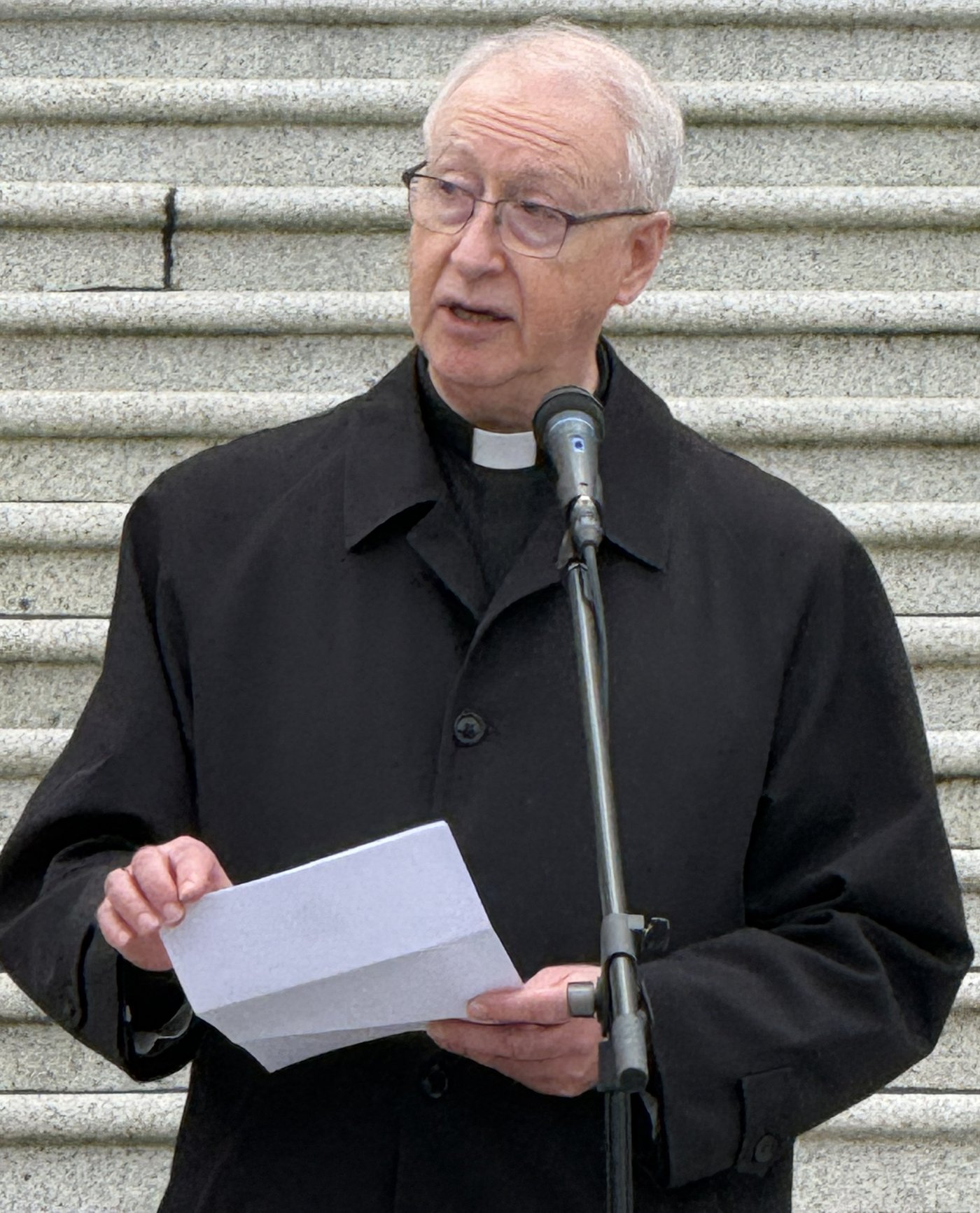
“This is why we march,” he said. “It is incumbent upon all of us to look for any and every opportunity to witness to the truth of God’s own love for life.”
Speaking later in front of the legislature, Archbishop Smith said the annual March for Life was part of a broader effort to build “a culture of life” through speaking, celebrating, and serving.
“Our march is a very peaceful event, and a great occasion for us to witness to the beauty of all life,” he said, quoting Pope Benedict, that every human being is “willed, loved and necessary.”
He also said society needs “radically transformed human relationships, defined no longer by an extreme individualism and a false notion of freedom, but by a self-giving love that welcomes the other as gift.”
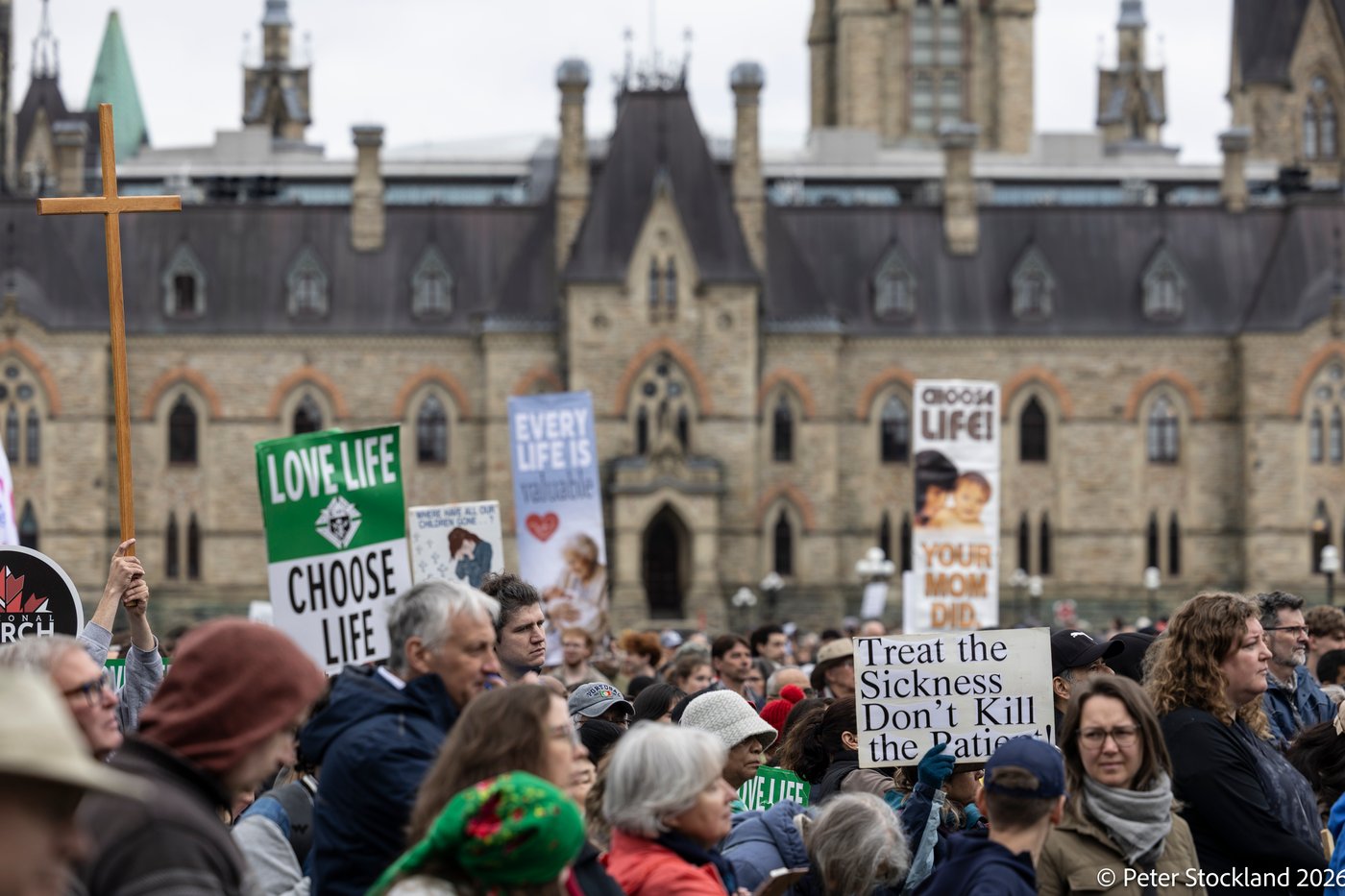
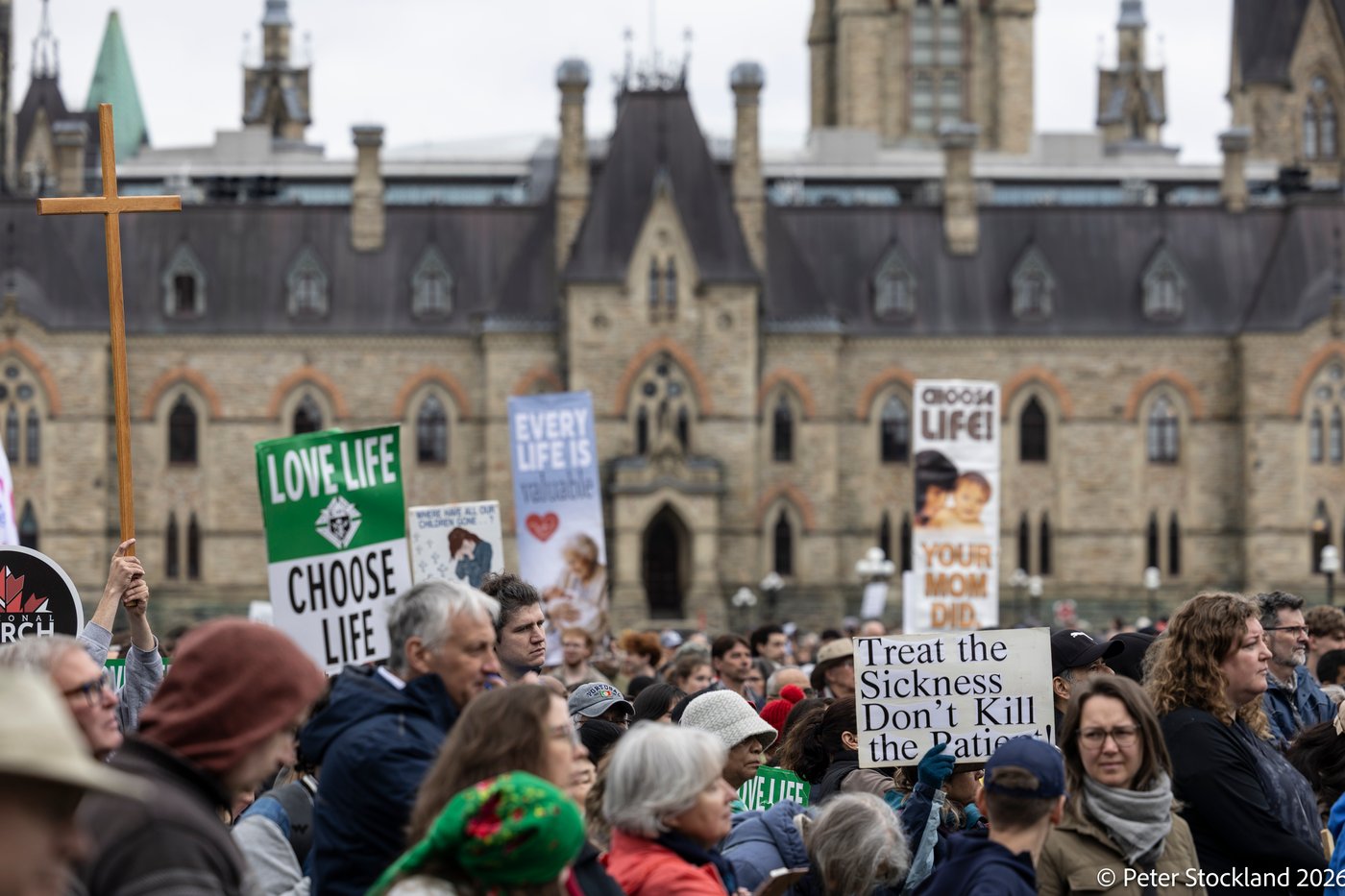
Meanwhile in Ottawa, it took almost 25 minutes for a crowd organizers said numbered in the thousands to inch its way from Parliament Hill down Wellington Street to Elgin Street during the National March for Life .
At a rally before the march, organizer Debbie Duval told the crowd, “We march on a Thursday, in Ottawa, because that’s when our legislators are sitting in the House of Commons. We want them to hear us. We want them to know we’re here.”
Matthew Wojciechoski of Campaign Life Coalition said participants were calling on Parliament to enact legal protections “for all human beings from conception up to natural death.”
Pro-life supporters rally on Parliament Hill at National March for Life
It took almost 25 minutes for a crowd that organizers said was in the thousands to inch its way from Parliament Hill down Wellington Street to Elgin Street during the National March for Life in Ottawa.
Members of every ethnic background, young and elderly, priests, families and church groups carried pro-life signs and walked the streets of the Canadian capital to press for an end to abortion and euthanasia in Canada.
The day began with liturgies celebrated at Notre Dame Cathedral, St. Patrick’s Basilica, and St. Clement. Ottawa-Cornwall Archbishop Marcel Damphousse was the main celebrant at the cathedral, joined by papal nuncio Archbishop Ivan Jurkovič, Ukrainian Catholic Bishop Bryan Bayda, and some 30 priests and deacons.
At a midday rally before the march, organizer Debbie Duval told the crowd, “We march on a Thursday, in Ottawa, because that’s when our legislators are sitting in the House of Commons. We want them to hear us. We want them to know we’re here.”
Matthew Wojciechoski, Project Manager at Campaign Life Coalition (CLC), which organizes the annual event, told the crowd, “We are here to call upon the members of Parliament to enact legal protections for all human beings from conception up to natural death. To remind Parliament of four simple words, ‘Thou shalt not kill.’”
The March for Life takes place in May to mark the month in 1969 when the omnibus bill that decriminalized abortion in Canada was passed.

This year’s march fell on the very anniversary of the vote and adopted as its theme Jesus’ command, “Follow me.”
CLC national president Jeff Gunnarson asked the crowd to pray for founder and former president Jim Hughes who is in hospital with pneumonia and “not doing well.”
“Jim devoted decades of his life to the unborn and building this movement in Canada. Many of us are standing here today because of sacrifices he made long before we arrived,” Gunnarson said.
The featured speaker was Aleš Primc, co-founder of the Slovenian political party Voice for Children and Families that recently forced a referendum to overturn the country’s assisted suicide law. He led pro-lifers in a series of loud “hellos” to people of all ages, from unborn children to “people with gray hair like me.”
“Saying “hello” is the start of recognizing our shared humanity,” he said.

Speaker Rebecca Kiessling, a U.S.
Seeking joy when it isn’t obvious
As mentioned in previous columns, I have been striving to live with Easter joy, from deliberately focusing on the everyday joys of life to truly pondering all that the Resurrection means. As with most stages of life, this Easter there have been some bittersweet stumbling blocks as I have attempted to notice and embrace joyful moments, rather than taking them for granted.
In fact, during a three-day period in this year’s Eastertide, I have participated in and completed a school musical with my students, attended my daughter’s final games as a varsity athlete at UBC, and—most significantly—I have faced the suffering and death of a dear friend.
I have been involved in musical productions at our elementary school for seventeen years. Rehearsing the music for months results in melodies and lyrics running through my head at random times throughout the day—and night. Working with children creates a wonderful bond, and witnessing individual and collective growth is an experience beyond words. The joy inherent in a musical is obvious on the outside, but it does not come without its share of anxiety, frustration, and exhaustion behind the scenes. However, after the adrenaline settles, the dreams are realized, and the final curtains close, sadness inevitably sets in. Shows consume us. We put energy into them, we anticipate their arrival, and like all things, they come to an end.
After the final show, children tearfully realized that this special experience is now part of the past. I must admit that I find this reality hard to swallow myself, but I do appreciate that the gifts of the experience make the stress and sadness worthwhile.
The day after the show, I attended our third child’s final games as a UBC varsity softball player. She began playing softball when she was just eight years old, and even though other sports and music have played roles in her life, she has spent a large part of the past fourteen years training and playing softball.
While life in sport has been busy and demanding, it has also been so much fun to watch her grow as an athlete and a person. She has built resilience, patience, and muscle, along with wisdom and friendships to last a lifetime. She has learned to speak up for herself and others, and to articulate and express difficult feelings with grace and respect.
Tears were shed as she gave her farewell speech at the reception following the games, reflecting on all her years as an athlete. Some of these tears were in recognition of challenges faced and overcome, some were sadness at the speed of time, and others were tears of joy for the blessings that softball life has brought upon our whole family.
Beyond Confirmation: growing into the Spirit’s gifts
Sixth Sunday of Easter, Year A
First Reading: Acts 8:5-8, 14-17
Second Reading: 1 Pt 3:15-18
Gospel Reading: Jn 14:15-21
This Sunday, just two weeks before Pentecost, we hear that Jesus promised his disciples to ask his Father to send them the “Spirit of truth,” to be with them forever. Then we hear how Peter and John laid their hands on the new Christians of Samaria and “they received the Holy Spirit.”
Today, our reception of the Holy Spirit in Baptism is “confirmed” in the sacrament of Confirmation, in which the bishop, a successor of the apostles, lays his hands on us and prays that the Holy Spirit will bestow on us his gifts of wisdom, understanding, counsel, fortitude, knowledge, piety, and fear of the Lord.
These gifts, first attributed to the Messiah by the prophet Isaiah, are supernatural reflexes or instinctive reactions by which we respond to God spontaneously, but always with full consent.
They are essential if we want to account for our trust in God, as St. Peter enjoins in the Second Reading. However, we cannot expect Confirmation to make us wise, understanding, or knowledgeable without any effort on our part.
It is true that God can “infuse” his gifts miraculously, just as he can heal us miraculously, but that is not his usual way: he normally does it through doctors and medicine. In bestowing his gifts on us, God grants us the dignity of co-operating or collaborating with him.
Recall the joke about a man who asked God to let him win a lottery. When he reproached God for not answering his prayer, God replied, “Well, at least buy a ticket!”
All too often we mark Confirmation, near the end of elementary school, by ceasing to learn about God. For the rest of our lives, we remain satisfied with an elementary education about the most important questions in life.
There are many ways in which we can, and should, continue to learn about our faith as adults.
One way is reading the Bible, the inspired word of God. We hear excerpts from the Bible at Mass, but we should also read it for ourselves, especially the Gospels. Rather than trying to read it from beginning to end, we can focus on the books and the chapters from which the Church chooses her daily and weekly Mass readings.
Another way is to study the Catechism of the Catholic Church, a clear yet profound exposition of all that the Catholic Church believes and teaches.
We can also read the lives of the saints, recent papal publications, and the documents of the Second Vatican Council, easily available from Christian bookstores or vatican.va.
St. Francis Jubilee becomes local call to pilgrimage and renewal
When Father Dan Gurnick thinks about St. Francis of Assisi, he doesn’t think of birds, flowers, or sentimental images of the beloved saint.
He begins with Christ.
“Francis was very Christ-centred,” said Father Gurnick, a Franciscan friar and pastor of St. Joseph the Worker Parish in Richmond. After St. Francis’ conversion, he saw “the crucified Christ in lepers,” and even in creation. “It’s more than just seeing trees, it’s seeing Christ in the trees,” Father Gurnick told The B.C. Catholic.

That vision is now shaping local observances of the Jubilee Year dedicated to St. Francis of Assisi, proclaimed by Pope Leo XIV to mark the 800th anniversary of the saint’s death.
The jubilee year runs from Jan. 10, 2026, to Jan. 10, 2027, and offers the faithful the opportunity to obtain a plenary indulgence by making a pilgrimage to churches dedicated to St. Francis or served by Franciscan communities. The usual conditions apply: sacramental confession, Communion, prayer for the Pope’s intentions, and freedom from attachment to sin. The elderly, sick, and those unable to travel may participate spiritually by offering their prayers and sufferings.
In the Archdiocese of Vancouver, Archbishop Richard Smith has highlighted three parishes for coordinated observances: St. Francis of Assisi in East Vancouver, which bears the saint’s name, and two parishes served by Franciscan friars — St. Joseph the Worker in Richmond and Immaculate Conception in Vancouver.
In a pastoral letter, Archbishop Smith called the jubilee “a time of grace” and reminded the Church that renewal begins with conversion to Christ.
“Every renewal begins with a renewed encounter with Jesus Christ,” he wrote. “A pilgrimage is a meaningful act of faith. It is a step away from routine and an intentional journey toward the Lord.”
The Archbishop said the jubilee is especially timely as the Archdiocese enters “our own time of renewal,” including in parishes and schools, infrastructure stewardship, clergy support, and the celebration of the liturgy.
Pope Leo XIV has framed the year as a response to a divided world. In a letter to Franciscan leaders, he said St. Francis continues to speak “in this era, marked by so many seemingly endless wars, by internal and social divisions that create distrust and fear,” because his life points to “the authentic source of peace.”
The Pope added that Francis reminds the Church that “peace with God, peace among people, and peace with creation are inseparable dimensions of a single call to universal reconciliation.”
For the three local parishes, that global call is taking local form.

How Powerful is the Devil?
“Resist the devil and he will flee from you.” James 4:7 Are you giving too much power to the devil? Dave VanVickle shares how we should view Satan.
Remember he’s just a creature, therefore his power is limited. If we stay close to the Creator, we should not fear!
View original post at Behold Vancouver
Author: {authorlink}
Posted on May 6, 2026… Read more “How Powerful is the Devil?”
Marriage and Meaning with Special Guests Arthur and Ester Brooks
In this episode, we welcome Arthur and Ester Brooks to talk about marriage, suffering, and the path to lasting love. Arthur and Ester share what it’s like to minister together, revealing both the grace needed and the hard work it takes to love each other faithfully over decades. We also reflect on suffering as an invitation for growth, why pain is fruitful, and how the hardest places in life are where love is purified. Whether you are married, single, or in religious life, intimacy with God is our source of strength for every situation we encounter in life.
Show Notes
One Thing We Love This Week:
-
Sister Miriam’s one thing – Heather’s Easter Spotify Playlist
-
Michelle’s one thing – Everyone who just came into the Catholic Church!
-
Heather’s one thing – Franciscan’s Resurrection Party!
-
Heather’s other one thing – 10 Day Pentecost Audio Prayer Plan
-
Ester’s one thing – Her husband Arthur!
-
Ester’s other one thing – Professional Cycling
-
Arthur’s One Thing – Opportunities to witness to the Catholic faith during The Meaning of Your Life book launch
Discussion Questions:
When are you tempted to be led by your feelings?
When have you had to let go of resisting suffering in the past?
Where in your life, marriage, or relationships do you feel stalled?
How is God inviting you to prioritize Him over your marriage, relationships, and responsibilities?
Journal Questions:
What does it look like to fight well?
How have I witnessed or experienced a marriage that is an antenna to God?
What suffering in my life am I resisting?
What are the discomforts and sufferings I have experienced today that I can thank God for?
Quotes to Ponder:
“It is Jesus that you seek when you dream of happiness; he is waiting for you when nothing else you find satisfies you; he is the beauty to which you are so attracted; it is he who provokes you with that thirst for fullness that will not let you settle for compromise; it is he who urges you to shed the masks of a false life; it is he who reads in your hearts your most genuine choices, the choices that others try to stifle. It is Jesus who stirs in you the desire to do something great with your lives, the will to follow an ideal, the refusal to allow yourselves to be grounded down by mediocrity, the courage to commit yourselves humbly and patiently to improving yourselves and society, making the world more human and more fraternal.”
— Pope John Paul II, World Youth Day, Rome, 2000
Scripture for Lectio Divina:
“Let love be genuine; hate what is evil, hold fast to what is good; love one another with mutual affection; outdo one another in showing honor.
Transforming Small Talk: Building Community Through Meaningful Conversations
The autumn air swirled around the skirt of my formal dress while jazz music filled the party tent. My husband and I were attending a work event, and I knew only a small handful of people there. The band was entertaining, and the food was delicious, but anyone who has been in a similar situation knows that engaging in small talk during cocktail hour can get dull and uncomfortable. Then, one of my husband’s colleagues turned to me with a warm smile and asked, “So Catherine, what has been the best part of your day?”
Instantly, I relaxed into a similar smile as I told her about the haircut I received earlier that morning. We swapped funny stories about haircuts and hairdos — both good and bad — and I found myself enjoying a friendly rapport with a woman I had just met. The party became much more fun after that conversation because I had a new friend to enjoy it with.
In the weeks that followed, I couldn’t stop thinking about the question she asked me and the impact it had on my night. I had already been asked, “Where are you from?” and “What do you do?” several times. But her question, although equally simple, felt different, and I wanted to know why.
I found an answer in social psychologist Vanessa Van Edwards’ TEDxLondon talk titled, “You are contagious.” In it, she explains that when we are asked a question like, “Been busy lately?” our brains automatically start recalling examples of busyness and stress in order to answer it. If you ask questions that focus on positive or exciting answers like, “What has been the best part of your day?” you trigger a dopamine response in that person as they think about their answer. Then, as Van Edwards says, they can pass that excitement or happiness back to you through their vocal cues and micro expressions, triggering a dopamine response in your own brain.
As a wife and mother, I regularly find myself in situations that require small talk. I decided to put Van Edwards’ findings to the test to see if I could make small talk more enjoyable for both myself and others.
Taking Van Edwards’ advice, I started by brainstorming a list of conversation starters that could trigger a dopamine response. I will admit that this felt awkward at first, but I knew if I wanted to avoid the automatic answers that come after, “What do you do?” and “Where are you from?” I needed to be prepared. On Substack, I started a list, and some of my favorites included, “How do you spend your days?”
MAiD at 10: how the Me Generation predicted the MAiD de-generation
Last week’s launch of the MAiD at 10 series examined the scale and impact of Medical Assistance in Dying in Canada. This week, reporter Terry O’Neill focuses on understanding how the country arrived at this point, and what those changes are beginning to reveal.
The 1970s are infamously known as the “Me Decade,” a term coined by writer Tom Wolfe, who described a cultural shift toward narcissism, self-fulfilment, and hedonism among the Baby Boomer generation.
Theologian and sociologist Germain McKenzie says a similar self-centred worldview can help explain why legalized euthanasia has proven to be so popular in Canada and threatens to continue expanding in other Western nations.
As Canada approaches the 10th anniversary of the legalization of MAiD on June 17, McKenzie, who teaches at Catholic Pacific College in Langley, said in an interview that pro-life advocates need better strategies to loosen MAiD’s grip on the country. To do that, it’s important to understand how euthanasia has taken such a strong hold.
McKenzie sees five major cultural trends over the past few centuries that have propelled this country to the precipitous place it is now. Primary are the Enlightenment’s emphasis on autonomous reasoning and Romanticism’s celebration of self-fulfillment.
Those ideologies are thriving alongside capitalism’s utilitarian ethos, adverse impact of mass media, and advances in medical technology allowing previously unimaginable procedures such as gender reassignment. Together they have eroded the Christian values on which Western civilization was built, McKenzie said.
The Enlightenment and Romantic ideals alone have “radicalized” our times, he said. Where once a Christian ethos balanced them and “put some limits in place,” all of that crumbled in the turbulent years following the Second World War amid the rapid secularization of society.
Individuals now try to shape their own moral universe, as though society has reverted to an immature stage. “It’s like being a teenager,” he said.
The result is legalized medical killing, something unthinkable a generation ago outside of dystopian movies like Soylent Green (1973) and Logan’s Run (1976).
While few think Canada will become the 23rd-century society of Logan’s Run where individuals live in pleasure and comfort, but only until age 30, it’s hard to predict just what future shocks will rock a society that has lost one of its core values—valuing the lives of the sick and the elderly. Medical deaths of willing patients have become commonplace to what St. Pope John Paul II called the culture of death.
Life “has been devalued,” said Mathew Schmalz, professor of religious studies at the College of the Holy Cross, in Worcester, Mass. “We need as a society to rethink our attitude to life,” being sensitive to “all its complexities,” joy as well as pain.
When a friend’s email turns into a scam
Recently I received an email from a friend—an email that immediately aroused suspicion.
It was an appeal of the tear-jerker variety, designed to invoke a response through emotion-generating hooks and through a sense of urgency.
Like many such emails, it had an aspect of believability, along with warning signs. It even ended with a “God bless” sign-off, representative of the sender as I know the person.
None of it, of course, was true. It was quite an elaborate scam, although one which was dependent on a mistake by the ostensible sender.
I resisted immediately writing back with the typical “you’ve been hacked” or “you’ve been scammed,” opting to wait until I saw my friend in person two days later. Actually, I wouldn’t have used the expression “you’ve been hacked,” as my experience with these sorts of events is that nearly always it’s the victim who has “clicked somewhere” or used a fake site, believing it to be real and safe.
By the time I saw my friend, I had already learned from others in our mutual circle that they too had received the same email. What was surprising to me, in a good way, is that each of them immediately wrote off the message as being part of a scam. We’ve come a long way over the past decade or so when it comes to situational awareness and skepticism with technology.
When I saw my friend, he was already aware of the matter. Someone had indeed contacted him, via text message, to see if he was aware of the email in question. When another person reached him with the same concern, he took action which proved prescient under the circumstances.
He was actually out of the country at that point. He phoned the service provider. Amazingly, he reached someone who immediately guided him through changing the password for his webmail service. That action halted further use of the account by the scammer or scammers.
So, just what occurred here? Although my friend can’t specifically recall the trigger event, it is clear he was tricked onto either a fake version of his webmail sign-in page or onto a fake Wi-Fi node in the hotel where he was staying. No matter which of the two, his email credentials were compromised, and the scammer immediately harvested his entire contacts list—some 400 or so email addresses—spent a few minutes looking through his sent emails to get an idea of a typical sign-off he might use, and then sent out the emotional appeal to all those contacts.
In this case, the scammer did not change the webmail password or take any further action. When I was asked to look at my friend’s computer and webmail, I could find no evidence of tampering at the machine level.